AWS Launches Open-Source Physical AI Toolchain to Accelerate Robot Development
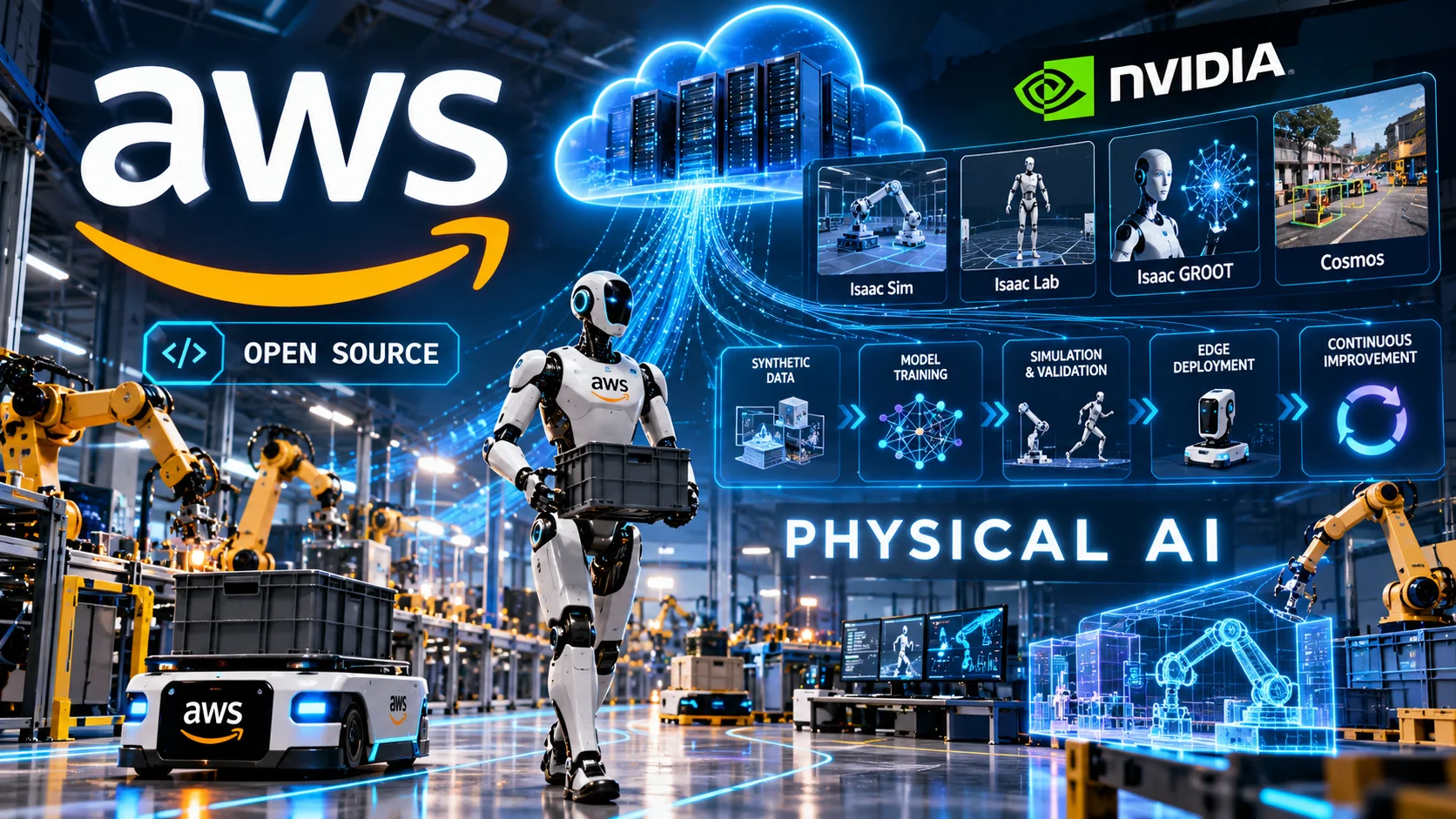
Amazon Web Services has launched an open-source Physical AI Toolchain aimed at helping robotics developers and manufacturers build, train, simulate, validate and deploy AI-powered robots more efficiently. The platform combines AWS cloud infrastructure and services with NVIDIA’s Physical AI software, creating a workflow that connects AI development with robots operating in real-world environments.
The launch addresses a growing challenge in robotics: developing AI models in the cloud while ensuring those models can operate reliably on physical machines. The toolchain allows developers to use the complete workflow or select individual components according to their requirements.
Connecting AI Development With Physical Robots
Physical AI systems need to understand and respond to real-world environments rather than operating only within digital environments. Developing these systems can require large quantities of training data, simulation, computing resources and repeated testing before an AI model is deployed on a robot.
AWS’s new toolchain is designed to bring these stages into a more connected development process. It supports synthetic-data generation, model training, simulation and validation before models are moved toward physical deployment.
AWS and NVIDIA Combine Robotics Capabilities
The toolchain incorporates NVIDIA’s Physical AI software alongside AWS services. NVIDIA technologies are used across areas such as simulation, robotics development and AI model deployment, while AWS provides cloud infrastructure and services for training and scaling workloads.
The combination is intended to give developers access to the computing and software infrastructure needed to create robotics applications without having to assemble every stage of the development pipeline independently.
Synthetic Data and Simulation Support Robot Training
A key part of the workflow is the use of synthetic data and simulation. Instead of collecting every training example from physical robots, developers can generate simulated environments and scenarios to expose AI models to different conditions.
Simulation can also allow developers to test robot behaviour before deploying models on physical machines. This can reduce the need for repeated physical testing and help developers identify potential problems earlier in the development cycle.
From Cloud Training to Edge Deployment
The toolchain is designed to extend beyond cloud-based AI development. Once models have been trained and validated, they can be prepared for deployment on edge devices and robots operating in physical environments.
This cloud-to-edge workflow is becoming increasingly important as robotics moves toward more autonomous systems. Robots used in manufacturing, logistics and other industrial settings need to process information and respond to changing environments with limited reliance on remote infrastructure.
Open-Source Approach Targets Wider Robotics Adoption
AWS is making the Physical AI Toolchain open source, allowing developers and organisations to use individual components or combine them into a broader development workflow. This approach could give robotics teams more flexibility when integrating the toolchain with existing systems and development environments.
As Physical AI becomes a larger part of robotics development, tools that connect simulation, AI training and physical deployment could become increasingly important for companies building autonomous machines and industrial robots.