Classical LDPC Theory Opens New Route to High-Rate Quantum Error Correction
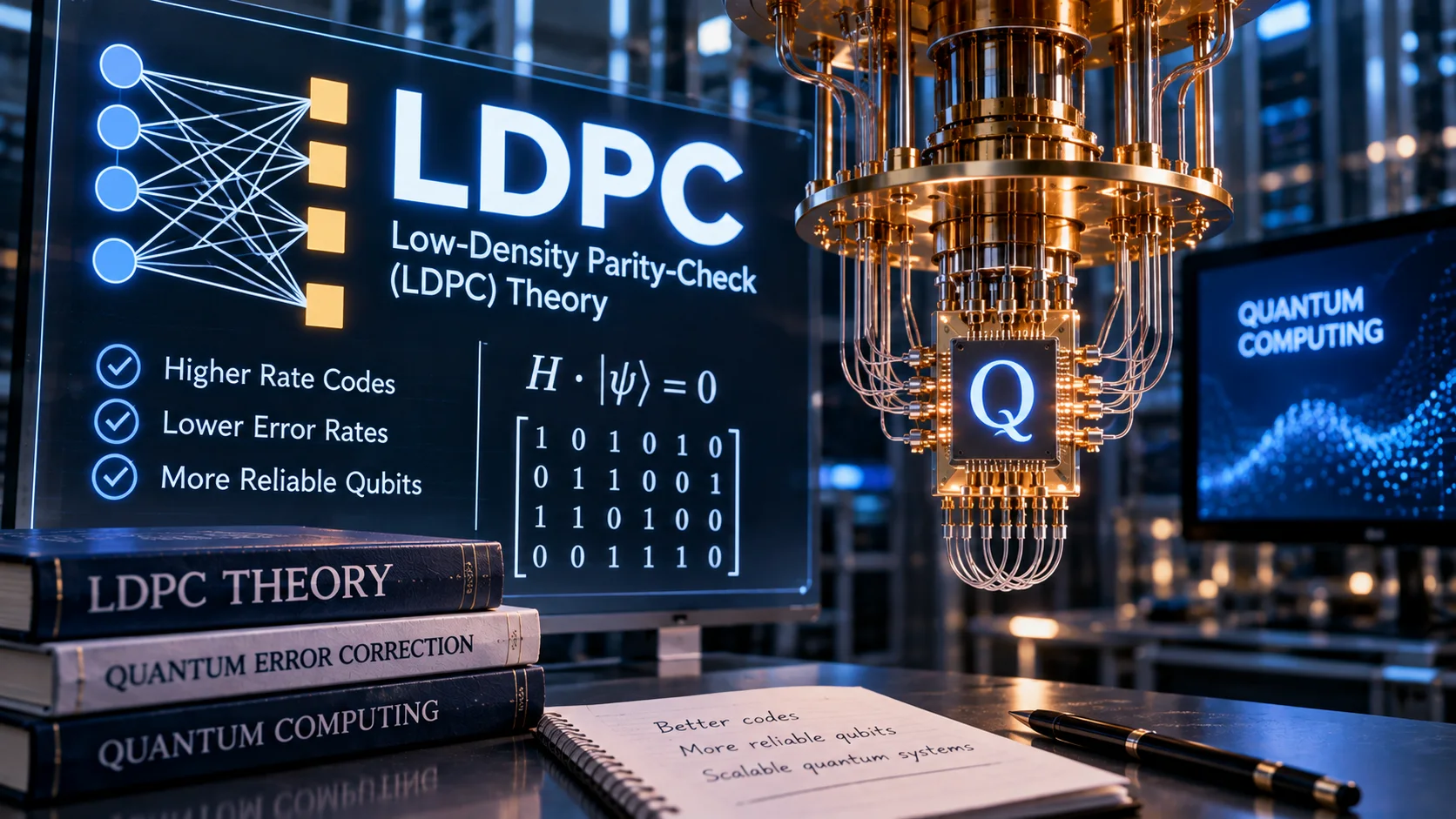
Researchers at Institute of Science Tokyo have developed a new quantum low-density parity-check (LDPC) code that adapts established classical error-correction design principles for quantum computers. The approach addresses a major challenge in quantum error correction by limiting the quantum-specific orthogonality constraint to the part of the code where it is actually required, allowing more of the design freedom used in classical LDPC systems to be retained.
The work, led by Associate Professor Kenta Kasai, produced a code that protects 4,612 logical qubits using 9,216 physical qubits. The researchers report a girth of eight, strong evidence for a minimum distance near 48 and a clear decoding “waterfall” under simulation. The study was published in the journal Quantum on September 9.
Why Classical LDPC Codes Are Important
LDPC codes are widely used in modern communication and storage systems because they can detect and correct errors efficiently while using relatively sparse connections between data bits and error-checking bits. Their design has been studied for decades, giving researchers established methods for balancing error protection, decoding complexity and hardware requirements.
Moving those principles directly into quantum computing is much harder. Quantum LDPC codes must satisfy additional mathematical conditions so that the different error checks do not interfere with each other. Applying those constraints throughout a code can introduce short loops and low-weight structures that make the resulting code less effective.
Kasai's approach instead uses affine permutation matrices and applies the orthogonality requirement selectively to the active rows used for error correction. The remaining latent rows retain more of the randomness and structural flexibility associated with classical LDPC design.
The New Code Uses Nearly Two Physical Qubits Per Logical Qubit
The resulting construction is a (3,12)-regular quantum LDPC code written as [[9216,4612,d]], with the researchers establishing that d is no greater than 48 and finding strong evidence that the overall minimum distance is close to 48.
In practical terms, 9,216 physical qubits are used to protect 4,612 logical qubits. That is a rate of almost one logical qubit for every two physical qubits, which could potentially reduce the hardware overhead required for quantum error correction compared with lower-rate approaches. However, the researchers have not established a complete global lower bound for the code's minimum distance, so the near-48 figure should be treated as evidence from construction and numerical testing rather than a fully proven value.
The researchers also eliminated four- and six-cycle structures from the code's underlying graph. Those short loops can contribute to difficult error patterns known as trapping sets, which can prevent belief-propagation decoders from successfully correcting errors.
Simulations Show a Strong Error-Correction Signal
The team tested the code using belief-propagation decoding combined with a low-complexity post-processing method. In simulations, the frame error rate reached 10⁻⁸ at 4% depolarizing noise, equivalent to approximately one failure per 100 million trials under the tested conditions.
The researchers also observed a decoding waterfall close to the density-evolution prediction for the corresponding classical random (3,12)-regular LDPC ensemble. That benchmark is approximately 5.7%, but the researchers explicitly caution that it is not the measured threshold of the quantum code. The result instead suggests that classical methods for predicting decoder performance may remain useful when designing quantum LDPC systems.
The Result Is Still a Theoretical Demonstration
The research does not yet show that the code can run on a large-scale quantum processor. Its results come from mathematical construction and numerical simulations, meaning the performance on actual quantum hardware still needs to be established.
That distinction is important because a quantum error-correction code must eventually work within the physical limitations of a particular processor. Gate errors, measurement errors, qubit connectivity, control operations and the time required to perform repeated error checks can all affect whether a theoretically strong code remains practical in hardware.
Even so, the approach is already attracting attention from other researchers. Teams at Harvard, MIT and QuEra have adapted the construction for reconfigurable neutral-atom quantum computers, while other groups have proposed related code families based on the same design principles. These efforts suggest the underlying idea could be useful beyond the specific code demonstrated in the new study.
A Potential Path Toward Scalable Quantum Error Correction
Quantum computers require error correction because fragile quantum states can be disrupted by noise and operational imperfections. The number of physical qubits needed to protect a useful logical qubit is therefore one of the major obstacles to building fault-tolerant machines.
Kasai's work does not remove that challenge, but it offers a different way to approach the trade-offs between encoding rate, minimum distance, decoder performance and code structure. By retaining more of the design freedom developed for classical LDPC systems, the method could give researchers additional tools for constructing quantum codes with high rates and useful error-correction properties.
The next step will be determining how these codes perform on real quantum hardware and whether their theoretical advantages survive the constraints of physical implementations. For now, the study provides computational evidence that classical LDPC design theory can inform quantum error correction without imposing the full quantum orthogonality constraint across the entire code structure.