Renesas RZ/T2N Processor Combines Motor Control and Industrial Ethernet
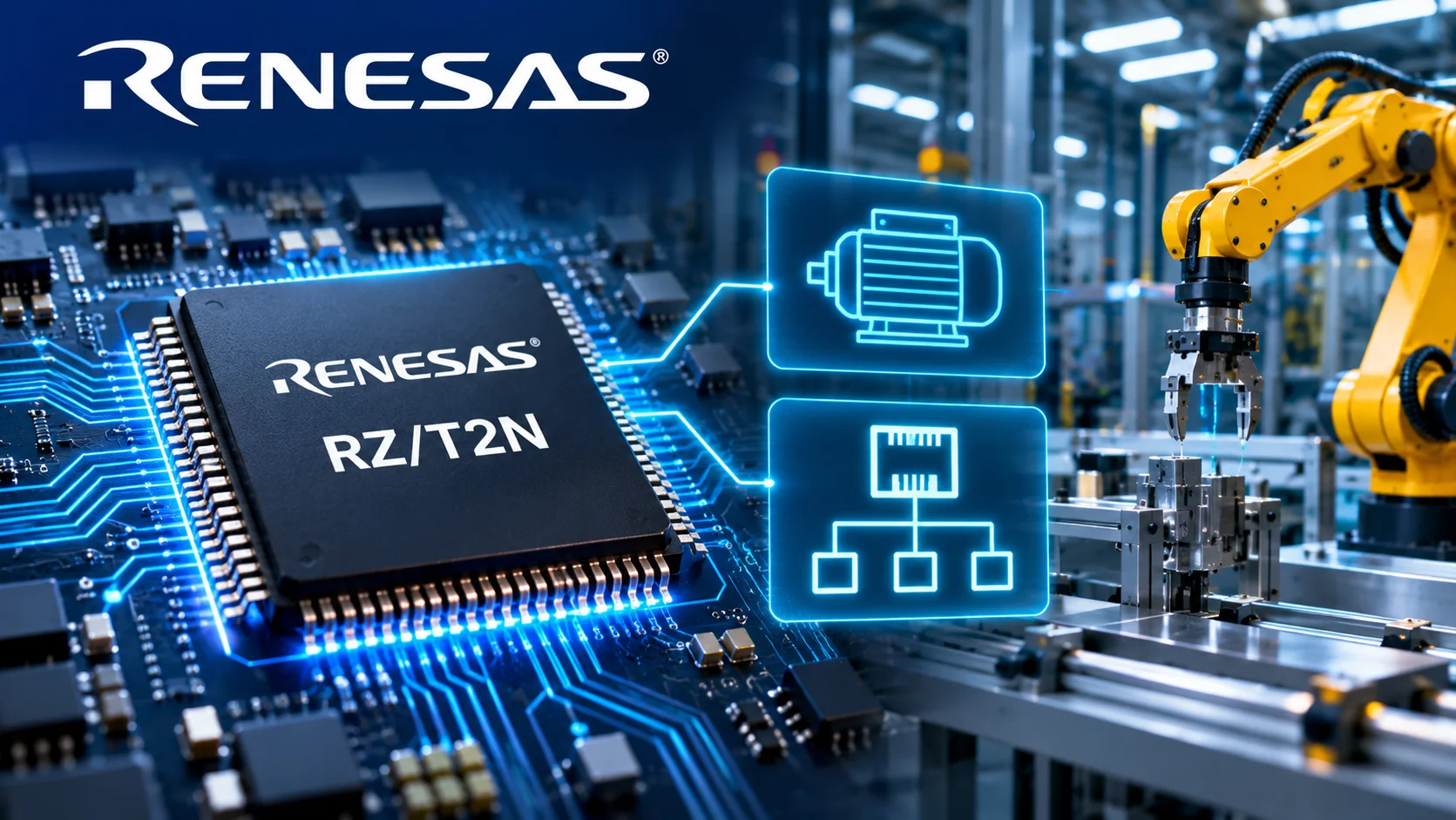
Renesas Electronics has introduced the RZ/T2N processor, a 64-bit microprocessor designed to combine motor control, industrial networking and application processing on a single chip. The RZ/T2N processor targets industrial robots, programmable logic controllers (PLCs) and multi-axis servo systems that require precise real-time operation.
Announced on November 5, 2026, the new device integrates dual Arm Cortex-A55 cores for application processing and two Cortex-R52 cores for real-time control. It supports motor control for up to four axes and major industrial Ethernet protocols, including EtherCAT, PROFINET RT/IRT and EtherNet/IP.
Renesas says the integration can reduce the number of separate components needed in industrial equipment. This can help manufacturers save circuit-board space, simplify system designs and reduce bill-of-material costs.
RZ/T2N Processor Integrates Four-Axis Motor Control
The RZ/T2N uses two Cortex-A55 cores operating at up to 1.2GHz for application workloads, including Linux-based processing. Two Cortex-R52 cores, running at up to 800MHz, handle real-time control tasks.
This combination allows the processor to manage higher-level applications while maintaining the predictable timing required for motor-control operations. Each Cortex-R52 core includes 576KB of tightly coupled memory with error-correcting code protection to support reliable real-time processing.
The integrated motor-control peripherals support up to four axes. This makes the device suitable for industrial equipment that coordinates multiple motors, including articulated robots, SCARA robots, delta robots and multi-axis servo drives.
The processor also includes encoder interfaces for measuring motor position and movement. These interfaces support several industrial encoder standards, including Tamagawa T-Format, HIPERFACE DSL, EnDat and BiSS protocols.
Industrial Ethernet and Network Reliability
Alongside motor control, the RZ/T2N integrates networking features intended for industrial automation environments. It includes three Gigabit Ethernet MACs, an Ethernet switch and an EtherCAT SubDevice Controller.
Support for Time-Sensitive Networking enables time-synchronised communication across industrial networks. The processor also supports redundancy protocols such as High-availability Seamless Redundancy, Parallel Redundancy Protocol and Frame Replication and Elimination for Reliability.
These capabilities allow equipment manufacturers to use the same processor platform in both network-controller and network-device applications. Renesas says this flexibility can help engineers reuse designs across different types of industrial equipment.
Security features include secure boot, secure firmware updates, hardware cryptographic functions and Arm TrustZone. The processor also supports error-correcting code protection across its memory systems.
Renesas Targets More Compact Industrial Equipment
Industrial controllers and robotic systems have traditionally relied on separate chips for application processing, real-time motor control and network communication. Integrating these functions into one processor can reduce component requirements and simplify the overall hardware architecture.
For manufacturers, this could translate into smaller circuit boards and more flexible equipment designs. It may also reduce development complexity when building products that need both precise motion control and industrial connectivity.
The RZ/T2N and its evaluation board are available now. Renesas will also demonstrate the processor at electronica 2026 in Munich, Germany, from November 10 to 13.
The launch reflects the semiconductor industry's growing focus on specialised processing for industrial automation. As robots and factory systems become more connected and require increasingly precise movement, processors that combine real-time control with application and networking capabilities could become an important part of future equipment designs.