
Acoustic Tractor Beams Can Now Reprogram Materials and Levitate Objects
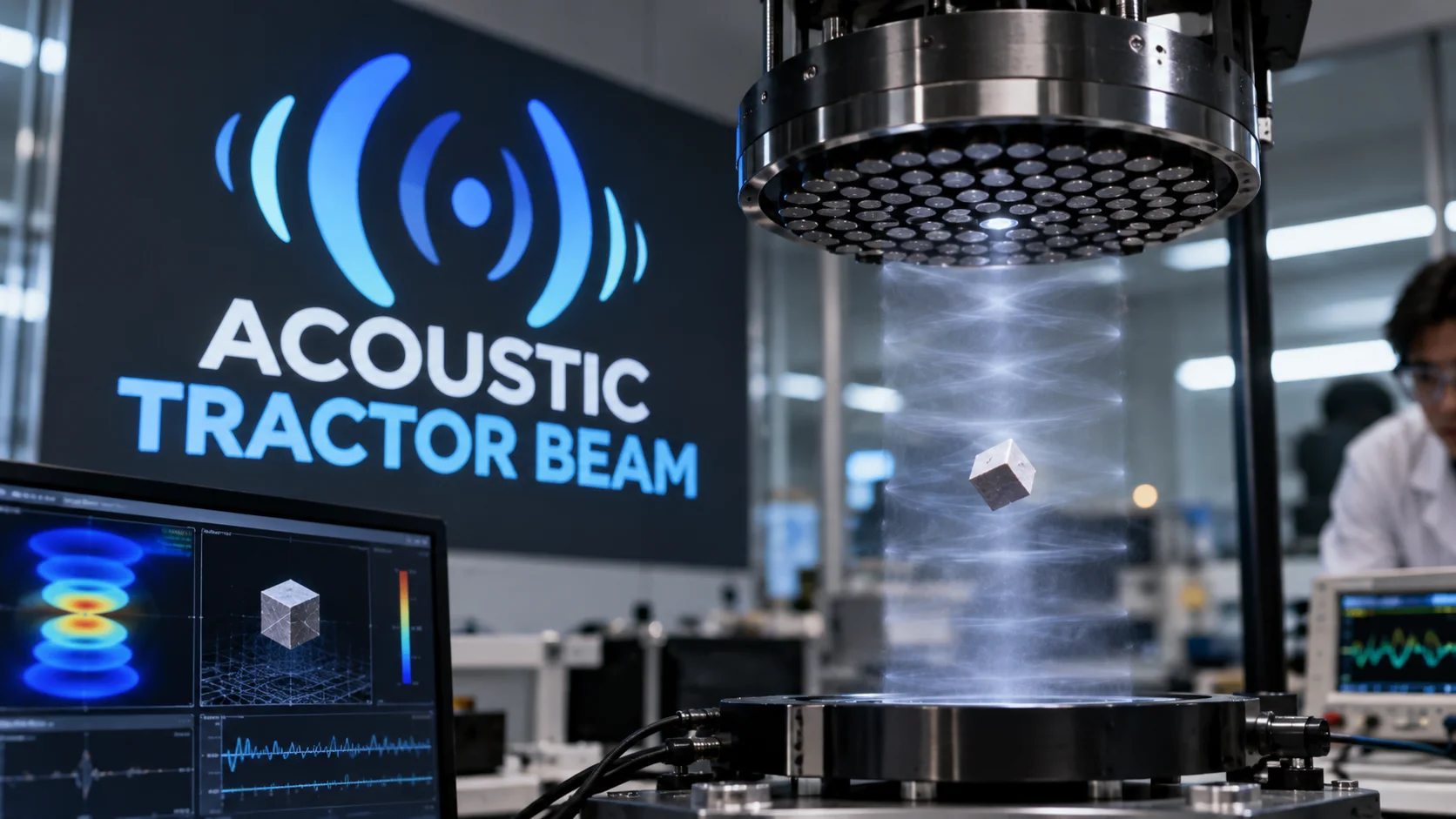
Scientists are pushing acoustic tractor beam technology beyond the familiar idea of moving objects with sound. Two studies published in 2026 have demonstrated different ways of controlling matter with acoustic waves: one can remotely move an internal mechanical feature that determines whether parts of a material are soft or stiff, while another can levitate and translate small objects in open air from a single-sided ultrasound source.
The developments come from separate research teams and tackle two long-standing challenges in acoustic manipulation. The first, published in Nature Communications, showed controlled movement of mechanical kinks inside a specially designed metamaterial. The second, published in Physical Review Letters in August, demonstrated stable three-dimensional levitation inside the high-pressure core of a Bessel beam at distances of up to 397 millimetres.
Sound Can Change a Material’s Internal State
The first breakthrough involves a structure known as a topological metamaterial. Researchers from the University of California San Diego, the University of Michigan and France’s CNRS designed an experimental system in which a localized mechanical feature called a kink can be moved using acoustic waves.
A kink acts as a boundary between two different internal states of a material. Its position determines which part of the structure is relatively soft and which part is stiff.
The researchers built a physical model using rotating disks connected by springs. One differently oriented disk represented the kink. When controlled acoustic pulses were applied, the kink moved toward the sound source.
Short pulses shifted it step by step, while longer vibrations could move it across the structure. This effectively changed the distribution of stiffness without requiring direct physical contact.
The study, published in February 2026, is notable because the researchers created a system where the kink can move without having to overcome the energy barrier that normally keeps such defects locked in place. This allowed the team to control its movement predictably rather than producing the chaotic motion seen in earlier acoustic experiments.
Acoustic Waves Act Like a Remote Control
The concept is different from conventional acoustic levitation. Instead of simply lifting a particle, the sound is interacting with the internal structure of the material itself.
The researchers found that only particular acoustic frequencies could move the kink. By changing the pulses, they could control how far the kink travelled and therefore alter the material’s stiffness profile.
Moving the kink to one end makes that region soft while the opposite side becomes progressively stiffer. Positioning it in the centre creates a softer middle section with greater stiffness toward both ends.
The present system is still an experimental model rather than a commercial material. The researchers say future work will examine three-dimensional versions and whether similar effects can be achieved at much smaller scales.
Potential applications include adaptive structures, soft robotics, protective equipment and medical devices whose mechanical properties could eventually be adjusted remotely.
A Second Team Pushes Acoustic Levitation Nearly 40 cm
The second 2026 breakthrough addresses a different limitation: how far a sound-based levitation system can operate when all the ultrasound comes from one side.
Traditional acoustic levitation generally traps objects at low-pressure regions, or pressure nodes, created by standing waves. These systems often require opposing sound sources or reflective surfaces, limiting where objects can be manipulated.
Researchers from the University of Tsukuba, the University of Bristol and Pixie Dust Technologies instead used a zero-order Bessel beam. Unlike an ordinary focused beam, a Bessel beam can maintain a narrow, high-intensity central region over a much longer distance.
The researchers demonstrated stable three-dimensional levitation within the beam’s high-pressure central core. A 1.5-millimetre expanded-polystyrene sphere could be levitated at distances reaching 397 mm from the acoustic source.
That is roughly six times the working distance previously achieved by comparable single-sided acoustic traps.
Objects Can Be Manipulated Around Obstacles
The system was not limited to holding one particle in a fixed position.
The researchers demonstrated three-dimensional translation, simultaneous levitation of multiple particles and manipulation of objects with different shapes. They also showed that an object could remain levitated beyond an obstacle because the Bessel beam can reconstruct its profile after encountering an obstruction.
This self-reconstructing property is important for practical contactless manipulation. Conventional acoustic traps can lose their effectiveness as the distance from the source increases or when something interrupts the acoustic field.
The new system instead maintained a usable trapping region much farther from the source, opening the possibility of manipulating objects in a more open environment rather than inside a tightly controlled chamber.
What Acoustic Tractor Beams Could Eventually Enable
The two studies approach acoustic manipulation from different directions, but together they broaden the technology's potential.
The metamaterial research points toward structures whose mechanical properties could be changed remotely. Such systems could eventually be useful in adaptive robotics, vibration control and medical devices.
The long-range levitation research could support contact-free handling of fragile, contaminated or hazardous materials. Possible areas include automated laboratory systems, manufacturing and three-dimensional displays, where objects need to be moved without physical contact.
Neither technology is ready for widespread commercial deployment. The metamaterial work remains a fundamental laboratory demonstration, while the levitation experiment operates with small objects and specialized ultrasound equipment.
Still, the results show that acoustic tractor beams are no longer limited to simply pulling or suspending small objects. Researchers are beginning to use carefully engineered sound fields to control both the position of matter and the mechanical state of materials themselves.