Adobe Acquires Indian AI Startup Rilo to Expand AI Marketing Tools
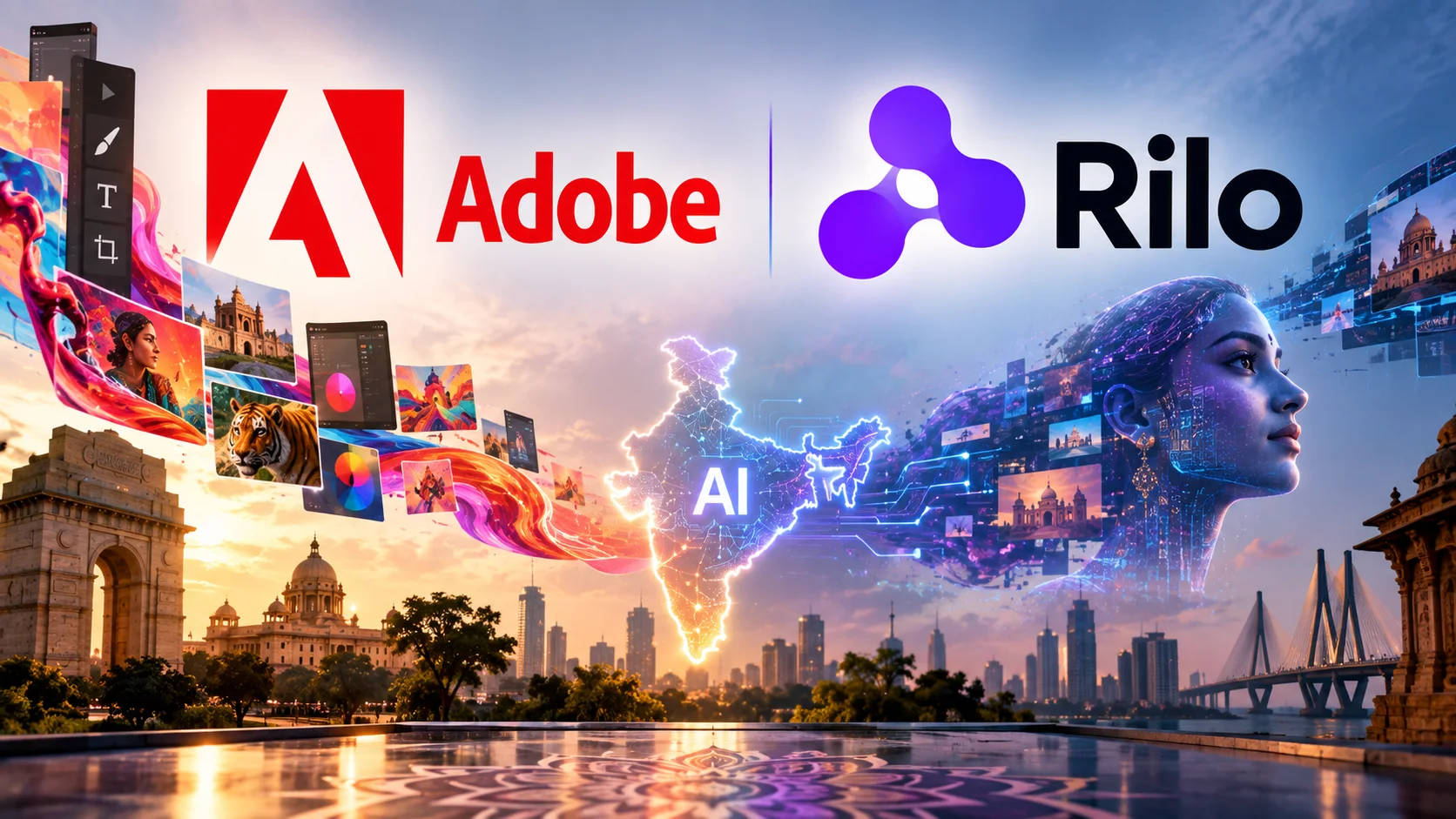
Adobe has acquired Indian AI startup Rilo, less than a year after the company was founded, in a move that gives the software giant another piece of technology for automating marketing and business workflows. The financial terms of the acquisition have not been disclosed. Rilo was founded in September 2025 by IIT Bombay alumni Dhruv Jaglan and Georgi Boby and had built AI agents that could create and execute complex workflows from plain-English instructions.
For a startup that had been around for barely a year, the exit came remarkably quickly. Rilo had attracted more than 10,000 users within months of launching and had raised about $1 million from investors including Peak XV Partners, DeVC and Day Zero Ventures at a reported $10 million valuation.
Rilo wanted AI to do more than answer questions
Rilo was built around a fairly simple idea: users should be able to tell AI what they want done without having to design the workflow themselves. Its platform allowed non-technical users to describe a task in plain English. AI agents would then build and run the workflow across multiple tools. The company later focused heavily on marketing and go-to-market teams, developing what it called “AI employees” for jobs such as competitor tracking, prospecting, LinkedIn outreach, social media work and campaign research.
That puts Rilo in the growing field of agentic AI, where software is expected to carry out a series of actions rather than simply generate a response to a prompt. For marketing teams, that could mean an AI system watching competitors, identifying potential customers, analysing sales calls or preparing campaign material without requiring a person to manually move information between different applications.
A quick journey from startup to Adobe
Rilo's short history is one of the striking parts of the deal. Jaglan and Boby started the company in 2025, and the startup quickly found users and investors for its AI automation platform. Jaglan had previously co-founded AI recruitment platform Babblebots.ai, while Boby had worked as a technology lead at cooking robotics company CloudChef. Rilo's acquisition also brings its small team into Adobe. Reports say the deal includes licensing Rilo's technology and bringing its six-member team into the company, while Rilo's existing platform will be shut down following the transaction. The financial terms have not been made public.
For Rilo's investors, the acquisition provides an exit after a relatively short period. For Adobe, the appeal is less about the size of the startup and more about what its technology can add to the company's existing AI products.
Why Adobe wants Rilo's technology
Adobe has been pushing deeper into AI-powered marketing and customer-experience software as businesses increasingly use AI to automate campaign creation, customer interactions and other repetitive work. Rilo's technology fits into that direction. Its workflow agents were designed to move from a user's goal to the actions required to achieve it, which could complement Adobe's broader enterprise marketing and customer-experience products. The acquisition is also Adobe's second known acquisition of an Indian startup. In 2023, the company bought generative AI video startup Rephrase.ai, another India-founded company.
The timing is notable as competition around AI-powered marketing software grows. Companies are increasingly trying to turn AI from a tool that helps employees complete individual tasks into systems that can handle entire pieces of a workflow. Rilo's own journey shows how quickly that market is moving. A startup founded in September 2025, with a six-member team and a product that had reached more than 10,000 users, is now becoming part of Adobe's much larger AI ecosystem. The product may disappear as a standalone platform, but its technology and the people who built it are moving into a company with a much bigger audience to serve.