
ASUS Expands AI Infrastructure From Cloud to Edge With New Servers
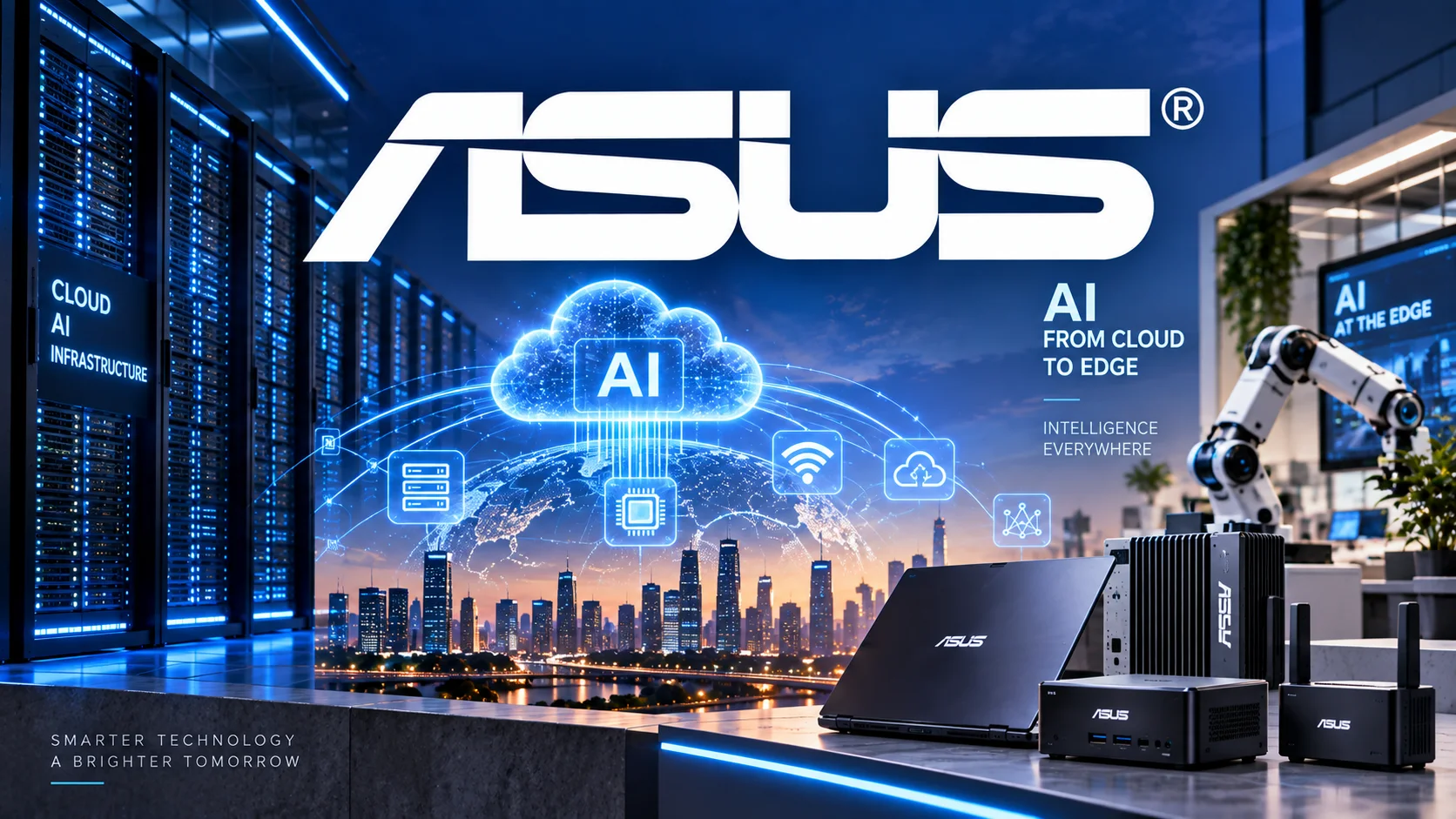
ASUS is expanding its AI infrastructure business beyond traditional data centers, introducing a broader portfolio designed to support workloads from enterprise servers to industrial edge environments. The company announced the expansion at ASUS AI Tech 2026 in Seoul on September 3, bringing together new server platforms powered by Intel and AMD alongside industrial computing systems. ASUS is positioning the portfolio as part of an end-to-end AI infrastructure ecosystem that can support organizations as AI moves from centralized cloud environments into factories, hospitals, vehicles and other real-world settings.
New Intel and AMD server platforms
For enterprise and data center applications, ASUS showcased several new server systems built around the latest processors from Intel and AMD. The ASUS RS700-E12-RS4U and RS720-E12-RS12U use Intel Xeon 6 processors and are designed for AI, high-performance computing and other data-intensive workloads. ASUS also introduced the XA P8I-E13A, a high-density 6U system built around Intel's next-generation Xeon platform and designed to support demanding AI applications with GPU acceleration. On the AMD side, the RS720A-E14B-R32U, RS500A-E14B-R12U and ESC8000A-E13P target enterprise and AI workloads. The RS720A-E14B-R32U and RS500A-E14B-R12U feature AMD EPYC 9006 Series processors, with ASUS targeting modern data centers that need a combination of computing performance and efficiency.
AI moves closer to where data is generated
ASUS is also putting greater emphasis on edge AI, where data can be processed locally instead of being sent back to a centralized cloud. That approach can be particularly useful in environments handling sensitive or time-critical information. Hospitals, for example, can process patient-related data locally, while factories can analyze production information and video feeds without continuously moving that data to remote infrastructure. But putting computing hardware on a factory floor or inside a power plant presents different challenges from operating equipment inside a controlled data center. Systems may have to deal with temperature fluctuations, unstable power and electrical interference.
To address those conditions, ASUS has introduced its Industrial Edge Server, designed for applications including factory automation, automated optical inspection, video surveillance and healthcare. The company also unveiled the RUC-2000 series embedded computer, powered by Intel Core Ultra Series 3 processors and offering up to 180 AI TOPS. The fanless system is intended for machine vision, video analytics and in-vehicle AI applications.
Building an AI infrastructure stack
The announcement is part of ASUS' wider push to build infrastructure that covers different stages of AI deployment rather than focusing only on high-end data center hardware. The company has been expanding its AI infrastructure portfolio through partnerships with chipmakers and technology companies, including Intel, AMD, NVIDIA, IBM, Samsung and Schneider Electric. At ASUS AI Tech 2026, the company also presented its broader AI factory strategy, combining computing, networking, storage, deployment software and AI operations into a single infrastructure approach.
For businesses, the shift means AI infrastructure is increasingly being designed around where AI workloads actually run. Large-scale model training may remain concentrated in data centers, while inference and other applications can increasingly happen closer to users, machines and sensors. ASUS says its longer-term goal is to support this transition across cloud, enterprise and edge environments, giving organizations infrastructure options as they move from experimenting with AI to deploying it in everyday operations.