
AWS Plans 39-Building Pennsylvania Data Center Campus With 4.5GW Gas Power
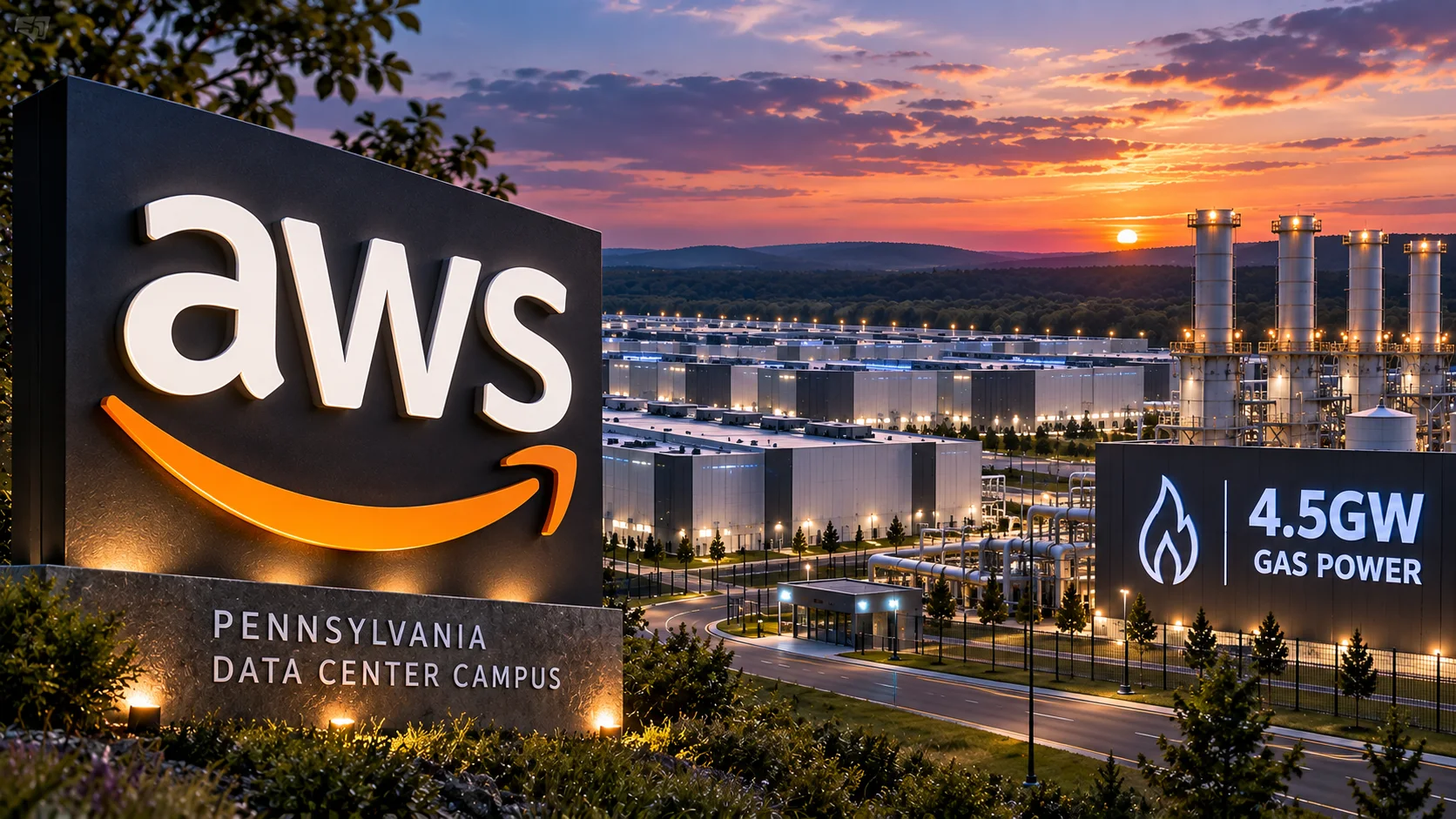
Amazon Web Services is planning a 39-building data center campus at the former Homer City power station site in Pennsylvania, adding another major development to the company's growing US infrastructure footprint as demand for cloud computing and artificial intelligence capacity continues to rise.
The proposed campus would cover roughly 2,200 acres and is expected to be developed in phases over about a decade. At full buildout, the project could support around 1,500 to 2,000 permanent jobs, in addition to thousands of construction positions during the development period. The campus is being designed primarily for cloud computing and AI workloads that require large amounts of computing power and electricity.
AWS Plans a Major New Data Center Campus
The scale of the Homer City proposal is significant. Rather than building a single hyperscale facility, AWS is planning 39 separate data center buildings across the site, allowing the company to expand computing capacity gradually as demand grows.
The project is still at the planning stage and will require the necessary approvals, permits and infrastructure work before construction can proceed. AWS has not indicated that all 39 buildings will be built simultaneously, with the proposed decade-long development timeline allowing capacity to be added in stages.
4.5GW Natural-Gas Power Complex
The most notable part of the development is its planned connection to a new natural-gas power complex at the former Homer City site. The proposed generation facility is designed to provide approximately 4.5GW of electricity, potentially giving the data center campus access to a dedicated source of power at a scale rarely associated with individual computing developments.
The 4.5GW figure represents the planned maximum generating capacity of the associated power project, rather than electricity that AWS would necessarily consume from the beginning. The energy development is being built as part of the broader redevelopment of the former coal-fired power station, which stopped operating in 2023 after decades of service. The planned facility is expected to use gas turbines supplied by GE Vernova. Earlier project plans called for seven hydrogen-capable gas turbines, with the new generation infrastructure intended to replace the site's retired coal generation.
Why AI Data Centers Need So Much Power
The Homer City project reflects a growing challenge for hyperscale technology companies. AI data centers require significantly more electricity than many conventional cloud facilities because they operate large clusters of GPUs and other specialised accelerators, alongside networking and cooling systems. As these facilities become larger, finding enough electricity through existing grid connections can become a major constraint. New power generation located close to a data center can provide developers with greater certainty over future capacity while potentially reducing some of the delays associated with traditional grid interconnection.
That approach also comes with environmental considerations. Natural-gas generation produces carbon emissions, and large data center projects can place additional pressure on regional electricity infrastructure. Pennsylvania is therefore facing the broader challenge of balancing the economic opportunities created by AI infrastructure with concerns over energy supply, emissions and the impact on local communities.
Part of Amazon's Wider Pennsylvania Investment
The Homer City campus should not be described as a standalone $20 billion project. The figure comes from Amazon's broader commitment to invest at least $20 billion in Pennsylvania's data center infrastructure for artificial intelligence and cloud computing. Amazon announced the statewide investment in 2025, saying it would support at least 1,250 high-skilled jobs as well as thousands of additional positions through construction and related activities. The company has also identified other locations for its Pennsylvania expansion, including developments in Salem Township, Falls Township and Kline Township. The Salem Township project alone is planned across approximately 1,062 acres and is expected to contain 20 data centers. The Homer City proposal would therefore add another large campus to Amazon's expanding network in the state.
Former Coal Site Gets a New Role
The redevelopment of Homer City is particularly notable because the location once supported one of Pennsylvania's major coal-fired power facilities. With the coal plant now closed, developers are looking to reuse the site for a combination of energy generation and digital infrastructure. The transition is not a complete move away from fossil fuels. Instead, the planned development replaces older coal generation with natural-gas turbines while directing the resulting electricity toward the growing demand from data centers. For AWS, the location offers a combination of land, existing energy infrastructure and access to a large planned power supply. For the energy developers, an anchor customer with long-term demand for electricity can help justify investment in several gigawatts of new generation capacity.
A New Model for Hyperscale Infrastructure
The Homer City proposal illustrates how the AI infrastructure buildout is changing the way large data centers are planned. Companies are increasingly having to consider electricity generation, transmission capacity, cooling and physical infrastructure alongside servers and networking equipment.
For AWS, the proposed 39-building campus would provide room to expand computing capacity over many years. The associated 4.5GW generation project could give the development an unusually large power base, although the final scale and timing will depend on approvals, construction and AWS's future capacity requirements. The project remains a proposal rather than an operational data center, but its scale shows how closely AI computing and energy infrastructure are becoming linked. At the largest developments, securing enough electricity is no longer simply a utility issue; it is becoming one of the central components of building the data center itself.