Coratia Technologies Raises ₹18 Crore to Expand Underwater Robotics
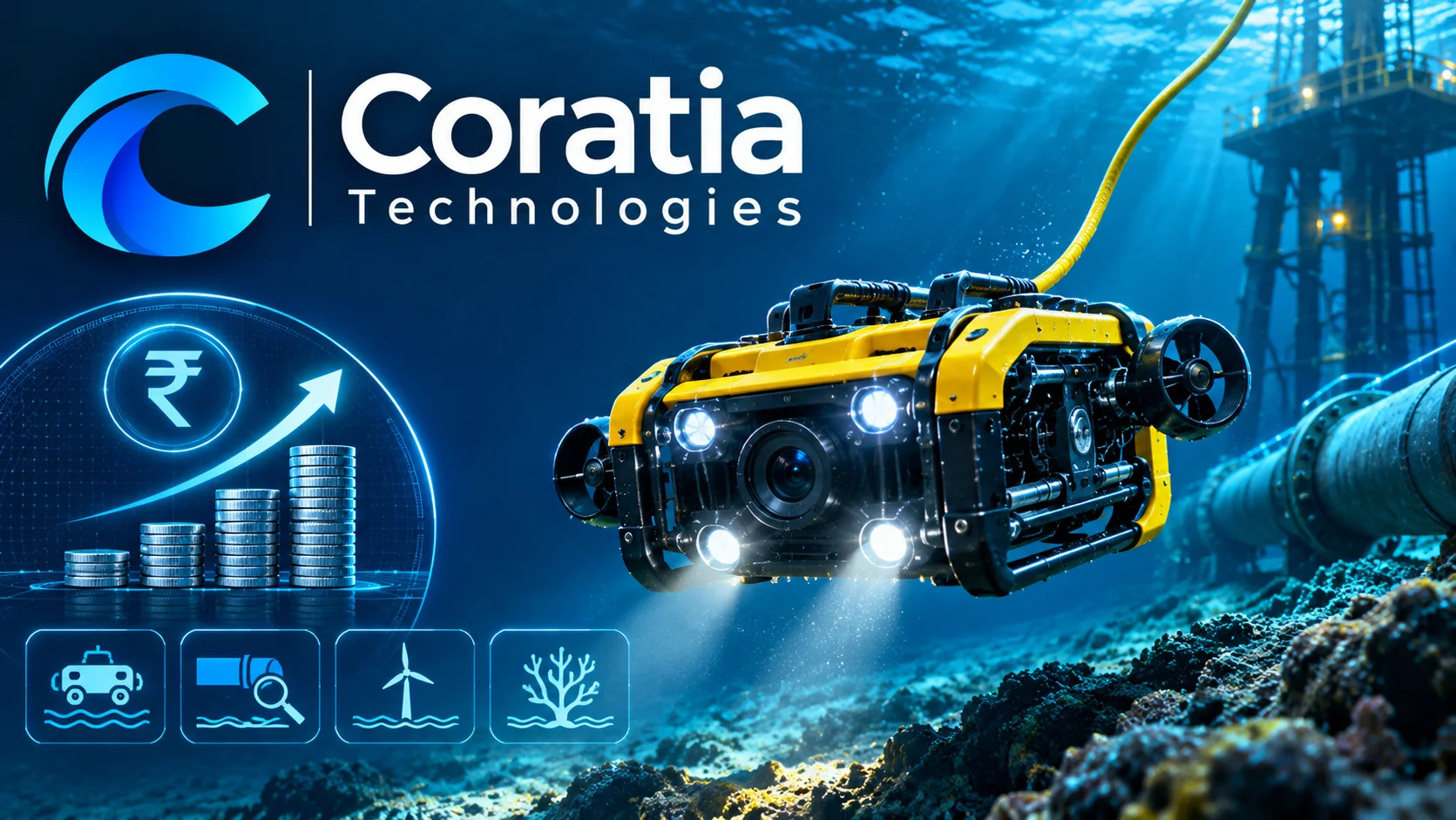
Indian deep-tech startup Coratia Technologies has raised ₹18 crore in a bridge funding round led by MGF Kavachh. The new capital will support the company’s work under an existing ₹66 crore Indian Navy contract, while helping it expand research, manufacturing and deployment of indigenous underwater robotic systems.
Announced on October 29, the funding comes as Coratia seeks to strengthen its capabilities for defence and critical-infrastructure applications. The company develops underwater robots designed to inspect and operate in environments where low visibility, silt and changing water currents can make conventional inspection difficult.
Coratia Technologies funding will support Navy programme
The ₹18 crore bridge round is intended to help Coratia execute its ₹66 crore contract with the Indian Navy under the Innovations for Defence Excellence (iDEX) initiative. The contract was signed in September 2025, so it is not a newly awarded order connected to the latest funding announcement. The Navy programme covers the supply and maintenance of indigenous underwater robotic systems for tasks including ship-hull cleaning, minor salvage operations and inspection of submerged infrastructure. Reports identify the platforms under the contract as Jalasimha and Jaladuta remotely operated underwater vehicles, alongside Navya, an autonomous surface vehicle.
Coratia said the fresh capital will also accelerate research and development of new products, strengthen its core underwater robotics capabilities and expand manufacturing and deployment capacity. The company had previously raised ₹17 crore in a pre-Series A round in 2025. Reports differ on the allocation of investors in that earlier financing, so the latest round should be treated separately from any additional funding figures reported elsewhere.
How Coratia is developing underwater robotic systems
Founded by Debendra Pradhan and Biswajit Swain, Coratia develops remotely operated underwater vehicles and autonomous marine systems for defence, industrial inspection and critical infrastructure. Its flagship Jalasimha platform is designed for underwater inspection and intervention, with the company stating that it has reached Technology Readiness Level 9, a stage indicating a system has been proven in an operational environment.
The systems combine cameras with technologies such as sonar, acoustic sensors and navigation equipment to gather information in murky water. Depending on the configuration, robotic systems can also carry manipulators and inspection tools to assess submerged structures. Coratia says its platforms are designed for challenging Indian water conditions, including high turbidity, silt and strong or changing currents.
Underwater robotics market extends beyond defence
The Navy contract provides a significant programme for Coratia, but the company is also targeting commercial and public infrastructure. Its stated applications include inspection of dams, reservoirs, ports, bridges, pipelines, offshore assets, ship infrastructure and subsea communication networks.
Its reported clients and partners include Indian Oil, Indian Railways, Tata Steel, Hindalco, SAIL and Jindal Steel and Power, in addition to the Indian Navy and NIT Rourkela. These applications could give underwater robotics companies opportunities beyond military procurement, particularly where inspections involve submerged structures or hazardous conditions for divers.
For Coratia, the immediate task is to turn its funding and existing contract into reliable manufacturing and deployment. The bridge round supports that effort, but the announcement does not establish how much of the Navy contract has already been delivered or when the full programme will be completed.