Eka Robotics Develops More Dexterous Robots With Force-Sensing AI
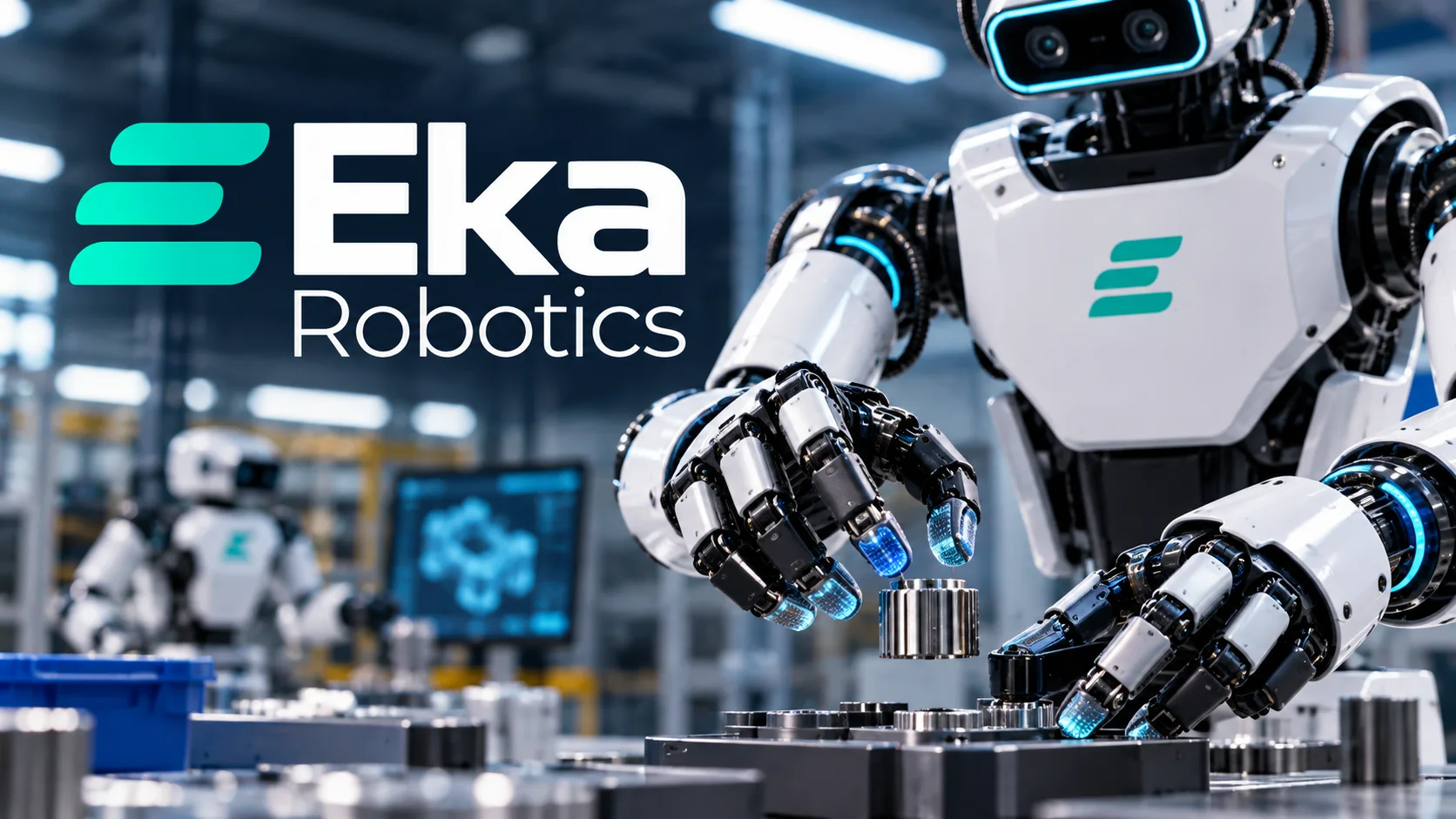
Eka Robotics is developing AI-powered robots that can handle unfamiliar objects by combining visual information with physical feedback. The company’s approach aims to improve dexterity, helping machines adjust their grip when picking up delicate or irregularly shaped items.
The startup announced a $150 million Series A on October 20, 2026, to expand its technology and accelerate customer deployments. The round was led by Andreessen Horowitz and F-Prime, with the company valued at a reported $1.45 billion after the investment.
Rather than relying on cameras alone, Eka’s system uses a vision-force-action (VFA) model that incorporates force data as a robot interacts with an object.
How Eka Robotics Uses Force-Sensing AI
Conventional robotic systems can struggle when objects shift, deform or slip during handling. Cameras help a machine identify an object and estimate its position, but visual information alone may not reveal how firmly a gripper is holding it.
Eka’s VFA model combines camera images with force measurements from a specially designed robotic gripper. This lets the system respond to physical contact and adjust its movements while performing a task.
The company is initially targeting dexterous manipulation, which includes work such as packing delicate produce, handling cables and assembling server racks. These tasks require robots to adapt to different objects rather than repeat a single fixed movement.
Eka says its robots can perform up to 1,500 pick operations per hour on objects outside their training distribution, compared with a human benchmark of around 600. The company also claims a success rate above 95% for picking tasks. These are company-reported performance figures, not guarantees for every industrial environment.
Simulation Helps Robots Learn Physical Tasks
Eka trains its model using reinforcement learning and physics simulation. Instead of depending exclusively on demonstrations of people performing tasks, the approach allows simulated robots to practise handling objects under different conditions.
The company says simulations can generate thousands of hours of robotic experience in minutes. This gives the system opportunities to learn how objects respond to pressure, friction and movement before transferring its learned behaviour to physical machines.
Simulation can reduce the time and cost associated with gathering real-world training data. However, transferring simulated behaviour to actual equipment remains a challenge because factory conditions, hardware wear and unexpected objects can affect performance.
Researchers who have seen Eka’s demonstrations have highlighted its ability to adapt to unfamiliar objects. They have also raised questions about whether the technology can maintain reliability during long-running industrial operations and generalise beyond pick-and-place tasks.
Eka Robotics Expands Industrial Deployment Plans
The new funding will help Eka extend its model to more tasks and accelerate deployments with industrial customers. The company is working on applications including pick-and-place operations and wire handling, where robots must combine speed with precise physical interaction.
Eka was founded by Pulkit Agrawal, an MIT professor, and Tuomas Haarnoja, a former Google DeepMind researcher. Its investors include Andreessen Horowitz, F-Prime, Obvious Ventures and E14 Fund, alongside other participants.
The next test is whether the technology can move from demonstrations and limited customer pilots to dependable production-line use. Industrial customers need systems that maintain performance over extended periods, work safely around people and justify the cost of deployment.
Eka’s approach offers one route toward more adaptable automation, but its wider impact will depend on how consistently the robots perform across real-world tasks. The company’s immediate priority is to turn its force-aware AI into reliable systems that manufacturers can use at scale.