Embodied AI AIR Robot Targets Factory Work With Wheeled Design and Flexible Arms
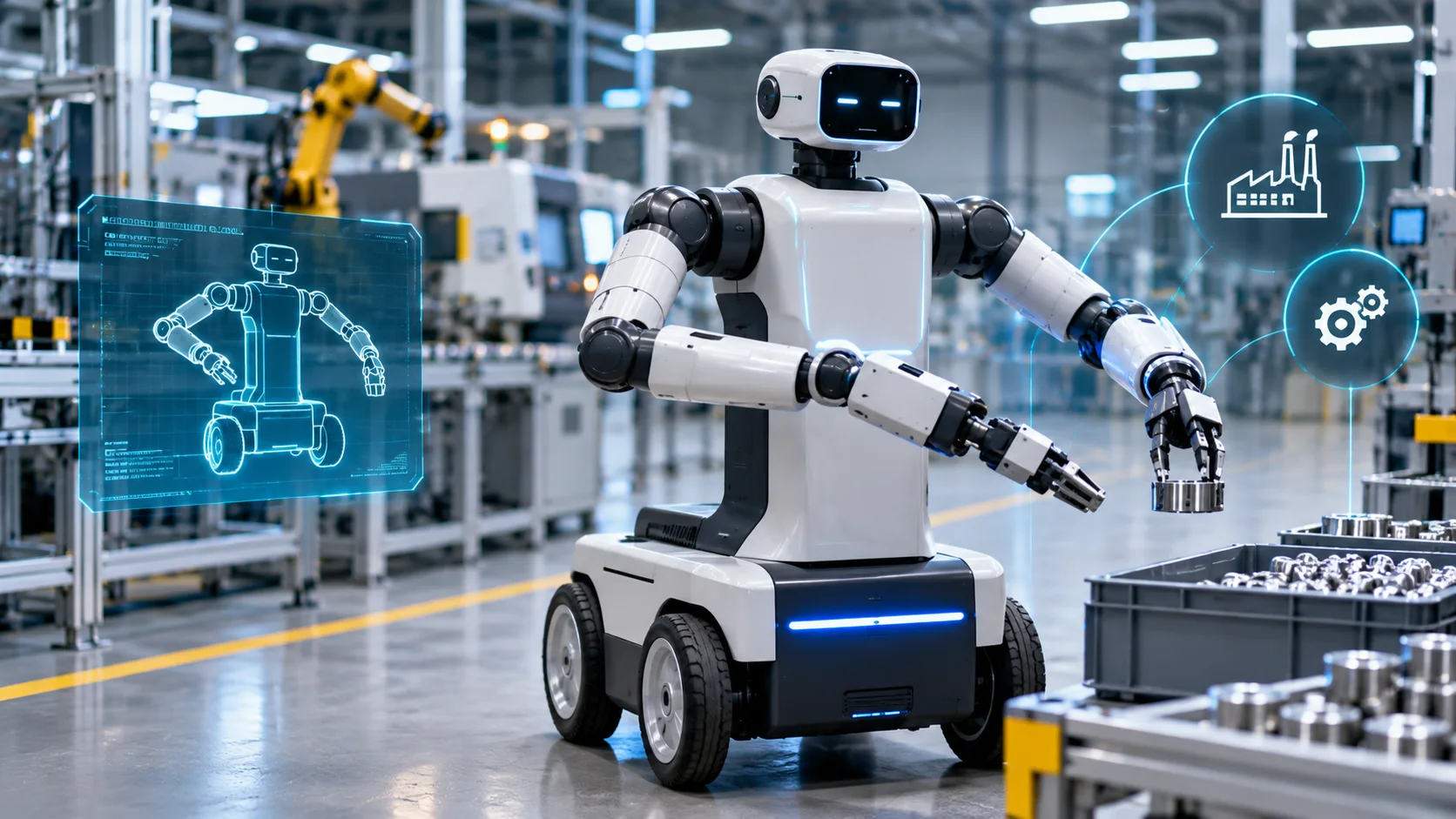
Swiss robotics startup Embodied AI has unveiled the Embodied AI AIR robot, a wheeled humanoid designed to perform industrial tasks alongside factory employees. The company introduced the machine at Humanoid Europe 2026 in Munich on November 6, presenting an alternative to legged humanoids and conventional industrial robots that often operate behind safety barriers.
AIR combines a torso, two lightweight arms and a wheeled mobile base. Its design prioritises stability and physical interaction in factory environments rather than human-like walking. The company is based in Lausanne and was founded by robotics researchers from EPFL.
Embodied AI AIR robot uses lightweight, tendon-driven arms
The robot's mechanical design places heavier components, including motors, gearboxes and electronics, inside its torso. Tendon-driven mechanisms transfer movement to its arms, keeping the moving components lighter.
The arms are designed to yield when they encounter a person or obstacle. This compliant structure is intended to reduce the risks associated with rigid robotic limbs operating near employees. Embodied AI says AIR was designed under the ISO/TS 15066 specification for collaborative robot safety.
The wheeled base is another deliberate choice. Many factory floors are relatively flat, so wheels can provide stable movement without the mechanical complexity of a bipedal walking system. The configuration also allows the robot to approach workstations while keeping its upper body available for handling objects and performing tasks.
CE marking is planned for 2027. That certification has not yet been completed, so the robot's design objectives should not be confused with a final regulatory approval.
Robot learns factory tasks through human demonstrations
AIR follows a human-guided training process. An operator initially controls the robot while carrying out a new task. Each run is recorded as training data, allowing its AI system to learn the required movements and workflow.
According to Embodied AI, AIR can typically take over a task independently within about a month. Human operators remain available to intervene when the robot encounters unfamiliar situations. Skills learned by one robot can also be shared with others.
This approach is intended to make deployment more practical for manufacturers. Instead of requiring a robot to arrive with every task already programmed, the system can learn from the conditions and processes at the factory where it will work.
Embodied AI says AIR is being tested with major manufacturers and that it has signed contracts with companies worldwide. It has not publicly identified those customers or disclosed the number of robots involved.
Industrial trials show progress, but AIR's results need context
The company says its software is already being used in paid deployments on a separate two-armed industrial robot. In an evaluation by a major consumer electronics manufacturer, that system achieved 98% reliability on a cable-handling task, compared with the customer's 90% target.
This result provides an indication of the company's software capabilities, but it was not a published performance benchmark for the complete AIR robot. The distinction matters as manufacturers assess how well a new robot performs under actual production conditions.
Embodied AI plans to move AIR towards scaled production, although it has not announced a production volume or commercial delivery schedule.
A different approach to factory humanoid robots
The Embodied AI AIR robot reflects a practical direction in industrial robotics: machines do not necessarily need legs or a human-like body to work in spaces designed for people. A stable mobile base and compliant arms may be more useful for many factory tasks.
If its trials translate into reliable deployments, AIR could help automate repetitive handling and assembly work while sharing workspaces with employees. Its wider adoption will depend on safety validation, task performance, integration costs and the ability to manufacture the system at scale.