Exyn Joins US DOE-Selected Autonomous Mining Project to Advance Mineral Discovery
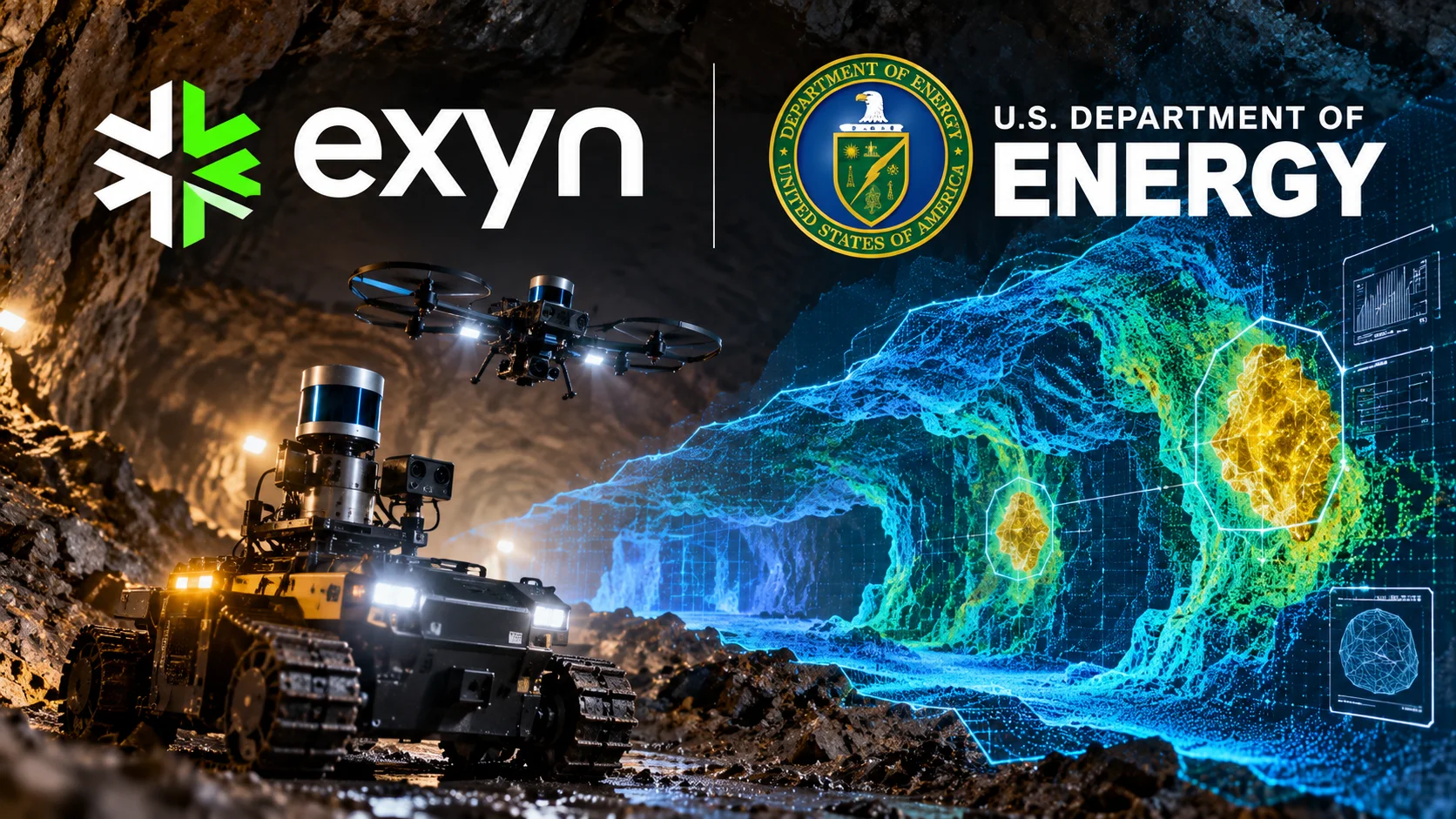
Exyn Technologies is joining a national laboratory-led project developing autonomous systems for underground mineral exploration after the initiative was selected for award negotiations under the US Department of Energy’s $29.5 million Mine of the Future programme.
The project, known as the Mining Autonomous Platform for Prospecting and Ore Discovery (MAP-POD), aims to combine robotics, advanced sensing and artificial intelligence to map underground mines and identify mineral deposits. Exyn is expected to contribute its ExynAI navigation technology for autonomous ground vehicles operating in environments where GPS signals are unavailable.
The DOE selected 17 national laboratory projects under the initiative, with the combined funding intended to advance domestic mining technologies and strengthen critical mineral supply chains. However, MAP-POD’s selection for award negotiations does not mean its final funding and terms have been confirmed.
Autonomous Robots to Map Underground Mines
Underground mines present significant navigation challenges. GPS signals cannot reliably reach these spaces, while darkness, confined passages and hazardous conditions can make conventional surveying difficult and time-consuming.
MAP-POD is designed to address these limitations through a mobile robotic platform equipped with advanced scanners, hyperspectral sensors and AI. The system aims to map underground environments and identify minerals in minutes, potentially reducing the time required for surveys that can otherwise take days or weeks.
Exyn’s contribution is expected to include near-zero-drift navigation through its ExynAI autonomy platform. The technology is designed to help ground vehicles determine their position and navigate complex environments without relying on GPS or requiring a pre-existing map.
Potential Benefits for Mining Safety and Efficiency
More capable autonomous systems could help mining teams gather information from areas that are difficult or dangerous for workers to access. Detailed underground maps can support exploration planning, improve awareness of mine conditions and help operators make decisions about where to investigate further.
Faster mineral identification could also help researchers and mining operators assess deposits more efficiently. The project’s focus on critical minerals is significant because these materials are important to technologies spanning energy systems, electronics and industrial manufacturing. Improving domestic exploration capabilities is one of the DOE initiative’s stated objectives.
Exyn has previously developed autonomous mapping technology for underground mining and other GPS-denied environments. Its participation in MAP-POD provides an opportunity to apply that experience within a research programme combining autonomous vehicles, advanced sensing and mineral discovery.
Funding Remains Subject to Negotiations
The project’s selection is an important step, but the funding process is not yet complete. The DOE’s announcement identifies MAP-POD among the projects selected for award negotiations, while Exyn’s announcement describes its expected contribution rather than a completed, fully funded deployment.
The next stage will depend on the outcome of those negotiations and the final scope, timing and funding of the project. Until those details are settled, MAP-POD’s intended capabilities should be viewed as development goals rather than confirmed operational results.