
Focused Energy Raises $240 Million for Laser Fusion Power Plant
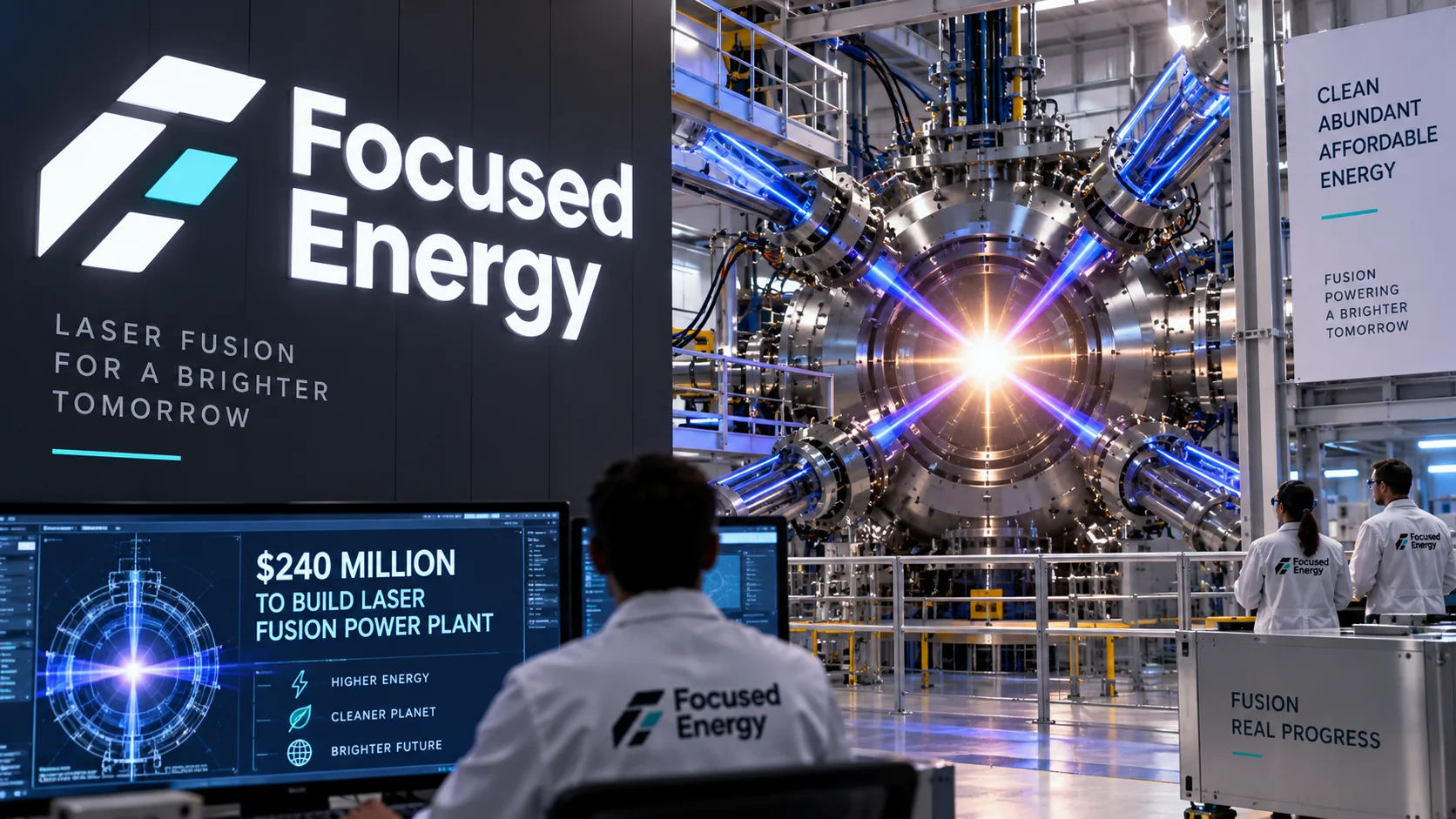
German fusion energy company Focused Energy has raised $240 million in a Series A financing round to accelerate the development of its laser-driven fusion technology and prepare for construction of a planned demonstration power plant in Biblis, Germany. The company says the round is the largest fully secured Series A financing in the global fusion industry to date and makes Focused Energy the most valuable fusion company in Europe.
The oversubscribed financing was led by RWE and includes the German Federal Agency for Breakthrough Innovation (SPRIND), the European Innovation Council Fund and existing investor Prime Movers Lab. The company said investors from Germany, Europe, Asia and the Gulf region participated, including potential future buyers of fusion energy.
$240 Million Round Targets Commercial Fusion
Focused Energy plans to use the new capital to move its laser-fusion technology from research and development toward an industrial-scale energy system. The company is developing an inertial-confinement approach in which powerful laser pulses compress a small fusion fuel target until the conditions needed for nuclear fusion are created.
The technology builds on research associated with the US National Ignition Facility, where scientists demonstrated a controlled fusion reaction that produced more energy from the fusion reaction than the laser energy delivered to the target. That scientific result is different from producing net electricity from a commercial power plant, which remains a major engineering challenge for the industry.
Biblis Site to Host Planned Demonstration Plant
A major part of Focused Energy's plan is the development of its Lighthouse demonstration system at the former RWE nuclear power station site in Biblis, Hesse. The company plans to use existing infrastructure at the decommissioned facility while drawing on RWE's experience in power generation and energy infrastructure.
The planned site is intended to become a foundation for scaling the company's laser-fusion technology and developing the supply chains required for future fusion plants. Focused Energy sees the project as more than a single demonstration facility, with the wider goal of establishing a European industrial base for fusion technology.
Direct-Drive Lasers Aim to Simplify Fusion
Focused Energy's approach uses lasers to directly compress the fusion fuel pellet, a method known as direct drive. The company is working to simplify the fuel targets compared with the more complex targets used at the National Ignition Facility.
That distinction matters because a commercial fusion plant would need to fire its laser system and produce fusion reactions at a vastly higher frequency than today's research facilities. Focused Energy has said its eventual system would need to operate at around 10 shots per second, compared with roughly 400 shots per year at the National Ignition Facility.
The company is also working on ways to manufacture fusion targets at much greater scale. Debbie Callahan, who previously worked on fuel-target design at the National Ignition Facility, joined Focused Energy as chief strategy officer and is involved in developing a simpler target design suitable for industrial production.
RWE and European Investors Back the Expansion
RWE's participation is particularly relevant because the German utility owns the former Biblis nuclear site and can provide experience in power-plant infrastructure. The investment also connects Focused Energy's private funding with Germany's broader push to develop a domestic fusion industry.
SPRIND and the European Innovation Council Fund bring public-sector backing to the project, while Prime Movers Lab provides continuity from the company's earlier financing. Focused Energy has also received substantial government support outside the new equity round. TechCrunch reported that the company had raised $300 million in private capital and received approximately $200 million in grants following the Series A announcement.
The new financing comes at a time when investors are committing increasingly large amounts of capital to fusion startups. Companies are pursuing several competing approaches, including laser fusion, magnetic confinement and other reactor designs, as the industry attempts to turn decades of scientific research into commercially viable energy generation.
Focused Energy Also Spins Out Industrial Technology
The company is not relying entirely on a future fusion power plant to create commercial applications. Following the financing, Focused Energy announced plans to spin out its laser-driven radiation-source activities into a separate company called SourceLight.
SourceLight is intended to commercialise technology that produces high-energy X-rays and neutrons for applications such as nuclear-waste characterisation, security screening and non-destructive testing of industrial components. The move allows Focused Energy to pursue near-term industrial uses of technology developed during its fusion programme.
That strategy could give the company an additional commercial route while its much larger fusion-energy project remains under development. It also reflects the broader effort among fusion startups to turn components and technologies developed for reactors into products for other industries.
The Road to Commercial Fusion Remains Long
The $240 million financing gives Focused Energy significant capital to advance its technology, but it does not mean commercial fusion electricity is now ready for deployment. The company still needs to demonstrate that its laser system, fuel targets, reaction chamber and supporting infrastructure can operate repeatedly and efficiently enough to produce electricity economically. That challenge is considerably different from achieving a single successful fusion reaction. A commercial plant would need to generate repeated reactions, recover energy, convert it into electricity and operate reliably while replacing components exposed to extreme conditions.
Focused Energy is betting that its direct-drive approach and the use of an existing power-generation site can help shorten that path. The Biblis project is expected to serve as a major test of whether the company's laboratory technology can be translated into an industrial system. The $240 million Series A nevertheless represents a significant increase in private capital flowing into fusion development. Focused Energy now has the funding to advance its Biblis project, develop its laser systems and fuel-target technology, and build the industrial supply chain needed for its longer-term power ambitions.