India’s Homegrown Space Firms Take Centre Stage at BSX 2026
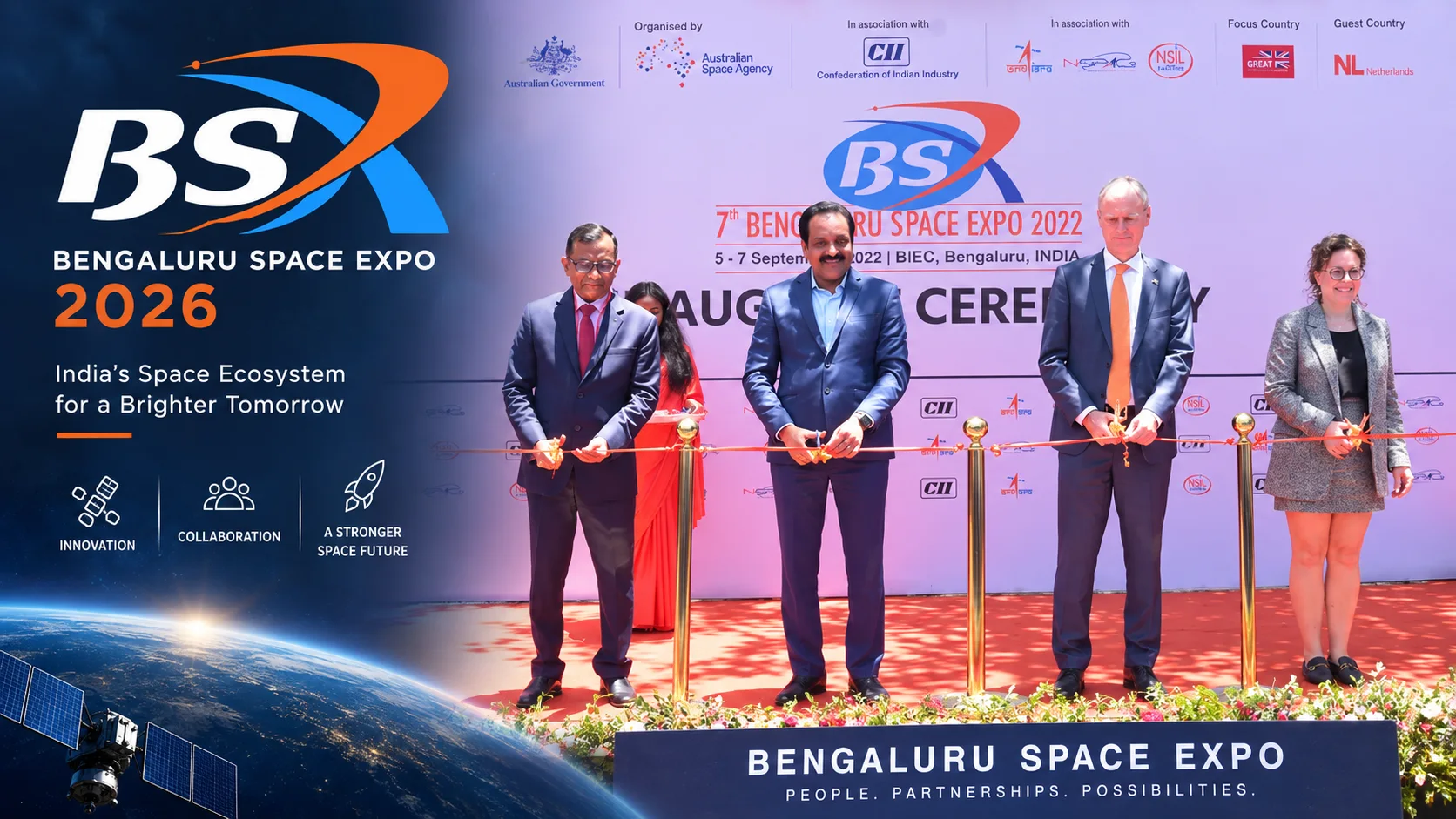
India’s private space companies are taking a prominent role at the ninth Bengaluru Space Expo (BSX 2026), which began on September 7 at the Bangalore International Exhibition Centre. The three-day event, running through September 9, brings together around 250 exhibitors from 20 countries, with Indian startups and established companies showcasing technologies across the space industry.
Organised by the Confederation of Indian Industry (CII) in partnership with the Indian Space Research Organisation (ISRO), IN-SPACe and NewSpace India Limited, BSX 2026 is focused on innovation, policy and commercial growth in the space sector. The event is expected to attract around 12,000 business visitors and 1,000 conference delegates.
India’s private space industry has expanded rapidly since reforms opened the sector to greater private participation in 2020. The BSX exhibition provides companies with a platform to present their technologies to potential customers, investors and international partners.
Indian Space Startups Showcase New Capabilities
Hyderabad-based Dhruva Space is among the prominent Indian companies at this year’s event. The satellite systems company is the title sponsor of BSX 2026 and develops satellite platforms, ground systems and orbital deployment solutions.
Skyroot Aerospace is also participating as a co-sponsor. The Hyderabad-based launch startup is developing its Vikram family of rockets and has already completed a sub-orbital mission with Vikram-S. The company is now working toward orbital launch capabilities and is using the event to engage with satellite operators and other potential customers.
Bengaluru-based Pixxel is showcasing its hyperspectral Earth-observation technology. Its satellites collect data across roughly 200 spectral bands, allowing applications such as monitoring agricultural conditions, identifying mineral resources and detecting environmental changes.
Pixxel's appearance comes shortly after the company raised $100 million in a Series C funding round led by Temasek and Seraphim, taking its total funding to $195 million. The company plans to use the capital to expand its satellite sensing capabilities and Earth-intelligence platform.
GalaxEye Brings Radar and Optical Imaging Together
Bengaluru-based GalaxEye is another Indian space company drawing attention at BSX 2026. The company is developing Earth-observation systems that combine radar and optical imaging.
Its Mission Drishti satellite, launched earlier this year, combines synthetic aperture radar and optical imaging on a single spacecraft. The approach is designed to provide Earth-observation data even when conventional optical cameras are limited by clouds or darkness.
The company is also developing onboard processing capabilities to analyse data closer to where it is collected, potentially reducing the amount of information that needs to be transmitted back to Earth.
Bellatrix Focuses on Orbital Mobility
Bellatrix Aerospace is focusing on another part of the space value chain: moving satellites after launch.
The Bengaluru-based company develops orbital transfer vehicles designed to transport satellites from their initial deployment orbit to their required operational positions. Such systems can give satellite operators greater flexibility when selecting launch services.
Bellatrix is also developing propulsion technologies and has worked on indigenous propulsion systems under government-supported programmes. Its presence at BSX reflects the growing range of private capabilities being developed beyond launch vehicles and satellites.
Astra Microwave Products is also participating as a co-sponsor. The company specialises in radio-frequency and microwave systems used in communications, radar and other aerospace and defence applications.
Smaller Firms Join the Growing Ecosystem
Gorakhpur-based Abyom Spacetech & Defence is among the younger companies looking to establish a presence in India's launch sector. The company is developing reusable launch vehicles and has received support from IN-SPACe.
Its focus on reusable systems reflects the industry's broader effort to reduce launch costs and improve the frequency with which vehicles can be used.
Other Indian companies exhibiting at BSX include firms working on satellite manufacturing, propulsion, Earth observation, communications and space-based data services.
The diversity of companies participating points to a private sector that is no longer limited to launch vehicles and small satellites. Indian businesses are increasingly working across different stages of the space value chain, from manufacturing and propulsion to orbital services and data analytics.
International Partnerships Take a Larger Role
BSX 2026 is also bringing international companies and government representatives to Bengaluru. The event includes dedicated sessions involving the UK, Europe, Japan and Australia, among others, with discussions focused on technology cooperation, commercial opportunities and joint development.
Russia is participating as the event's space agency partner, while international companies are looking at areas including satellite systems, communications, Earth observation and specialised manufacturing.
The international participation comes as India seeks to expand its role in the global commercial space market. The official BSX 2026 figures put India's current space economy at around $8.4 billion and project it could reach $44 billion by 2033.
India's private space ecosystem has also grown to more than 300 startups, according to BSX organisers. Government-backed funding programmes and access to space infrastructure are supporting companies as they move from early-stage development towards commercial operations.
For the companies exhibiting at BSX 2026, the focus now extends beyond demonstrating technology. International customers, investment, manufacturing partnerships and commercial contracts will determine how quickly these businesses can scale. With the exhibition running until September 9, the event is expected to provide a key platform for India's private space sector to build those connections.