Japan Launches MMX Mission to Collect Samples From Mars Moon Phobos
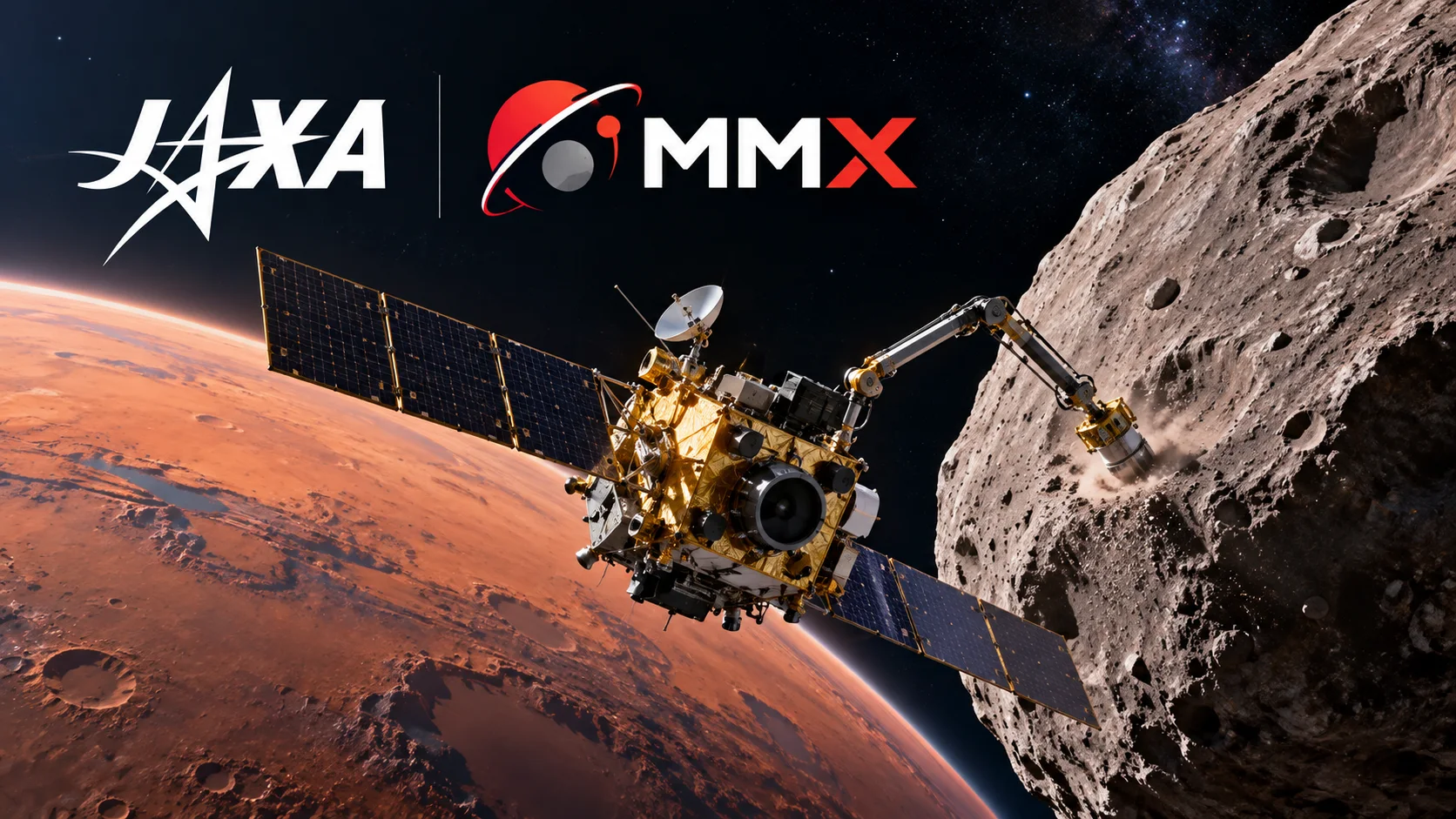
Japan has launched its Martian Moons eXploration (MMX) spacecraft on an H3 rocket, beginning a five-year mission to explore Mars’ moons and return surface samples from Phobos to Earth. Led by the Japan Aerospace Exploration Agency (JAXA), the mission aims to deliver the first samples collected from the Martian system, with the return capsule scheduled to reach Earth in 2031.
The spacecraft lifted off from Tanegashima Space Center on October 20. It will travel to the Mars system, study Phobos and Deimos, and attempt to collect at least 10 grams of material from Phobos. The mission has gained additional importance as NASA continues to face technical and budget challenges in its own effort to return samples collected on Mars.
MMX Targets Phobos for Sample Collection
Phobos is the larger and closer of Mars’ two moons, measuring approximately 22 kilometres across. Scientists are still uncertain whether Phobos and Deimos are captured asteroids or formed from material ejected when a large object struck Mars. Samples from Phobos could help researchers investigate these competing explanations and better understand the evolution of the Martian system.
The MMX spacecraft is expected to reach Mars in 2027 before beginning detailed observations of Phobos. Its instruments will examine the moon’s surface, composition, internal structure and other properties to help scientists select a suitable sampling location.
The mission aims to collect at least 10 grams of surface material during planned landing operations in late 2028 or 2029. After studying the moons, the spacecraft is expected to leave the Mars system in 2030 and return a sample capsule to Earth in 2031.
Idefix Rover Will Scout the Moon’s Surface
A key component of the mission is Idefix, a small four-wheeled rover developed jointly by France’s CNES and Germany’s DLR. The rover is designed to separate from the main spacecraft and explore Phobos at close range, helping researchers understand the surface conditions before the main lander attempts sample collection.
Phobos presents unusual engineering challenges because its gravity is extremely weak and its surface terrain is not fully understood. Idefix will examine the ground and help identify areas that are safer for the sampling spacecraft to approach. Its observations will also provide information about the physical properties of the moon’s surface.
The mission builds on Japan’s experience with asteroid sample-return projects, including Hayabusa and Hayabusa2. However, operating around Mars and landing on one of its moons introduces different navigation, communication and surface-operation challenges.
NASA’s Sample-Return Challenges Add to MMX’s Importance
NASA’s Perseverance rover has collected rock and soil samples directly from Mars, but returning those samples to Earth has proved difficult to fund and organise. The proposed Mars Sample Return programme has faced substantial cost and schedule challenges, leaving its future implementation uncertain.
MMX has a different scientific objective: it will collect material from Phobos rather than directly from the Martian surface. Scientists believe the samples may contain clues about the moon’s origin and could potentially include material ejected from Mars by ancient impacts. The mission therefore offers a separate way to investigate the planet’s history, although it cannot replace the samples collected by Perseverance.
The international mission includes contributions from NASA and European space agencies. Its results could help researchers refine theories about the formation of Mars’ moons and improve technologies needed for future planetary exploration.
For Japan, the launch marks the beginning of a demanding round-trip journey beyond Earth orbit. The mission’s major milestones will be reaching Mars, safely exploring Phobos, collecting the planned samples and returning them to Earth in 2031.