
JD.com Plans to Deploy 3 Million Robots in Five-Year Logistics Push
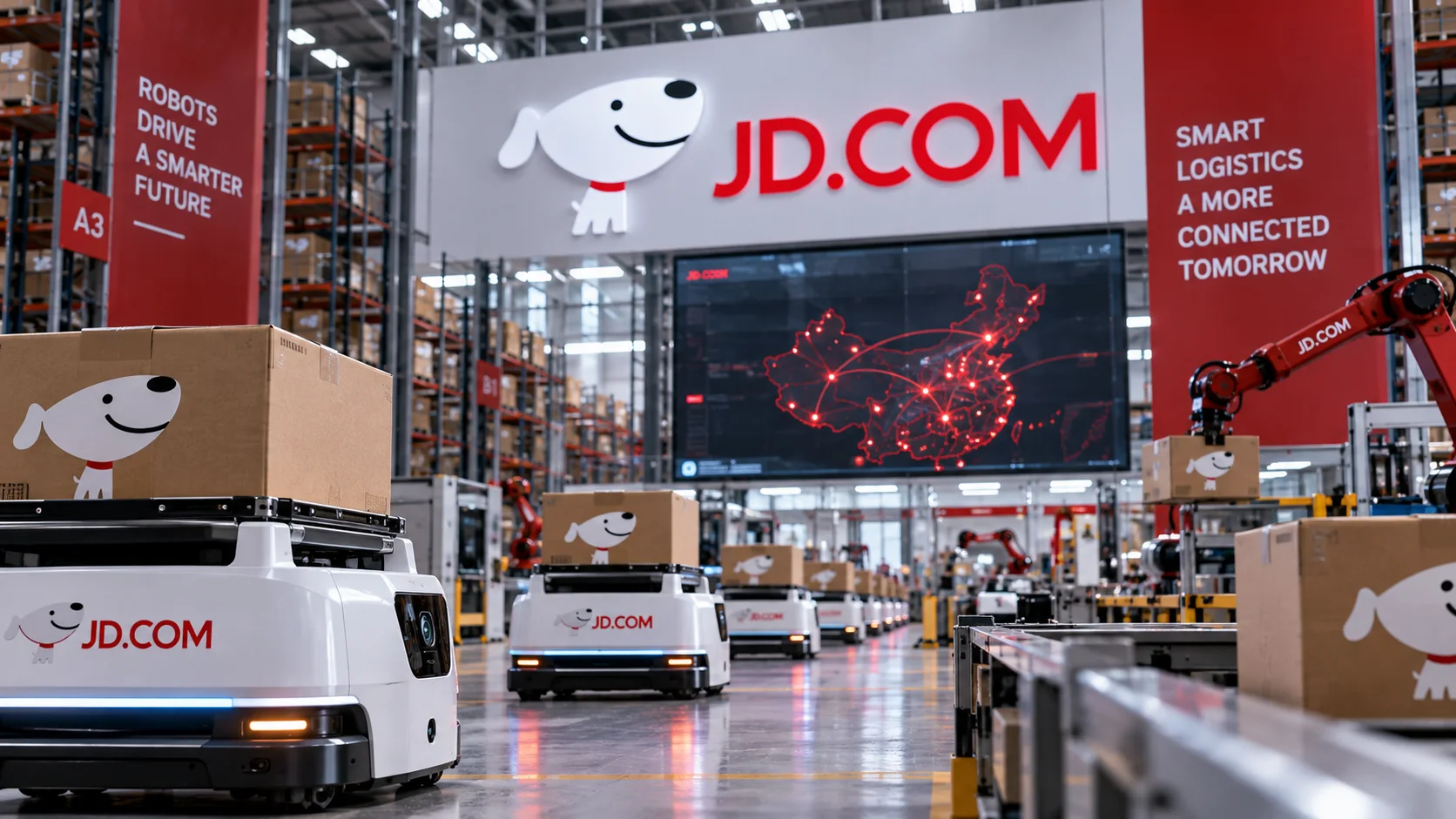
Chinese e-commerce giant JD.com is planning one of the largest commercial robotics deployments announced to date, with its logistics arm set to procure 3 million robots, 1 million autonomous vehicles and 100,000 delivery drones over the next five years. The company unveiled the plan on September 9 as part of a broader push to automate its logistics operations and develop physical AI systems.
The robots will be used across different stages of the supply chain, including picking, sorting, transportation and delivery. JD Logistics is also introducing its industrial Wolf Robot series, with specialized machines designed for tasks ranging from warehouse operations to work in temperatures as low as -20°C.
JD Targets End-to-End Logistics Automation
JD Logistics wants the new fleet to cover a much larger portion of its logistics operations with minimal human intervention. The planned deployment includes ground robots, autonomous vehicles and drones, giving the company several forms of automated transportation depending on the location and type of delivery.
The scale is significant even by the standards of China's rapidly expanding robotics industry. JD's logistics network already uses thousands of autonomous vehicles across more than 20 provinces, while more than 100 drone delivery routes are currently operating in China.
Wolf Robots Expand Beyond Warehouses
JD Logistics unveiled several systems under its Wolf Robot family as part of the expansion. The lineup includes robots for warehouse operations, low-temperature environments, intelligent delivery vehicles, logistics drones and dexterous robotic arms.
The company says these machines are being designed to handle repetitive and labour-intensive work while operating in environments where continuous human involvement can be difficult. Some systems are intended for specialized uses, including automated pharmaceutical dispatch and cold-environment logistics.
JD's existing logistics automation already includes the LangzuTech robotic arm, which uses the company's Metabrain large model to process sensor information and handle parcels with different shapes. The system operates around the clock at multiple logistics parks.
JD Plans 80 Robotics Hubs
The robotics expansion is not limited to purchasing machines. JD also plans to establish 80 RoboBase robotics industry hubs across China over the next five years as part of its Physical AI Acceleration Plan.
The company intends to use its logistics network as a large-scale source of real-world robotics data. JD plans to collect more than 10 million hours of real-world interaction data to help train and improve physical AI systems, connecting robot deployment with the development of increasingly capable embodied-intelligence models.
JD is also working with Chinese chipmaker Moore Threads on computing infrastructure for its robotics push. Reports say the companies plan to build large domestic-chip computing clusters to support the company's physical AI development.
Automation Raises Questions About Jobs
The scale of JD's automation programme could have a major effect on its workforce. JD and companies within its logistics ecosystem employ roughly 700,000 delivery and logistics workers, making workforce transition a significant issue as more tasks become automated.
JD founder Liu Qiangdong has previously said the company does not want automation to simply eliminate frontline jobs. Under its so-called Nirvana Plan, JD has been sending couriers, warehouse workers and other frontline employees for technical training so they can move into positions such as robot maintenance and servicing. The company has already trained some frontline workers as robot repair engineers.
Physical AI Becomes a Core Focus
JD's strategy goes beyond replacing individual human tasks with machines. The company is positioning its logistics network as a real-world testing ground for physical AI, where robots can continuously collect operational data and improve their ability to navigate physical environments.
That approach could give JD an advantage in developing robots for logistics because the company controls a large network of warehouses, vehicles, delivery stations and distribution operations. Its existing infrastructure provides both deployment locations and real-world data that robotics developers typically have to obtain through smaller pilot programmes.
JD's plan also reflects a wider shift in China's AI strategy toward embodied intelligence. While generative AI systems operate primarily in digital environments, physical AI connects AI models with robots capable of sensing, moving and manipulating objects in the real world.
The company is now targeting a massive expansion of that model. If JD follows through on the five-year procurement plan, millions of robotic systems could eventually become part of its logistics infrastructure, while the accompanying data and computing investments could help build a broader physical AI ecosystem.
The biggest test will be whether JD can deploy such a large fleet economically and reliably. Scaling from thousands of autonomous machines already operating in specific regions to millions of robots, vehicles and drones will require major investments in manufacturing, maintenance, software, connectivity and human oversight.