Kioxia Profit Forecast Jumps 24-Fold on AI Data-Centre Demand
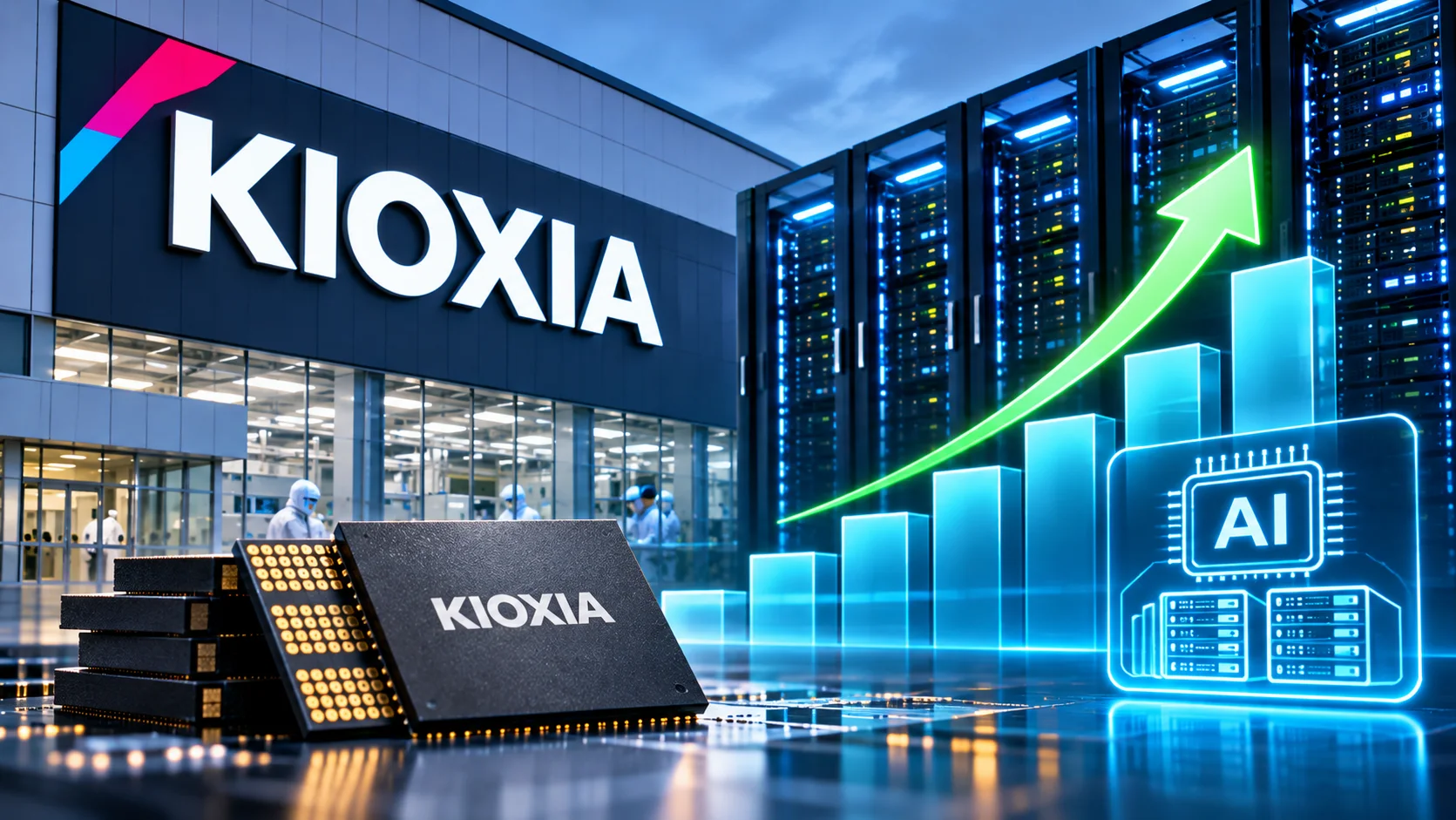
Japanese memory maker Kioxia Holdings expects net profit of ¥3.56 trillion for the nine months from April to December 2026, around 24 times its result for the same period a year earlier. The Kioxia profit forecast reflects a sharp rise in demand for NAND flash memory used in data centres, as AI companies expand the storage capacity needed to train and run large models.
The company also projects revenue of approximately ¥6.75 trillion for the nine-month period, about five times the year-earlier figure and a record for the period. The outlook underlines how investment in AI infrastructure is benefiting suppliers beyond manufacturers of graphics processing units and high-bandwidth memory.
Kioxia Profit Forecast Reflects AI Storage Demand
Kioxia reported net profit of ¥2.20 trillion on revenue of ¥4.25 trillion for the six months through September. For the October-December quarter, it expects net profit of about ¥1.36 trillion. The projected nine-month result combines the reported first-half performance with the company's third-quarter outlook.
The main driver is demand for data-centre storage. AI workloads require substantial volumes of data to be stored, accessed and processed, increasing the need for NAND flash memory and solid-state drives. Kioxia has said that demand from data centres is expanding as AI use spreads, while demand for memory used in smartphones and personal computers remains comparatively weak.
NAND Flash Moves Further Into the AI Infrastructure Supply Chain
The growth highlights a part of the AI supply chain that receives less attention than advanced processors. GPUs perform much of the computation involved in AI training and inference, but large-scale systems also depend on storage that can hold datasets, model parameters and the information generated during operation.
NAND flash is used in solid-state drives across servers and data-centre systems. As operators add AI computing capacity, storage demand can rise alongside spending on processors, networking equipment and power infrastructure. Kioxia's results show how that expansion is flowing through to memory suppliers.
Strong Earnings Come With Signs of a Changing Market
The outlook is exceptionally strong, but the market is not without risks. Bloomberg reported that Kioxia's operating-profit guidance for the October-December quarter fell short of analyst estimates and that the pace of NAND price increases had slowed from the previous quarter. That suggests the latest profit surge does not guarantee the same rate of growth will continue.
Memory is a cyclical business. If manufacturers expand production in response to high prices, additional capacity could eventually ease shortages and put pressure on margins. Kioxia's future performance will therefore depend on whether AI-related storage demand continues to grow quickly enough to absorb new supply.
The forecast illustrates the financial impact of AI data-centre investment on the storage market. It also shows why memory capacity, pricing and manufacturing expansion are becoming important indicators of the wider AI infrastructure cycle.