Microsoft Exits Nscale’s UK AI Data Centre Deal Over Power Delays
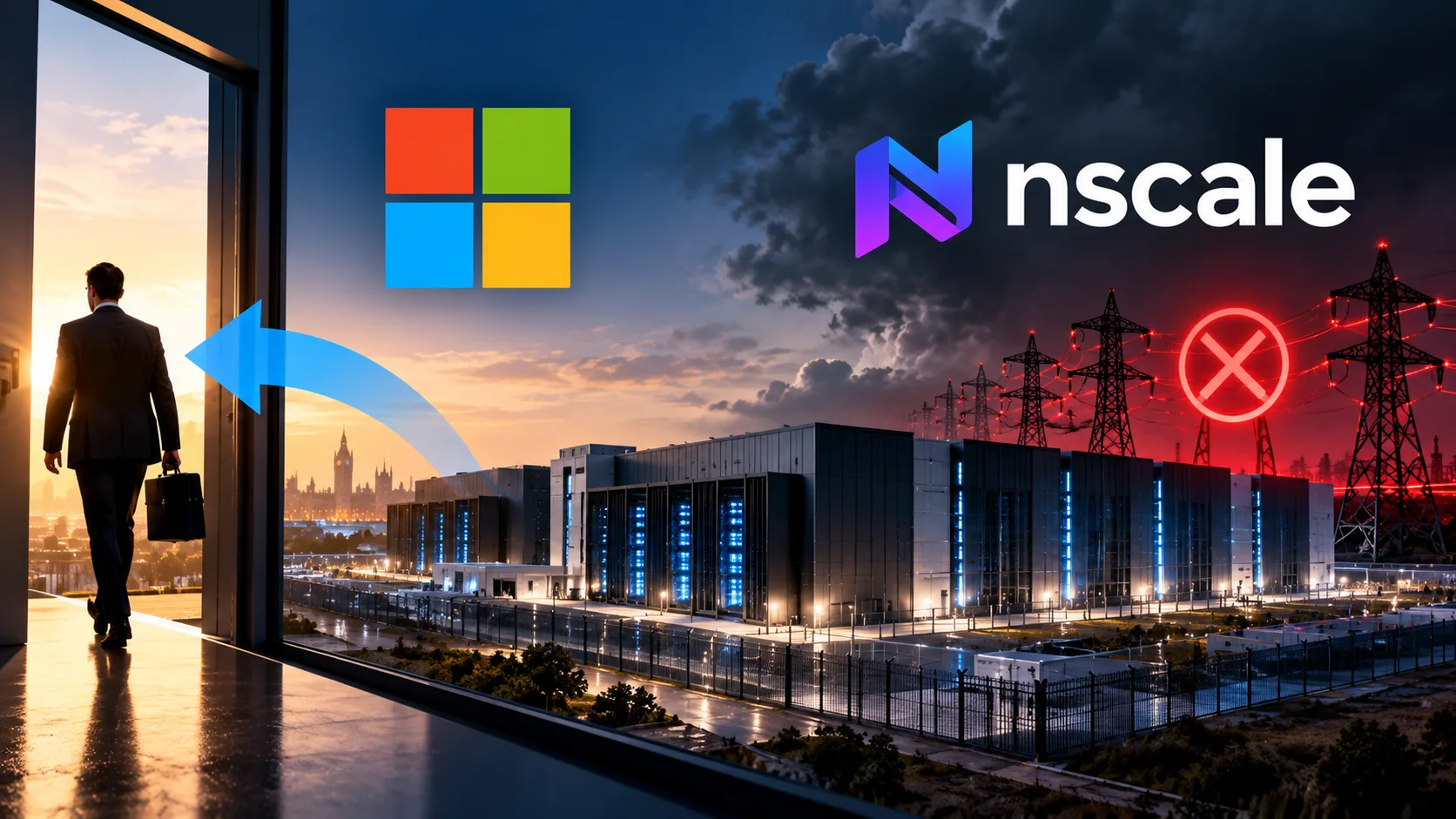
Microsoft has withdrawn from an agreement to lease computing capacity at British AI infrastructure provider Nscale’s planned data centre in Loughton, Essex, after delays to the site’s electricity connection threatened its operational timeline. The development highlights a growing constraint on AI infrastructure expansion: securing enough reliable power to bring planned computing capacity online.
The facility was intended to support Microsoft Azure services and house around 23,000 Nvidia GB300 graphics processing units (GPUs). However, electricity suppliers reportedly indicated that the required grid connection might not be available until the 2030s, far beyond the project’s original schedule.
Microsoft’s decision affects the Loughton site specifically. The company has said it remains committed to its broader partnership with Nscale, while the British provider says it is still pursuing the project and exploring alternative power sources.
Grid Delays Undermine the Project Timeline
The Loughton development was positioned as a major part of the UK’s ambitions to expand domestic AI computing infrastructure. Its planned initial capacity was 50 megawatts, with scope to expand to 90 megawatts. Microsoft was expected to become its anchor customer, providing a major source of demand for the facility’s computing resources.
But data centres cannot deliver AI services simply because buildings, servers and financing are available. They require substantial, dependable electricity to power processors, cooling systems and supporting equipment. When grid connections are delayed, operators may be unable to deliver contracted capacity when customers need it.
In this case, the reported prospect of waiting until the 2030s for sufficient grid power created a significant mismatch between the site’s expected availability and Microsoft’s operational requirements. The withdrawal shows how electricity access can become a decisive factor in AI infrastructure contracts.
Nscale Explores Alternative Power Sources
Nscale has said it remains committed to the Loughton project and the UK market. The company is exploring alternative power sources for the site while also considering other expansion locations in the country.
Alternative generation could help data centre developers reduce their dependence on delayed grid connections. However, any solution would need to provide enough capacity and reliability for energy-intensive AI workloads, while meeting relevant regulatory, technical and commercial requirements. The availability, cost and implementation timeline of alternative power will therefore influence whether the Loughton project can proceed on a revised schedule.
Microsoft’s exit also creates a commercial challenge for Nscale. Anchor customers can help justify the large upfront costs of data centre construction, computing equipment and energy infrastructure. Losing a major customer for a particular site can complicate plans to secure replacement demand and generate revenue from the planned capacity.
Electricity Is Becoming an AI Infrastructure Bottleneck
The setback illustrates a broader issue facing the AI industry. Companies are investing heavily in advanced chips and cloud infrastructure, but the physical systems required to operate them cannot always expand at the same pace. Electricity supply, grid connections, cooling and construction timelines can all determine when announced computing capacity becomes commercially usable.
For cloud providers, a delayed facility can disrupt capacity planning and force them to rely on other infrastructure. For specialist AI infrastructure companies such as Nscale, delays can also create financial pressure because major projects require substantial spending before they begin generating revenue.
The immediate question is whether Nscale can find a viable power solution and secure replacement demand for Loughton. More broadly, the case shows that the next phase of AI expansion will depend not only on chips and investment, but also on whether electricity infrastructure can keep pace with the industry’s ambitions.