
NASA Funds Spacecraft Concept to Map Minerals Across Other Worlds
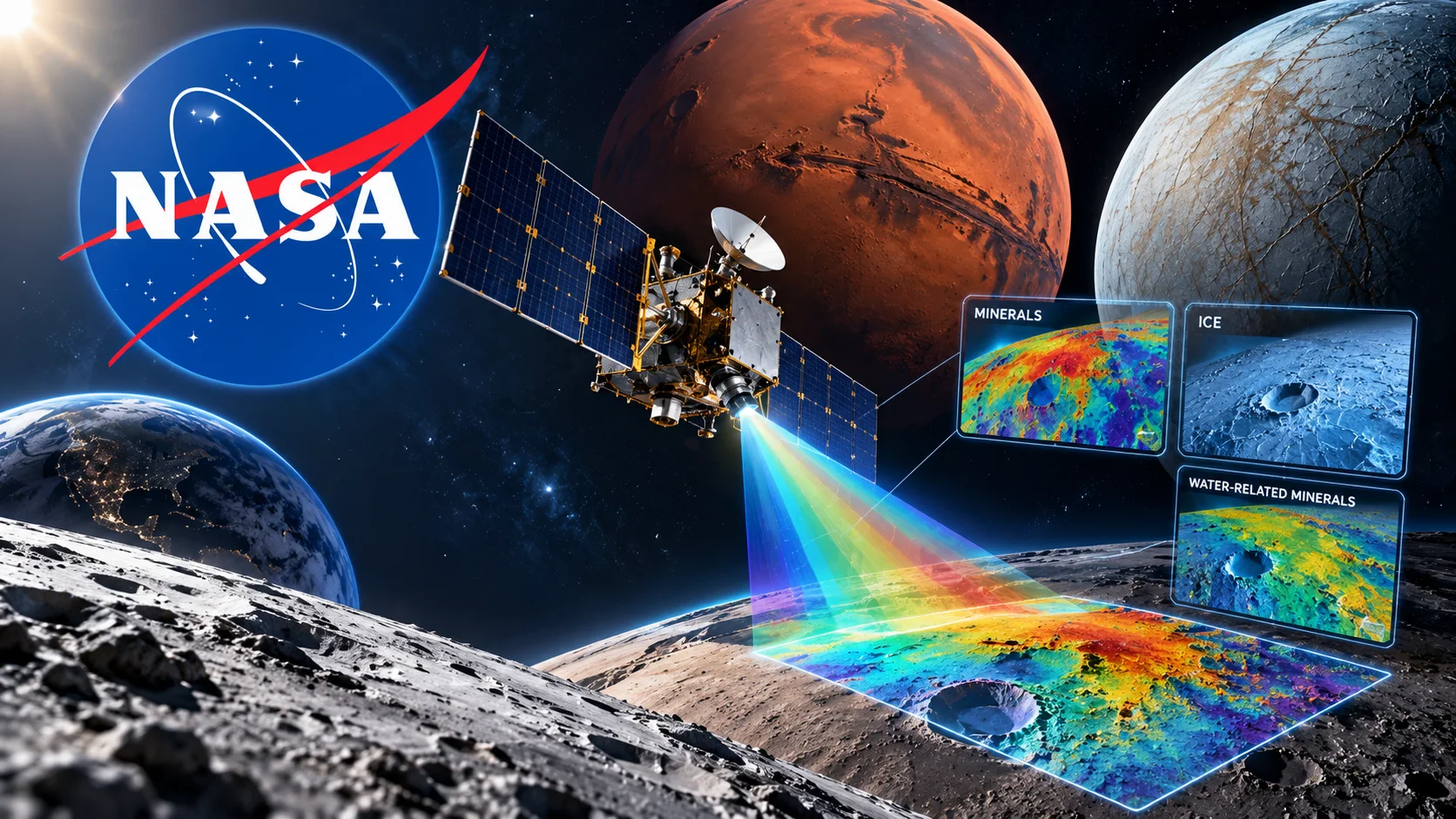
NASA has funded an early-stage spacecraft concept designed to map minerals across multiple worlds in the solar system without requiring a landing. The concept, called Interworld Slingshot Resource Surveys, would use a small reconnaissance spacecraft equipped with Raman spectroscopy to study the composition of planetary surfaces during high-speed flybys.
The proposed system could eventually be used to survey the Moon, asteroids and the moons of Mars, including Phobos and Deimos. Rather than sending a dedicated spacecraft to orbit or land at every target, the concept aims to gather mineral information as the spacecraft passes by different objects.
NASA's funding comes through its Innovative Advanced Concepts programme, which supports early-stage technologies that could enable new approaches to future space missions. The project remains at the concept-development stage and is not an approved operational mission.
One Spacecraft, Multiple Resource Surveys
The Interworld Slingshot concept is based on a relatively small spacecraft of around 300 kilograms. Its primary instrument would use Raman spectroscopy to identify minerals by analysing how laser light interacts with materials on a planetary surface.
The spacecraft would make high-speed flybys and attempt to collect useful compositional information from distances of tens of kilometres. That would allow it to move between targets instead of remaining at a single destination for an extended period.
The approach could be particularly useful for preliminary resource surveys. A spacecraft could identify potentially valuable materials first, helping scientists and mission planners decide which locations deserve more detailed investigation by orbiters, landers or rovers.
Moon, Asteroids and Mars' Moons Among Potential Targets
The Moon is one of the key potential targets for the technology. The system could search for resources such as water ice and ilmenite, materials that are relevant to future lunar exploration and possible in-situ resource utilisation.
Asteroids could also be surveyed for their mineral composition without requiring a spacecraft to land. The same technology could potentially be used around Phobos and Deimos, the two small moons of Mars.
The ability to conduct reconnaissance across several destinations could reduce the need to design a separate resource-mapping mission for every target. It could also give future missions more information before they commit to expensive and technically demanding surface operations.
Raman Spectroscopy Could Enable Faster Reconnaissance
Raman spectroscopy is central to the concept because it can provide information about the chemical and mineral composition of materials. The challenge is whether the technique can deliver sufficiently useful measurements from tens of kilometres away while the spacecraft is travelling at high speed.
That is one of the questions NASA's early-stage study is intended to address. The concept is being developed as a possible new class of planetary reconnaissance mission rather than as a spacecraft that is ready for launch.
If the technology proves practical, it could change how future planetary resource surveys are planned. Instead of committing an entire mission to one destination, a single spacecraft could potentially conduct reconnaissance across several worlds during successive flybys.
NASA's latest investment therefore focuses on an early technology rather than an immediate mission. But if Interworld Slingshot moves beyond the concept stage, it could give future explorers a faster way to determine what materials are present across the Moon, asteroids and Mars' moons before sending more complex missions to the surface.