
NASA’s Swift Mission Gets New Robotic Servicing Test as LINK Nears Observatory
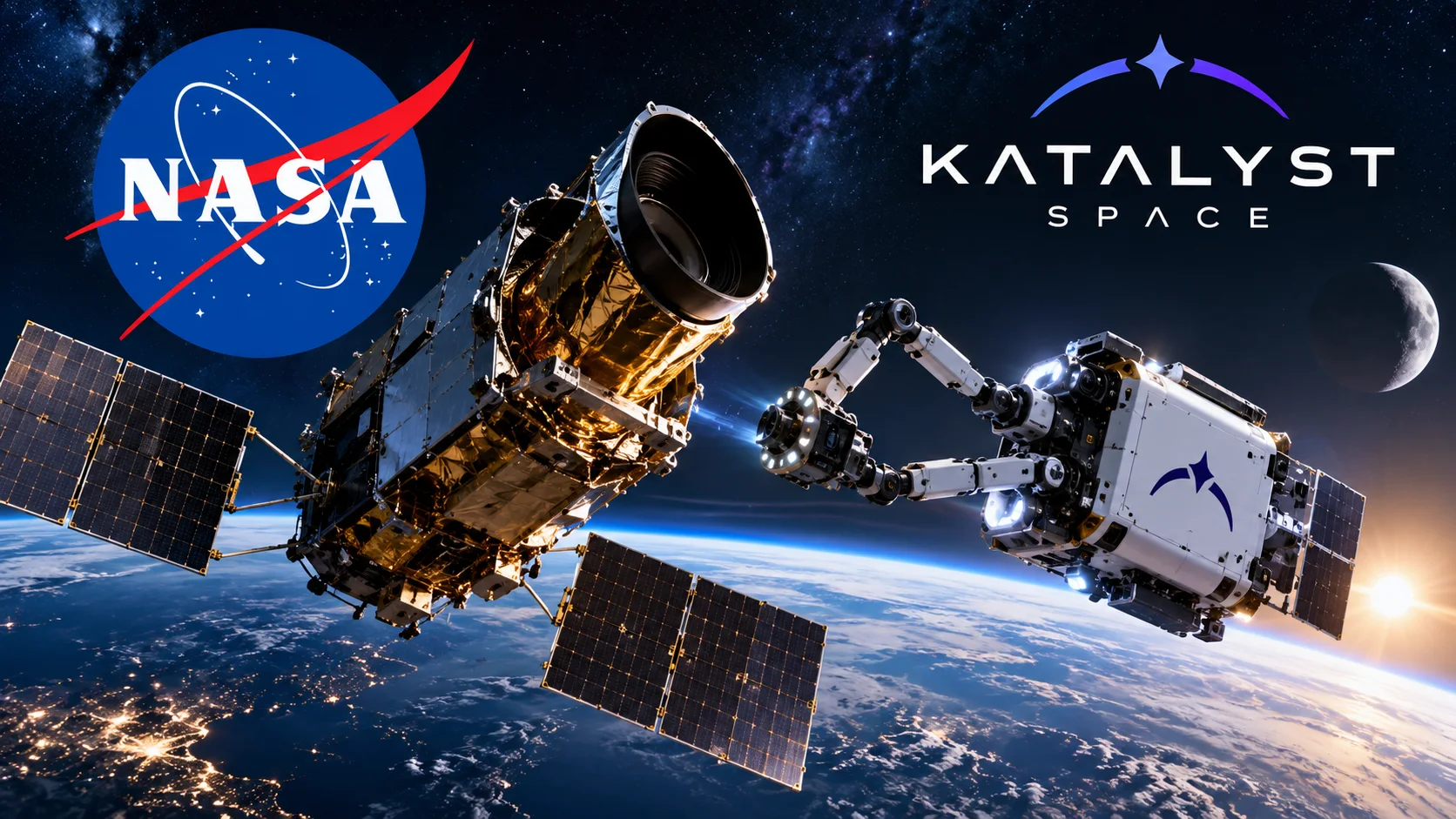
A commercial spacecraft originally sent to raise the orbit of NASA’s Neil Gehrels Swift Observatory is now being used for a different purpose: testing robotic satellite-servicing technologies in space. Katalyst Space conducted a series of in-orbit maneuvers this week with its LINK robotic servicing spacecraft, including orbital adjustments that brought it within 7.5 to 9 miles (12 to 15 kilometers) of NASA’s Swift observatory. The spacecraft will not make a closer approach to Swift, but the tests are allowing the company to gather real-world data on systems that could eventually be used to service satellites in orbit.
LINK tests its robotic systems in orbit
During the latest operations, Katalyst raised LINK’s orbit and adjusted its trajectory to align with Swift’s path. The spacecraft also deployed all three of its robotic arms and simultaneously fired its three electric propulsion thrusters. These are important demonstrations for a spacecraft designed to perform work around other satellites. Rather than simply observing another spacecraft from a distance, future servicing vehicles could potentially approach, inspect, maneuver around and interact with satellites that were never designed to be serviced after launch. The current tests are therefore being used to collect operational data that can help shape future in-space servicing technology.
The original Swift orbit boost was cancelled
The latest demonstration is a change from the mission Katalyst originally planned. NASA contracted Katalyst Space in September 2025 to build and launch LINK, rendezvous with Swift, capture the observatory and raise it to a higher orbit. Swift had been losing altitude faster than expected because atmospheric drag was increased by recent solar activity.
LINK launched in July aboard a Northrop Grumman Pegasus rocket. Later that month, the spacecraft developed problems with its ability to control its orientation. NASA and Katalyst announced on August 19 that LINK would no longer attempt to capture and boost Swift. Instead, the companies decided to continue the mission as a technology demonstration, allowing LINK to attempt rendezvous and proximity operations without making physical contact with the observatory.
Swift has returned to science operations
While LINK's mission changed, NASA’s Swift observatory has returned to much of its scientific work. The satellite switched its Ultraviolet/Optical Telescope and X-ray Telescope back on August 26 after they had been temporarily shut down earlier in the year to reduce atmospheric drag and preserve the spacecraft for the planned orbit-boost effort. NASA said its Burst Alert Telescope was also expected to return to data collection. Swift has spent more than two decades studying gamma-ray bursts and other cosmic events. Its ability to rapidly observe short-lived events across different wavelengths has made it an important tool for astronomers studying some of the universe’s most energetic phenomena.
A test for future satellite servicing
The LINK demonstration comes as robotic servicing becomes a growing part of the commercial space industry. Satellites can remain useful for years, but their missions can be limited by problems such as orbital decay, fuel shortages or equipment failures. A successful servicing spacecraft could eventually help operators inspect, repair, reposition or extend the lives of satellites without bringing them back to Earth.
Katalyst estimates that LINK will remain in orbit for another two to three weeks before deorbiting. Although the spacecraft will not deliver the planned boost to Swift, its final operations are giving engineers an opportunity to test robotic arms, propulsion, orbital maneuvering and rendezvous procedures in the environment where future servicing missions will actually operate. For NASA, the outcome also leaves Swift on a different path. The observatory is expected to continue descending as atmospheric drag takes its toll, while the data gathered from LINK can potentially contribute to future efforts to work on satellites already in orbit.