NEURA Robotics and SECO Partner to Build Robot Compute Modules in Europe
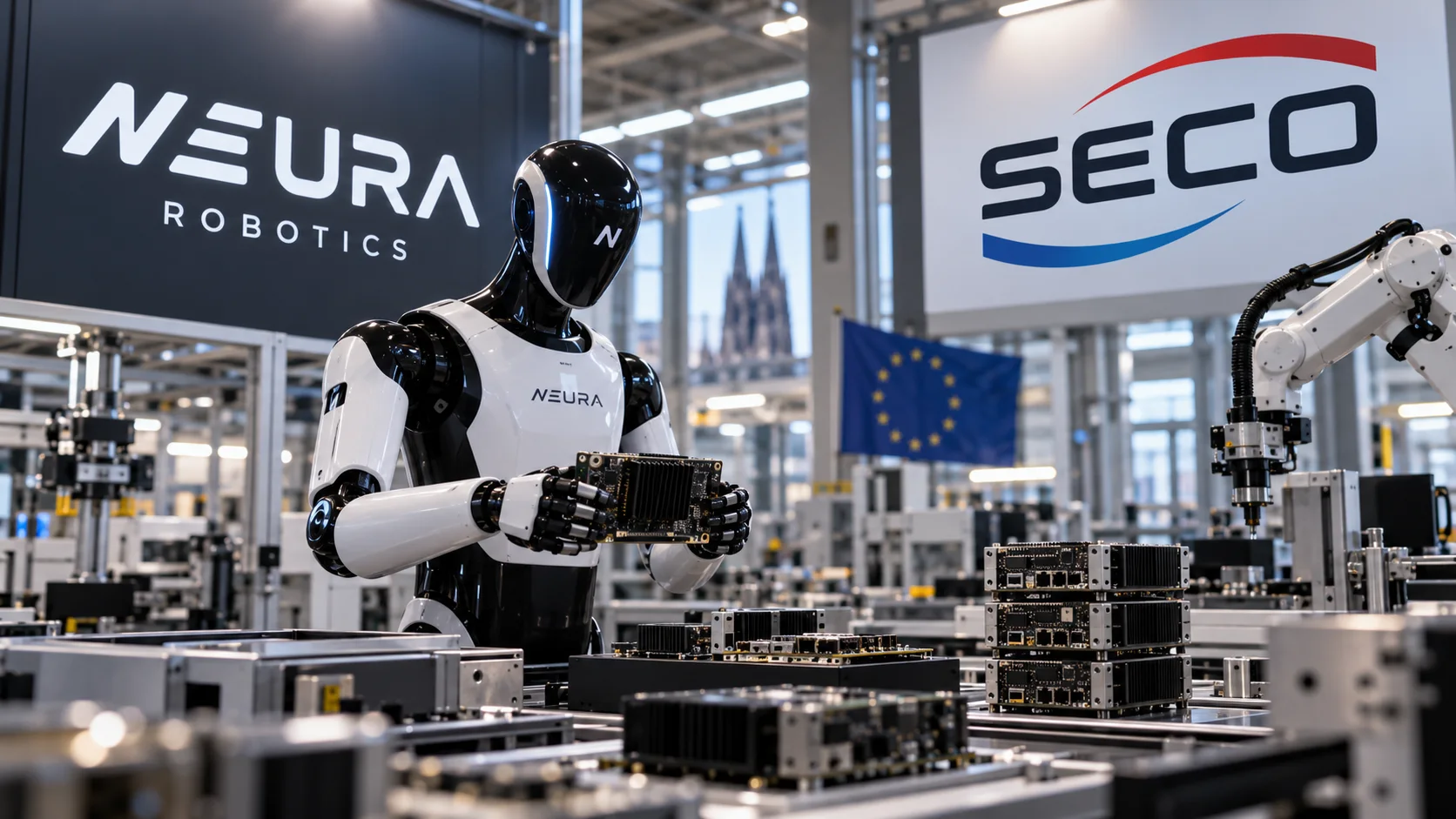
NEURA Robotics and Italian embedded-computing company SECO have formed a strategic partnership to develop and manufacture compute modules for NEURA’s cognitive robots, including its 4NE1 humanoid. The hardware will be engineered and produced in Europe, giving NEURA a regional manufacturing partner as it works to scale its Physical AI platform.
The partnership covers the design, engineering and industrialisation of electronic computing modules that will sit inside NEURA robots. The modules will use Qualcomm Dragonwing Robotics processors, while SECO will provide the embedded-computing expertise needed to turn those processors into production-ready hardware.
Compute Moves Closer to the Robot
NEURA is building its robots around a distributed computing architecture rather than relying on a single central processing unit. The company describes this approach as a “Brain + Nervous System” architecture, with sensing and computing capabilities distributed throughout the machine.
That includes placing intelligence closer to joints, sensors and other points where robots interact with their surroundings. The goal is to reduce the delay between sensing an environment and responding to it, which is particularly important for robots expected to work alongside people.
SECO's role is to engineer the corresponding compute modules and prepare them for scalable production. The company already works with Qualcomm on embedded computing platforms based on its Dragonwing processors.
For NEURA, the arrangement provides a dedicated European partner for a critical component of its robotic systems as the company moves from individual robot development toward larger-scale deployment.
4NE1 Is a Major Target
The partnership includes NEURA's 4NE1 humanoid robot, which the German company is developing for industrial and other real-world applications.
4NE1 is part of NEURA's broader cognitive robotics platform, which combines robotics hardware, artificial intelligence, sensors and edge computing. The company says its robots are designed to perceive their surroundings, learn from interaction and operate alongside humans.
NEURA announced a Series C financing of up to $1.4 billion in June 2026 to accelerate its Physical AI platform. The company has been positioning its technology around a broader ecosystem called Neuraverse, where robots can continuously learn from real-world operation.
The SECO partnership addresses one part of that strategy: the underlying computing hardware required to run AI directly on the robots.
Europe Wants More Physical AI Manufacturing
The companies are also using the partnership to strengthen Europe's position in Physical AI, a field that combines artificial intelligence with machines capable of sensing and acting in the physical world.
Europe already has established capabilities in industrial automation, robotics, electronics and manufacturing. However, many critical computing components used by advanced AI systems are produced outside the region.
NEURA and SECO say manufacturing their robot compute hardware in Europe will add another link to a European supply chain for Physical AI. The processors themselves are supplied by Qualcomm, meaning the partnership does not make the complete computing stack European-made.
The arrangement nevertheless gives NEURA greater regional control over the engineering and manufacturing of its custom robotic computing hardware.
Partnership Extends Beyond Robot Hardware
The companies plan to expand their collaboration beyond the compute modules themselves. One planned initiative is a NEURA Gym in Italy, which will become the company's first training hub in Southern Europe.
NEURA and SECO also intend to collect real-world production data as NEURA robots are deployed in industrial environments. That data could then be used to develop Physical AI systems for increasingly complex manufacturing tasks.
Semiconductor and electronics manufacturing is a particular area of interest. The companies want to use real production environments to train intelligent machines and develop automation systems that can eventually be deployed across industrial facilities.
The approach connects robot hardware, AI training and industrial data rather than treating robotics as a standalone machine-building exercise.
For SECO, the agreement expands its role in edge AI and embedded computing into humanoid and cognitive robotics. For NEURA, it provides a European manufacturing relationship for a core part of its Physical AI architecture as the company prepares to scale its robots.