NextDC Power Delays Wipe 41.7% Off Its Market Value
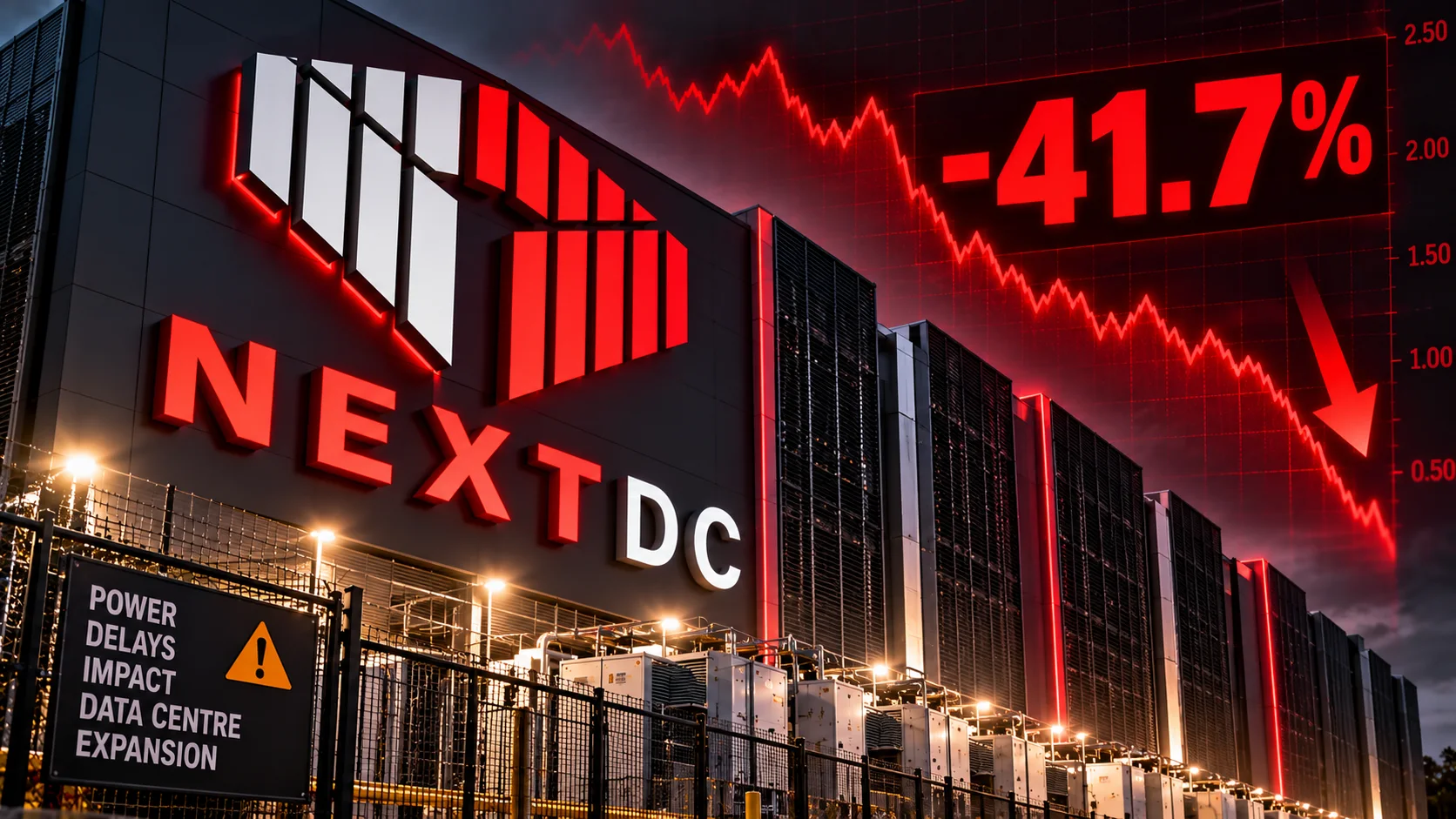
Australian data-centre operator NextDC lost 41.7% of its market value on October 21 after delays to electricity-network upgrades at its Melbourne facility forced the company to cut its financial outlook and pause future expansion plans.
The sell-off erased about A$3 billion from the company’s market capitalisation, marking its worst trading day since its 2010 listing. The immediate problem is a delay in getting enough electricity to its M3 Melbourne data centre, which has pushed back the delivery and billing of contracted customer capacity.
NextDC said about A$140 million in contracted revenue would be deferred during the current financial year. The setback highlights a growing challenge for data-centre operators: securing customers and financing facilities is not enough if the power infrastructure needed to run them is not ready.
NextDC Power Delays Force Financial Outlook Cut
NextDC lowered its financial outlook for the year ending June 2027 after the delays affected its ability to bring additional capacity online at M3 Melbourne.
The company now expects net revenue of A$475 million to A$500 million, down from its previous forecast of A$615 million to A$640 million. Its underlying earnings before interest, taxes, depreciation and amortisation (EBITDA) forecast has also fallen to A$245 million–A$265 million, compared with the earlier range of A$385 million–A$410 million. Both revised forecasts exclude the affected M3 contracts.
The next increase in electricity supply to the facility is now expected in the 2028 financial year. The delays stem from work by Jemena Electricity Networks, which suspended parts of the required network upgrades following opposition from community members and other stakeholders.
Expansion Plans Put on Hold
NextDC has put all new development projects and land acquisitions on hold for the foreseeable future as it prioritises capacity for customers already under contract.
The company has also reduced its capital expenditure forecast for the 2027 financial year to A$4.5 billion–A$5 billion, from A$5.25 billion–A$5.75 billion. Its board is reviewing spending plans and will consider selling selected development sites that are not required in the near term.
Planning approvals for further stages of the Melbourne facility have also faced delays, with decisions expected after Victoria’s November 28 state election. Together, the power-supply and planning setbacks could push the site’s later capacity stages back by several years.
Power Access Becomes a Data-Centre Bottleneck
The NextDC setback shows how electricity availability can affect the economics of large data-centre projects. Operators need substantial, reliable power to support the servers and networking equipment used for cloud computing and AI workloads.
When grid upgrades fall behind schedule, operators can face delays in delivering contracted capacity and recognising revenue. The consequences can extend to construction schedules, capital spending and investor confidence.
NextDC’s difficulties also come as investors scrutinise the cost of building AI infrastructure, including electricity, land and computing equipment. However, the company’s immediate guidance cut is tied to the Melbourne project’s power and planning delays, rather than a confirmed collapse in demand for data-centre services.
The company plans to present initial findings from its capital-spending review at its November 20 investor meeting. Until power supply and approvals become clearer, its expansion plans remain constrained by infrastructure timelines beyond its direct control.