OpenAI Acquires Orchestra Bio to Expand Drug Development AI
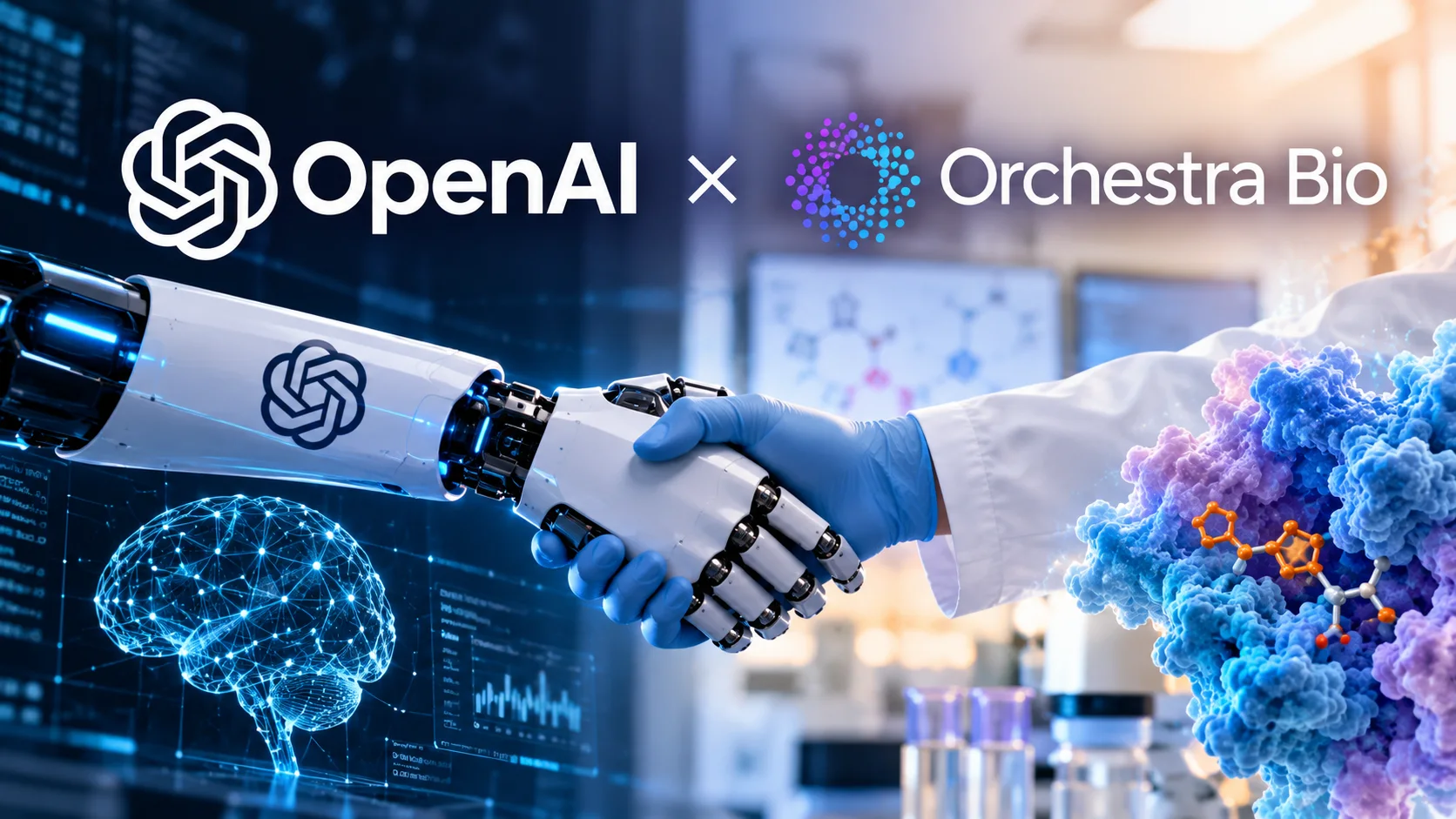
The Orchestra Bio acquisition expands OpenAI’s work in life sciences by adding software designed to help biotechnology companies coordinate drug development. The deal brings Orchestra Bio’s team and technology into OpenAI’s Rosalind research tools, extending its focus beyond scientific analysis to the operational work required to advance potential medicines.
Announced on October 20, 2026, the acquisition brings together OpenAI’s AI models for biology and chemistry with Orchestra’s platform for tracking drug programmes, studies and development timelines. Financial terms were not disclosed.
Orchestra Bio develops AI agents that help biopharma teams monitor research activities, identify scheduling problems and assess how disruptions in one part of a programme could affect other work.
How the Orchestra Bio Acquisition Expands Rosalind
OpenAI’s Rosalind tools are designed to help life-sciences researchers investigate scientific questions, analyse results and plan experiments. Orchestra adds a different capability: coordinating the work that takes a drug programme through multiple stages of development.
For example, a manufacturing problem can delay the supply of a medicine needed for a clinical trial. Orchestra’s agents can help identify affected activities, gather relevant information and compare possible responses, leaving scientists and programme leaders to make the decisions.
The integration could help connect scientific findings with the operational steps needed to advance a potential treatment. However, OpenAI has not announced a completed product that automatically manages every stage of drug development. The company’s stated aim is to build agents that connect research insights with studies, decisions and subsequent actions.
Why Drug Development Needs Operational Coordination
Developing a medicine involves more than identifying a promising biological target. Research teams must coordinate experiments, manufacturing, clinical studies, budgets and external partners, often using separate systems.
OpenAI estimates that developing a new medicine in the United States takes roughly 10 to 15 years from target discovery to regulatory approval. Delays in one area can affect the wider programme, making planning and information sharing important alongside scientific research.
Orchestra’s software focuses on these operational challenges rather than replacing laboratory research or clinical testing. Its agents are intended to help teams monitor progress and identify issues earlier, while human specialists retain responsibility for decisions.
The potential benefit is more coordinated development work, but the acquisition announcement does not establish how much time or money the technology will save. Those outcomes will depend on how the tools perform in real-world pharmaceutical operations.
OpenAI Strengthens Its Position in Life Sciences
The acquisition adds to OpenAI’s investment in specialised AI for scientific research. Its Rosalind platform focuses on life sciences, while the company says its partnerships with pharmaceutical businesses, including Moderna and Novo Nordisk, are helping apply AI to research and development.
Bringing Orchestra into the same organisation could give OpenAI a way to connect scientific reasoning with the management of complex development programmes. It also reflects a wider shift among AI companies towards tools designed for specific industries, where workflow integration and specialist knowledge can matter as much as the underlying model.
The terms of the acquisition remain undisclosed, and OpenAI has not detailed how Orchestra’s existing products and customer arrangements will change. It has said the team and technology will contribute to Rosalind, but the timing and form of future integrations remain unclear.
The immediate significance of the deal is the expansion of OpenAI’s life-sciences strategy from research support into drug development coordination. Whether that combination will accelerate medicine development at scale remains to be demonstrated.