Rocket Lab-Built ESCAPADE Spacecraft Complete Powered Earth Flybys on Route to Mars
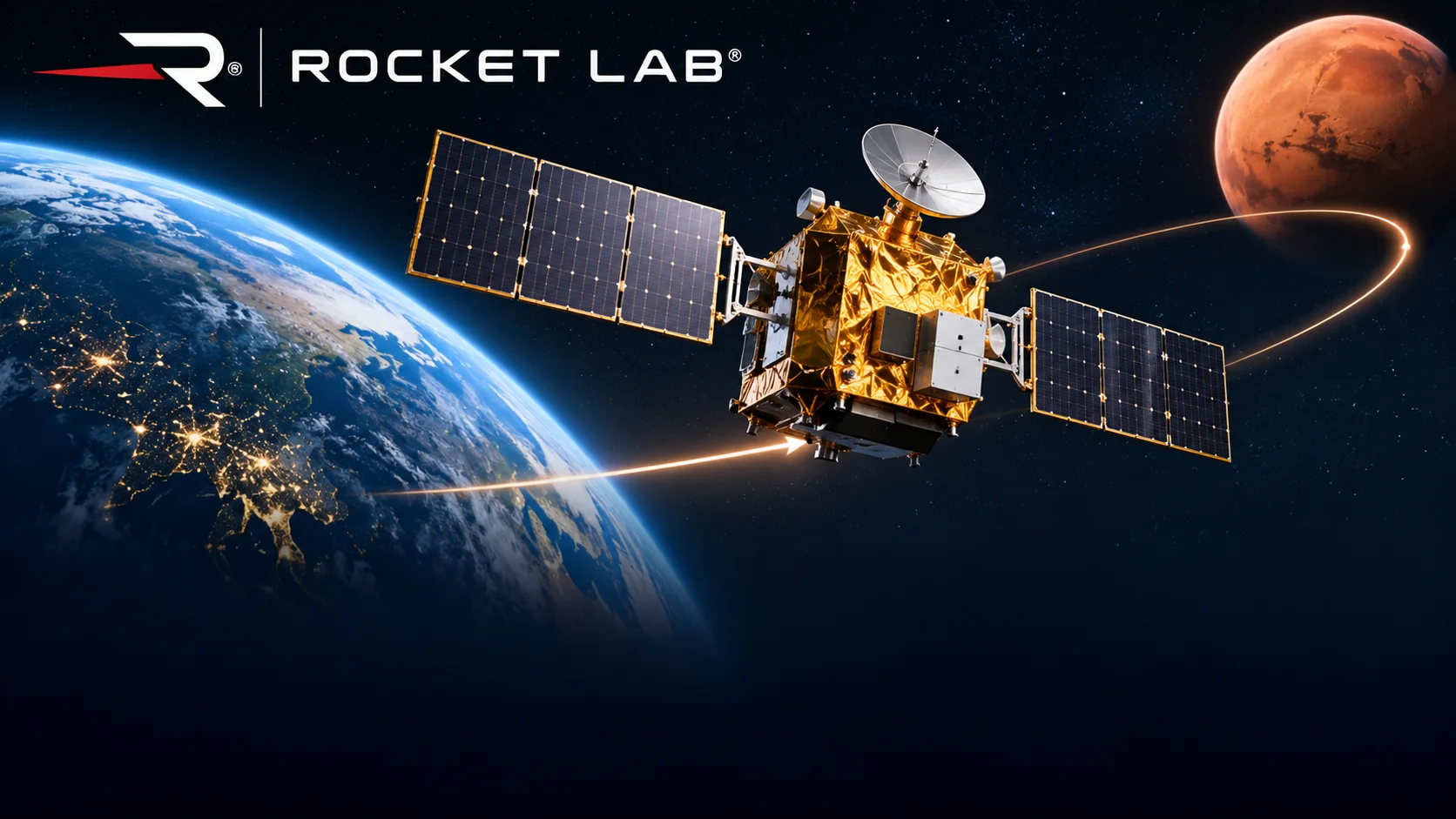
Rocket Lab has confirmed that the two spacecraft it built for NASA's ESCAPADE mission have successfully completed their trans-Mars injection burns. The twin probes, named Blue and Gold, performed the manoeuvres on November 7 and 9, 2026, using powered Earth flybys to set their course towards Mars.
The burns lasted approximately 10 minutes each and were executed autonomously, with Rocket Lab and University of California, Berkeley operators overseeing the manoeuvres. Rocket Lab reported that the burns achieved much greater than 99% overall accuracy, with a final attitude error of less than one degree.
The milestone puts both spacecraft on course to reach Mars in September 2027. It also marks an unusual approach to interplanetary navigation, with the probes using their own propulsion systems during Earth's gravitational assist rather than depending entirely on a launch vehicle's upper stage.
How the ESCAPADE Mission Set Its Course for Mars
The ESCAPADE mission, short for Escape and Plasma Acceleration and Dynamics Explorers, launched on November 13, 2025. Earth and Mars were not favourably aligned for a direct transfer at the time, so the spacecraft first entered a long-duration orbit around the Sun-Earth Lagrange Point 2 (L2).
After nearly a year in this loiter orbit, the probes returned towards Earth. Each then combined Earth's gravitational pull with an onboard engine burn to gain the speed and trajectory needed for the journey to Mars.
NASA described the powered Earth flyby as a first for one of its spacecraft travelling to Mars. The two probes carried out the manoeuvre separately, two days apart. Their successful burns now begin the approximately 10-month cruise towards the Red Planet.
What Blue and Gold Will Study at Mars
Once in Mars orbit, the twin spacecraft will work together to investigate the planet's magnetosphere and its interaction with the solar wind. This stream of charged particles from the Sun can strip ions from Mars' upper atmosphere, contributing to atmospheric loss over time.
By measuring these interactions, ESCAPADE aims to help scientists understand how Mars evolved from a planet with a thicker atmosphere into the colder, thinner-aired world observed today. The findings could also improve understanding of space weather around Mars and inform planning for future human exploration.
The spacecraft are scheduled to perform their Mars orbit insertion burns in September 2027. NASA expects science operations to begin in June 2028, after the probes spend several months adjusting their orbits and moving into their initial formation.
A Different Approach to Deep-Space Navigation
The ESCAPADE mission demonstrates how spacecraft can use onboard propulsion during a planetary flyby to shape their own interplanetary trajectories. This approach required precise navigation, trajectory planning and the ability to sustain a continuous engine firing during a demanding manoeuvre.
Rocket Lab designed and built both spacecraft for NASA and UC Berkeley's Space Sciences Laboratory. The company also developed key hardware and software in-house, including propulsion-related components, avionics and flight systems.
The successful departure burns do not complete the mission. The spacecraft will still need trajectory correction manoeuvres during their cruise and another major engine firing to enter Mars orbit. However, the milestone clears a significant hurdle on their journey to study the Red Planet's changing space environment.