TDK Launches 10μF 100V MLCCs for AI Servers, Humanoids and EVs

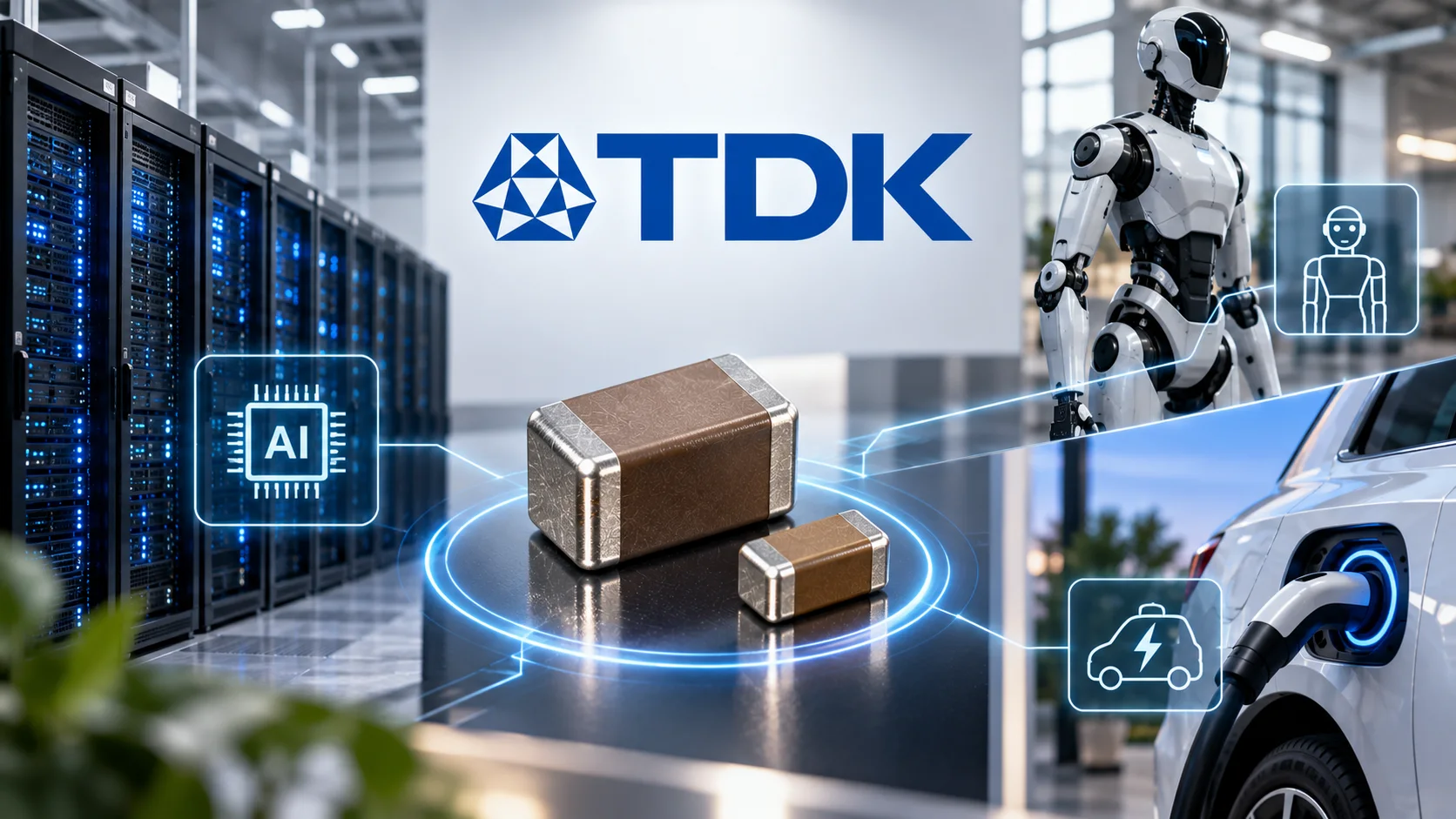
TDK has launched a new series of 100V X7R multilayer ceramic capacitors (MLCCs) designed for 48V power systems in AI servers, humanoid robots, electric vehicles and industrial equipment. The new components deliver 10μF capacitance in the 3225 package, measuring 3.2 × 2.5 × 2.5 mm, while combining soft termination with low electrical resistance. TDK says the products began mass production in September 2026.
The components are part of TDK's CN series, which uses an optimized resin-electrode structure to address a common trade-off in soft-termination MLCCs. Soft termination can help protect ceramic capacitors from cracking caused by mechanical stress, but adding a resin layer can increase equivalent series resistance (ESR). TDK says its new structure keeps resistance at a level comparable with standard-terminal products.
Built for 48V Power Systems
The demand for higher-capacitance 100V MLCCs is linked to the growing use of 48V power architectures. These systems are increasingly being used in AI servers and other equipment to reduce power losses and the weight of wiring compared with lower-voltage power distribution.
TDK says its new components can provide twice the capacitance of its conventional capacitors of the same size. That can allow manufacturers to reduce the number of MLCCs required on a power line and free up board space. The company is positioning the parts for smoothing and decoupling power lines, functions that help stabilize voltage and suppress unwanted electrical fluctuations.
Soft Termination Without the Usual Resistance Trade-Off
The CN series uses resin electrodes as part of its soft-termination structure. This gives the components additional protection against mechanical stress, an important consideration for applications where circuit boards and components can experience vibration or other physical loads.
TDK says its optimized material selection and electrode design significantly reduce the ESR increase normally associated with resin-based soft termination. The new parts therefore combine high capacitance and 100V operation with low resistance, allowing designers to target smaller component counts without giving up the reliability benefits of soft termination.
AI Servers and Humanoid Robots Among Target Applications
AI servers are one of the key applications for the new MLCCs. As server architectures increasingly adopt 48V power distribution, components capable of handling higher voltage while maintaining low resistance and high capacitance become important for power conversion and regulation systems.
Humanoid robots and xEVs are also listed among the intended applications. Both categories involve increasingly complex electrical systems and high power demands, while space and weight remain important design constraints. TDK also expects the components to be used in various industrial equipment requiring 48V power lines.
Automotive-Grade Versions Are Also Available
TDK is offering two versions of the new 10μF/100V component. The CNA version is intended for automotive applications, while the CNC version is aimed at commercial applications. The automotive version is qualified under the AEC-Q200 standard for passive components used in vehicles.
The company lists the new components with an X7R temperature characteristic and a capacitance tolerance of ±10%. The products operate across a temperature range of -55°C to 125°C. Initial production is based in Japan, with TDK's Japanese announcement specifying an initial production plan of 1 million units per month.
TDK's new MLCCs arrive as manufacturers continue moving toward higher-voltage power architectures in data centers, robotics and vehicles. By combining 100V operation, 10μF capacitance and low-resistance soft termination in a relatively compact package, the company is targeting a component-level bottleneck that becomes more important as these systems demand higher power without increasing board size.