
UNIST-Cambridge Photobattery Charges 70% in 10 Minutes
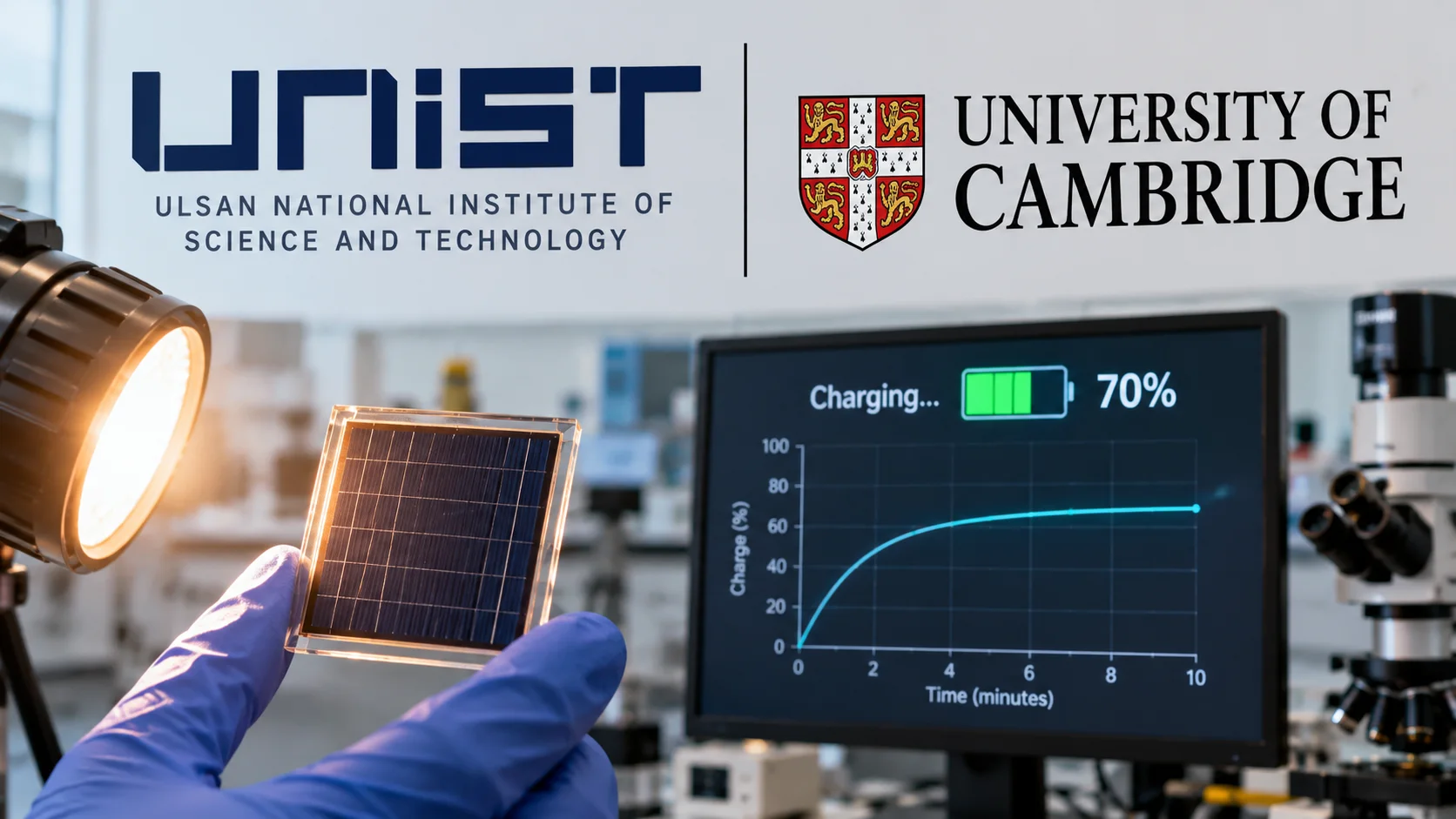
Researchers at South Korea’s Ulsan National Institute of Science and Technology (UNIST) and the University of Cambridge have developed a photo-rechargeable battery that can harvest light and store the resulting energy within the same device. In laboratory testing, the battery reached 70% state of charge within 10 minutes under standard one-sun illumination and also demonstrated operation under indoor lighting.
The research tackles a major challenge in photo-rechargeable batteries: integrating light harvesting and energy storage without compromising the performance of either function. The team combined a lithium-metal battery with a dye-sensitized photovoltaic electrode, creating an integrated system capable of converting light into electricity and storing it.
The study was published in Energy Storage Materials on July 29, 2026.
A different approach to photo-rechargeable batteries
Photo-rechargeable batteries combine two functions normally handled by separate devices. A photovoltaic cell converts light into electricity, while a battery stores that energy. Putting both functions into one system could reduce the need for external wiring and separate charging components in small electronic devices.
The researchers compared different battery cathode materials and liquid catholytes before developing their final design. Their analysis found that solid battery materials such as lithium iron phosphate offered advantages in energy density and charging performance because of their compact structure.
The resulting design uses a lithium-metal battery with a lithium iron phosphate cathode alongside a dye-sensitized photovoltaic electrode.
This arrangement allows the photovoltaic component to generate the voltage needed to charge the battery while remaining integrated with the storage system.
Charging under sunlight and indoor lighting
In laboratory tests, the prototype reached 70% state of charge after 10 minutes under one-sun illumination, a standard laboratory condition used to simulate sunlight.
The researchers also tested the system under indoor lighting. An indoor-light configuration operated at 1,000 lux, approximately comparable to the lighting levels found in many office environments.
The experiments also examined the battery while it was supplying power. The researchers found that simultaneous photo-charging and discharging could increase the usable output of the battery compared with operation without light.
This is important for devices that remain in use while exposed to ambient light. Instead of relying exclusively on stored battery energy, such systems could potentially continue collecting small amounts of energy from their surroundings.
Potential applications in IoT devices
The technology could eventually be useful for autonomous sensors and Internet of Things (IoT) devices that need to operate for extended periods without regular battery replacement or a direct connection to the power grid.
Small sensors installed in buildings, infrastructure or remote locations could potentially use ambient light as an additional source of energy. Indoor devices could also benefit because they would not necessarily require direct sunlight to generate power.
The researchers are primarily targeting applications where relatively small amounts of energy are required. The technology is not intended to replace conventional batteries or large solar-plus-storage systems at its current stage of development.
Modular design offers greater flexibility
Another important part of the research is the flexibility of the photovoltaic section. The researchers demonstrated that the number and arrangement of solar-cell components can be adjusted to provide the voltage required by different battery materials.
That approach could allow the same basic photo-rechargeable architecture to be adapted for different battery chemistries instead of requiring an entirely new system for each application.
The technology remains at the research stage, and the reported charging performance comes from controlled laboratory experiments. Commercial deployment would require further testing of long-term durability, manufacturing, efficiency under real-world lighting and integration into actual electronic products.
For now, the UNIST-Cambridge research offers a way to combine light harvesting and energy storage in a single battery system. Its most immediate potential lies in small autonomous electronics and IoT devices that can benefit from continuously collecting energy from available light.