US Finalizes $775 Million CHIPS Awards for Quantum Computing
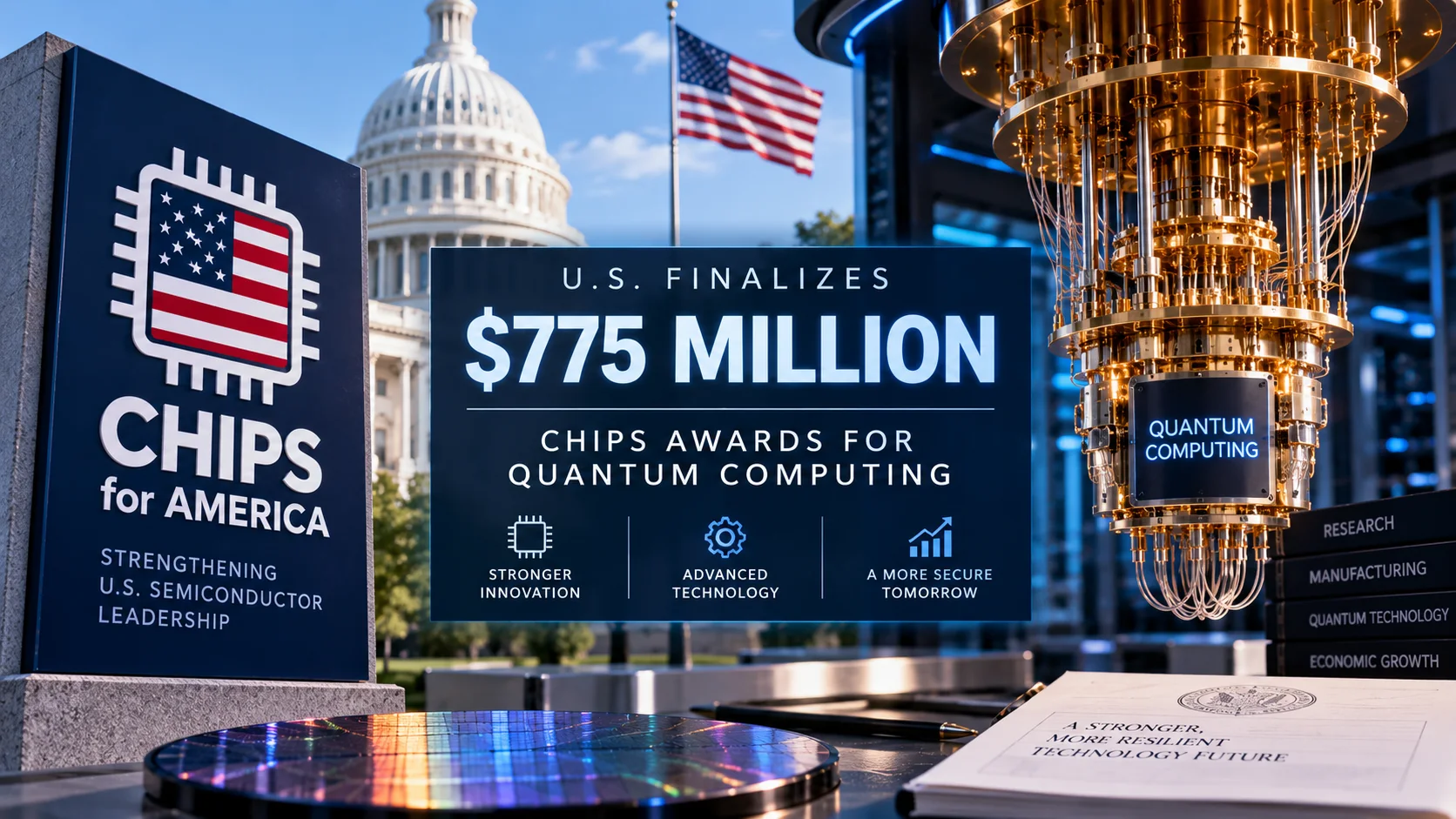
The U.S. Department of Commerce has finalized up to $775 million in CHIPS and Science Act funding for quantum computing and semiconductor manufacturing, turning earlier funding commitments into binding agreements with five companies. The recipients are GlobalFoundries, Rigetti Computing, D-Wave Quantum, PsiQuantum and Quantinuum, with the U.S. government taking minority, non-controlling equity stakes as a condition of the awards.
GlobalFoundries is receiving the largest award, worth up to $375 million, for a domestic quantum foundry and related manufacturing capabilities. Rigetti, D-Wave, PsiQuantum and Quantinuum will each receive up to $100 million for research and development covering different quantum-computing architectures and semiconductor technologies.
GlobalFoundries Gets the Largest Award
GlobalFoundries' $375 million award is focused on building a secure U.S.-based quantum manufacturing infrastructure rather than funding a single quantum computer. The programme will support a domestic foundry capable of serving different quantum architectures, alongside work on cryogenic CMOS process design kits, advanced packaging and heterogeneous integration.
The investment is intended to address a major bottleneck in quantum computing: moving technologies from laboratory prototypes to repeatable semiconductor manufacturing. Instead of each quantum company developing its own manufacturing infrastructure, the planned foundry is expected to provide capabilities that can be used across multiple quantum platforms.
Four Quantum Companies Receive $100 Million Each
The remaining $400 million is divided equally among four quantum-computing companies, with each receiving up to $100 million. The awards are spread across different approaches rather than concentrating government funding on one type of quantum processor.
D-Wave's award supports superconducting annealing and gate-model systems, including improvements to qubit counts, error rates, coherence and advanced packaging. Its longer-term targets include a 100,000-qubit annealing system and a 10,000-qubit gate-model system designed around 100 logical qubits capable of more than one million operations.
Funding Covers Different Quantum Architectures
Rigetti's funding is directed toward superconducting quantum technology, including readout electronics, cryogenic architectures and fabrication for high-connectivity quantum processors. The company is using the award to accelerate development of its next-generation systems and domestic manufacturing capabilities.
PsiQuantum is taking a different route, with its funding focused on photonic quantum computing. The work includes electro-optic materials, single-photon detectors and low-loss photonic packaging. Quantinuum's award targets trapped-ion technology, including integrated photonics, cryogenic semiconductor components and optical systems needed to control and scale its quantum processors.
US Government Takes Equity in Return
The funding structure is different from a conventional research grant because the Commerce Department receives minority equity stakes in the companies in return for the federal investment. The stakes are non-controlling, meaning the government does not gain control of the companies.
The arrangement gives taxpayers a potential financial return if the companies increase in value while allowing the government to support technologies it considers strategically important. D-Wave's agreement, for example, explicitly states that the Commerce Department will receive a minority, non-controlling equity stake as a condition of the funding.
Quantum Manufacturing Becomes a US Priority
The finalized awards are part of a much larger quantum initiative announced by the Commerce Department in May. At that stage, the government had announced letters of intent worth about $2.013 billion covering nine companies, including a planned $1 billion award for IBM's purpose-built quantum foundry in Albany, New York. IBM's award was not among the five agreements finalized this week.
The government's focus extends beyond quantum processors themselves. The awards cover semiconductor fabrication, packaging, photonics, cryogenic electronics and other components needed to build complete quantum systems. That approach reflects the difficulty of creating a domestic quantum supply chain when many of the required components depend on highly specialized semiconductor manufacturing.
Companies Must Meet Development Milestones
The money will not necessarily arrive as a single upfront payment. D-Wave's agreement, for example, specifies that its $100 million award will be distributed in stages tied to defined milestones, with an initial tranche of about $53.6 million becoming available shortly after the award date.
The milestone structure gives the government a way to track technical progress while limiting the risk of committing the full amount before companies demonstrate that projects are moving forward. It also gives recipients capital to accelerate development without requiring them to finance the entire programme privately.
The finalized awards represent a shift from government promises to active investment in the U.S. quantum ecosystem. By combining funding with equity ownership and targeting several competing technical approaches, Washington is attempting to strengthen both the companies developing quantum computers and the semiconductor infrastructure needed to manufacture them.
The next test will be whether the funding can translate into commercially useful quantum systems and a scalable domestic supply chain. For the participating companies, the awards provide significant new capital; for the U.S. government, they represent a larger strategic bet that quantum computing and semiconductor manufacturing will become critical technologies for national security, advanced science and future industries.