Xanadu and HyperLight Cut Optical Switch Loss to 7 Millidecibels
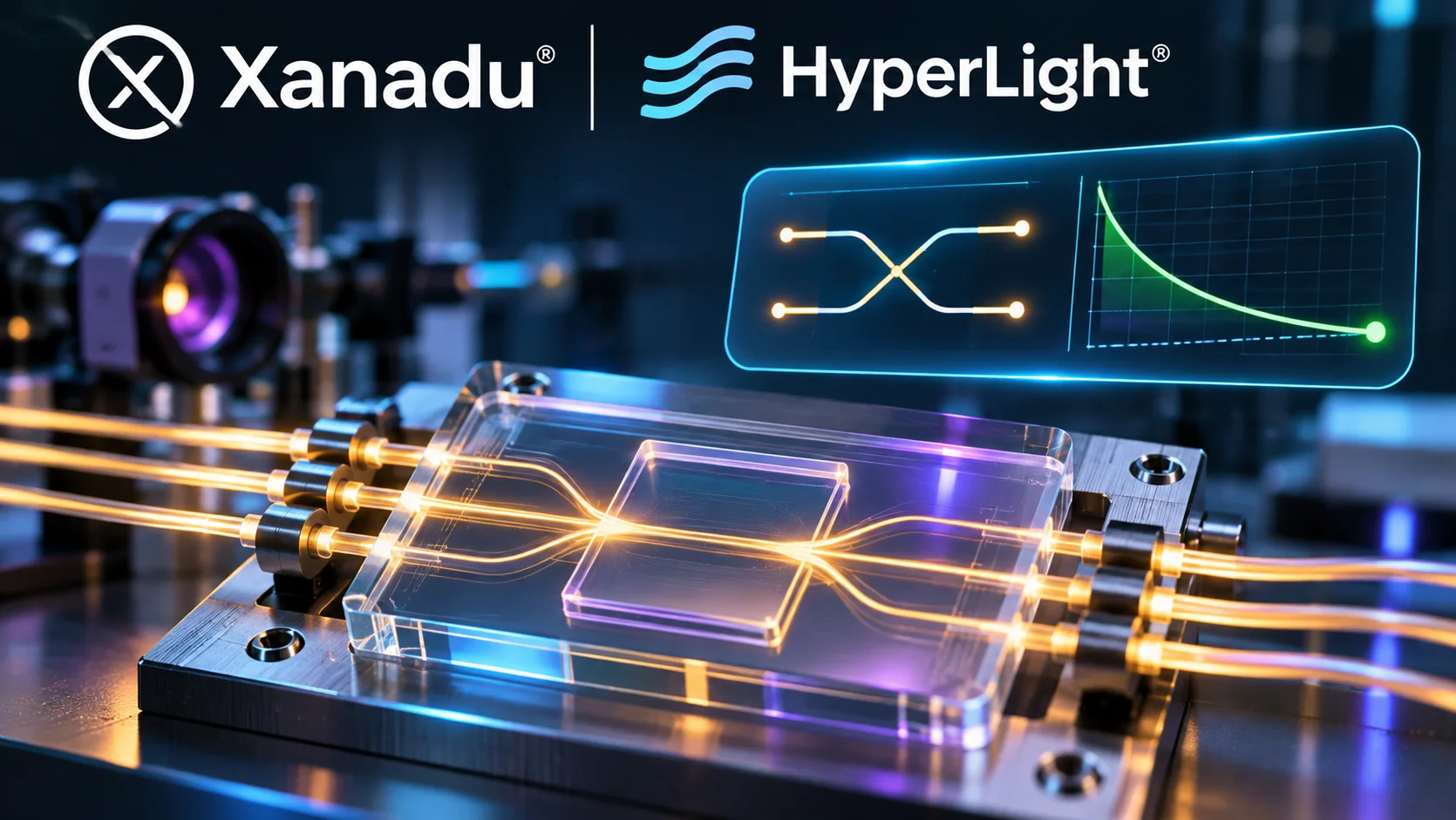
Xanadu and HyperLight have reported a significant improvement in optical switch performance, reducing insertion loss to 7 millidecibels (mdB). The result marks a nearly threefold improvement over their previous 20 mdB benchmark, announced in 2025.
The Canadian quantum computing company and the photonics specialist announced the development on November 10, 2026. It uses thin-film lithium niobate (TFLN) technology and was demonstrated on a high-volume wafer manufacturing line using HyperLight’s TFLN Chiplet platform.
The advance addresses one of the hardware challenges involved in scaling photonic quantum computers: keeping optical signal losses low as quantum information moves through increasingly complex systems.
Why Lower Optical Switch Loss Matters
Photonic quantum computers use photons, or particles of light, to carry quantum information. Optical switches route these photons between different parts of a computing system. Each switch can introduce some signal loss, which becomes a concern when information must pass through multiple components.
Unlike conventional optical communication signals, fragile quantum states cannot simply be amplified without affecting the information they carry. Lost photons can therefore disrupt quantum operations and make it harder to maintain the reliability of a larger system.
Reducing optical switch loss can help preserve quantum-state fidelity and limit the number of photons lost during routing. It could also reduce the need for additional laser power or hardware redundancy as photonic systems grow.
Thin-Film Lithium Niobate Supports the Improvement
The companies achieved the 7 mdB result using thin-film lithium niobate, a material used in integrated photonics. HyperLight’s TFLN Chiplet platform is designed for scalable manufacturing and also serves applications in AI data centres and telecommunications networks.
Xanadu and HyperLight said the demonstration showed strong manufacturing yield and repeatability on a high-volume wafer line. These factors matter because a laboratory performance result must translate into consistent production before it can support commercial hardware at scale.
Xanadu said the milestone indicates that its quantum-compatible switches are ready to move towards production ramp-up. However, the announcement does not mean that utility-scale photonic quantum computers are already commercially available.
A Step Towards Scalable Photonic Quantum Computing
The improvement from 20 mdB to 7 mdB represents a substantial reduction in insertion loss. Xanadu says lower losses could improve system performance while reducing hardware overhead and supporting more efficient manufacturing.
The companies also see potential applications beyond quantum computing, including parts of the wider data centre ecosystem, where demand for faster and more efficient optical connections continues to grow.
The next challenge will be demonstrating that the performance can be maintained across larger production runs and integrated into complete quantum computing systems. The 7 mdB result is a hardware milestone, but it does not by itself establish fault tolerance or commercial-scale quantum computing.
For Xanadu and HyperLight, the development provides a measurable improvement in a key photonic component. Its wider significance will depend on how reliably the technology performs when deployed in larger and more complex systems.