Zeroth Launches Bridge AI Robot and OpenBridge Open-Source Ecosystem
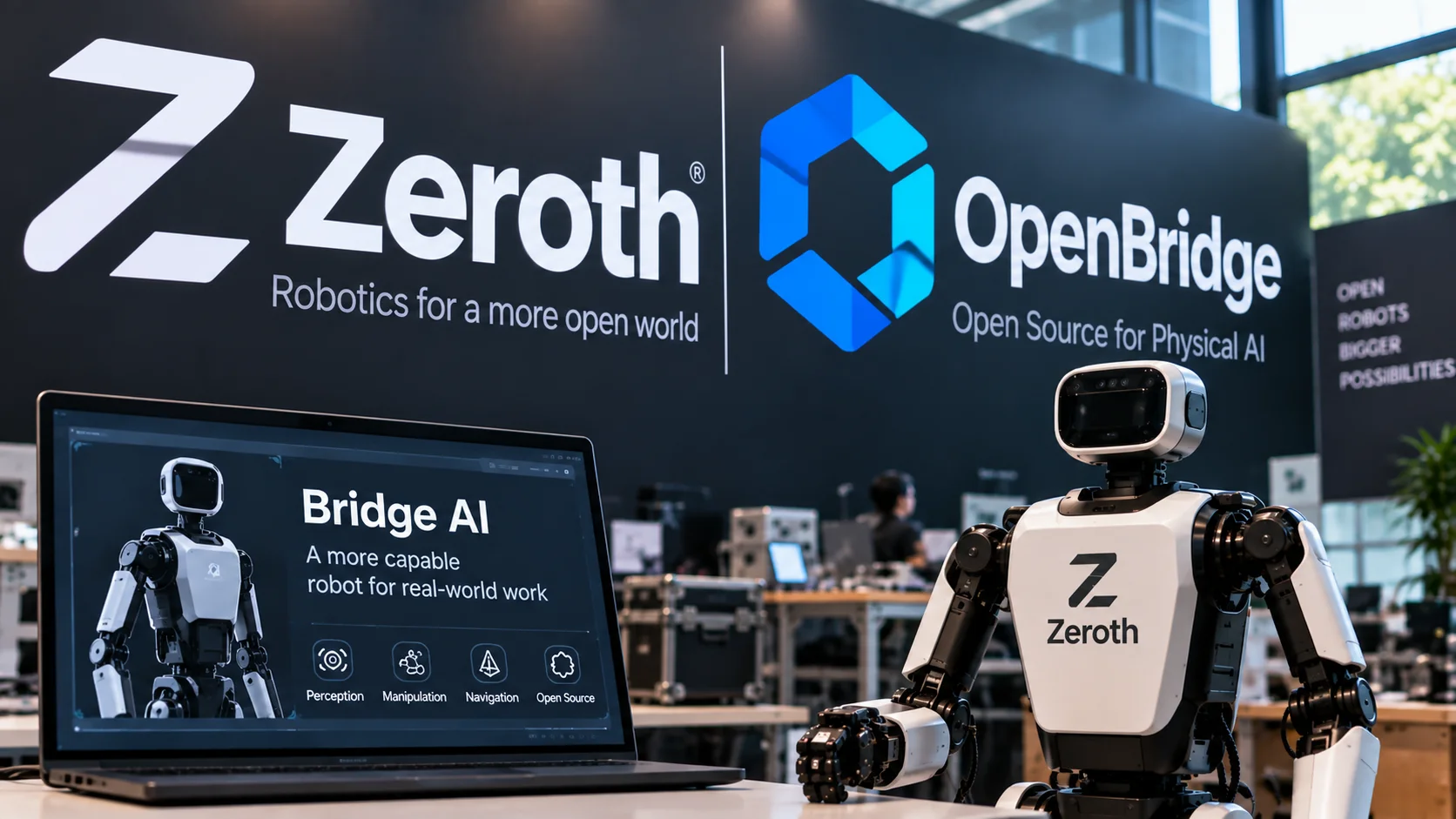
Chinese robotics company Zeroth has launched Bridge, an AI-native humanoid robot, alongside OpenBridge, an open-source ecosystem designed to let developers build, test and share capabilities for embodied AI systems. The first batch of the Bridge Geek Edition is now available, while the company has also opened its Bridge Builder Program for developers and researchers.
Bridge is designed as a compact humanoid robot for physical AI development rather than a machine limited to a fixed set of pre-programmed movements. Zeroth has developed its hardware, motion-control system and developer interfaces together to support AI-driven physical interaction.
The robot is priced at $3,999, according to Zeroth. It stands about 88 cm tall and weighs approximately 13 kg. Its design includes 30–40 cm arm reach and two-finger end effectors, making it suitable for development, experimentation and research.
Bridge is built for AI-driven physical interaction
Bridge supports capabilities including bipedal walking, obstacle avoidance and different programmed movements. Developers can access software development kits, motion-control APIs and motion-capture and virtual-reality integration.
The platform is designed to allow developers to deploy their own algorithms and create new robotic skills instead of relying only on capabilities provided by the manufacturer.
Bridge also supports teleoperation, including real-time motion mapping and whole-body control. Developers can use VR-based control to operate the robot and test movements before turning them into reusable robotic skills.
The robot's relatively compact size is another part of the design. Zeroth is positioning Bridge as a platform for developers, universities and research teams that may not have access to the facilities required to work with larger industrial robots.
OpenBridge puts developers at the centre
Alongside Bridge, Zeroth has introduced OpenBridge as an open-source ecosystem for embodied intelligence. The platform brings together tools for hardware access, robotic skills and simulation.
Its Skill Hub is intended to let developers create and share reusable robot capabilities and action sequences. The Simulation Hub provides an environment for developing and testing robot behaviours before deploying them on physical hardware.
This approach could reduce developers' dependence on a closed software ecosystem. New capabilities can be created by different developers and potentially shared with others working on similar robotic applications.
Zeroth's goal is to build an ecosystem where physical AI capabilities are developed by a broader community rather than solely by the company producing the robot.
Bridge Builder Program targets developers
Zeroth has also launched the Bridge Builder Program to bring developers into the early stages of OpenBridge's development.
The first phase is planned around 500 shortlisted developers. The top 200 participants are expected to receive complimentary access to Bridge and take part in ecosystem development, while another 300 will receive priority purchase access to the Bridge Geek Edition, SDK access and eligibility for future opportunities.
The program is designed to give developers early access to the hardware and software while allowing Zeroth to collect feedback and identify useful applications for the platform.
A developer-focused approach to embodied AI
Bridge arrives as robotics companies increasingly work on embodied AI, where artificial intelligence systems are designed to understand and interact with physical environments.
Zeroth is taking a developer-focused approach by combining a compact humanoid platform with open software, simulation tools and shared robotic skills. The company aims to make experimentation with physical AI more accessible to developers and research teams.
The platform is currently positioned primarily for development, experimentation and research rather than as a replacement for industrial robots or a general-purpose humanoid worker. Its longer-term potential will depend on how many developers contribute useful skills and how reliably those capabilities can move from simulation to real-world operation.
For now, Bridge serves as the hardware foundation of Zeroth's ecosystem, while OpenBridge provides the software, simulation and community layer around it. The company is betting that combining accessible hardware with an open development environment can accelerate experimentation with physical AI.