China Embodied AI Race Shifts Beyond Humanoid Robot Demonstrations
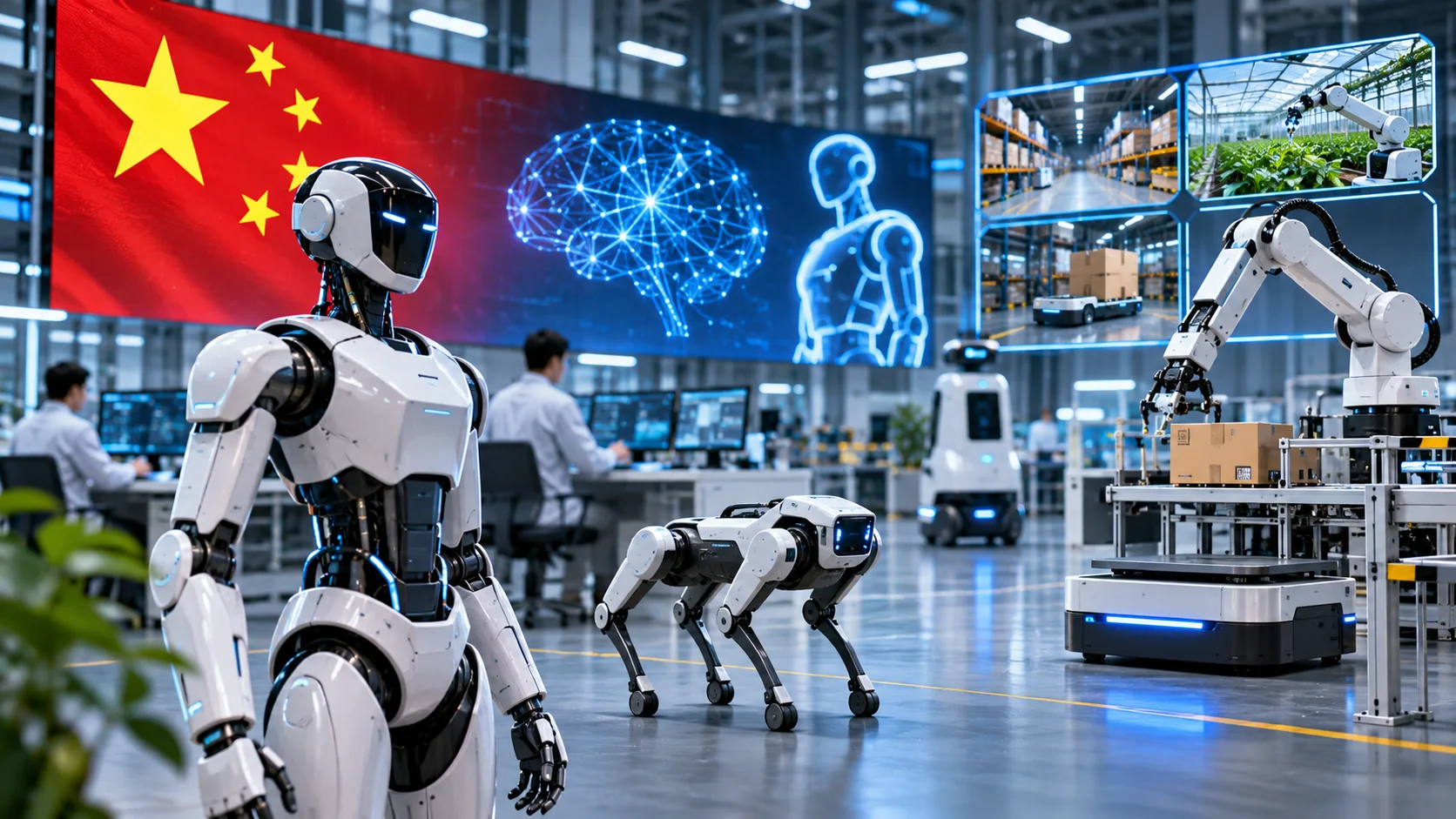
China's embodied AI sector is drawing growing investment as robotics companies move beyond humanoid machines designed mainly to run, dance or perform backflips. Developers are now competing to build the software that allows robots to understand their surroundings, learn unfamiliar tasks and adapt to changing conditions without being programmed for every movement.
Chinese embodied AI companies raised 93.5 billion yuan (about $13 billion) across 322 deals in the first half of 2026, five times the amount recorded a year earlier, data research firm ITjuzi reported. The funding is reaching specialist developers of robot intelligence as well as established manufacturers, reflecting a shift in where companies expect future value to emerge.
China Embodied AI Race Puts Intelligence at the Centre
The change is partly driven by falling hardware prices. Robotics companies increasingly see software, rather than the physical machine alone, as the source of differentiation. Startups such as X Square, Galaxea and Spirit AI are developing systems intended to transfer skills across tasks and environments.
The competition is not limited to China. US developers including Physical Intelligence, Skild AI and Generalist are working on models that can teach robots multiple skills without extensive retraining. American firms retain advantages in some areas of advanced AI research and access to powerful computing chips. Chinese developers, however, can draw on a large manufacturing base and closer access to industrial settings where robots can be tested.
Training Robots Requires Real-World Data
Unlike chatbots trained on large collections of text, robots need examples of physical interactions, including gripping objects, handling flexible materials and moving through unfamiliar spaces. Chinese companies are collecting this information through human demonstrations, wearable sensors and simulated environments.
Spirit AI has hired around 1,000 people to record everyday and industrial activities, its co-founder told Reuters. Ant Group's robotics unit Robbyant said it trained a model on 160,000 hours of material, including 50,000 hours of human-guided robot movements. ACE Robotics uses wearable sensors to capture workers' movements and grip forces in shops and hotels.
Simulation can expand training data, but it cannot perfectly reproduce real-world physical interactions. Data quality remains a central challenge, particularly when a model must work across different robot designs and workplaces.
Commercial Deployment Remains the Bigger Test
Some systems are already being tested in industrial and commercial settings. Battery maker CATL said Spirit AI robots connect flexible wires during battery-pack testing at its Zhongzhou plant. Robbyant said its robots handle orders in two Shanghai pharmacies, where staff check medicines before dispatch.
These deployments show progress, but they do not establish that robots can reliably perform a wide range of unfamiliar tasks without human supervision. Developers also face constraints from shortages of advanced Nvidia chips linked to US export controls, alongside funding pressures and concerns about crowded valuations.
The longer-term goal is to build systems that can learn new jobs with limited additional training and operate across different environments. That will require better models, dependable training data and access to sufficient computing resources. Reuters' interviews with robotics executives and analysts suggest that China has manufacturing and data advantages, while the United States remains strong in parts of the AI research and computing ecosystem.
For the embodied AI sector, the next measure of progress will be whether impressive demonstrations translate into dependable performance at customer sites. A breakthrough in demonstrations may arrive before robots are ready for widespread commercial use.