
d-Matrix Adopts NVIDIA NVLink Fusion for Next-Gen AI Inference Chips
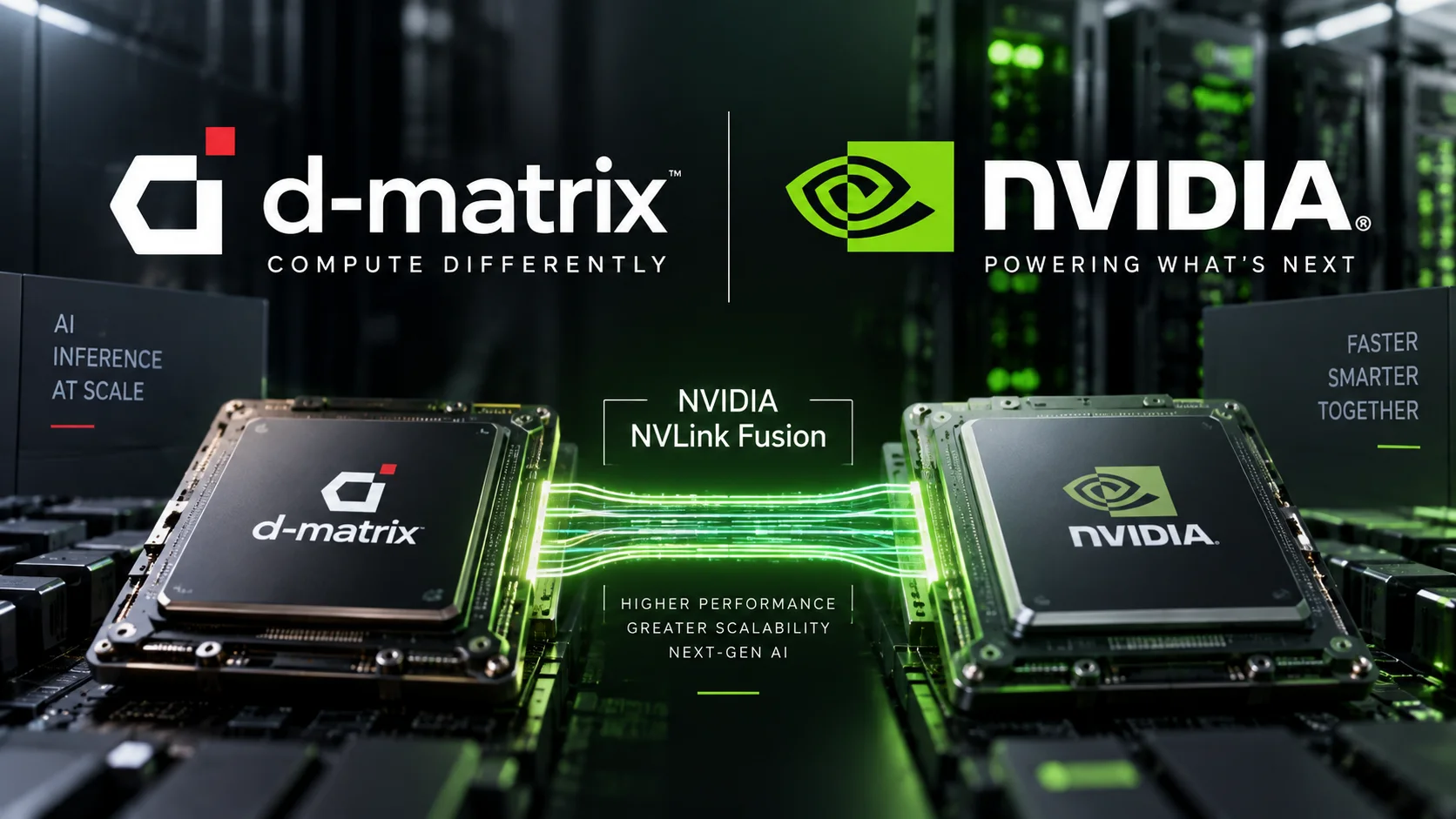
AI chip startup d-Matrix will use NVIDIA’s NVLink Fusion technology to integrate its next-generation Raptor inference processors into NVIDIA’s data-center infrastructure. The collaboration gives d-Matrix a route to deploy its custom AI chips within NVIDIA’s existing rack-scale architecture instead of requiring customers to build separate systems around them.
The Raptor processors will connect with NVIDIA’s NVLink scale-up and Spectrum-X scale-out networking, as well as the company’s MGX rack architecture. d-Matrix says the combined systems are being designed for low-latency AI inference workloads such as chatbots, coding assistants and voice agents.
Raptor Chips Join NVIDIA’s Rack Architecture
NVLink Fusion is designed to allow third-party custom processors to connect with NVIDIA’s broader AI infrastructure. For d-Matrix, that means its inference-focused XPUs can use components and infrastructure already built around NVIDIA systems, including networking, memory and rack-level technologies.
The first Raptor designs are expected to complete their final design stage by the end of 2026, while NVIDIA-compatible rack systems incorporating the chips are expected to become available in 2027. Financial terms of the collaboration have not been disclosed.
d-Matrix Targets the AI Inference Market
d-Matrix focuses on AI inference, the stage where trained models generate responses and perform tasks for users. This workload is becoming increasingly important as AI applications move from model training into everyday services that need to process large numbers of requests quickly.
The company says its Raptor-based systems will target applications where response time and energy efficiency are important. Integrating with NVIDIA’s infrastructure could give d-Matrix access to established server, networking, power and cooling designs while reducing the work required to deploy its chips at scale.
Astera Labs Joins the Infrastructure Push
d-Matrix is also working with connectivity company Astera Labs to develop custom high-speed data paths for the systems. The goal is to maintain fast communication between the different components as inference workloads scale across larger server configurations.
The partnership gives d-Matrix an opportunity to position its processors alongside NVIDIA’s dominant AI infrastructure rather than compete with the entire platform. For NVIDIA, bringing custom silicon providers into its ecosystem can expand the range of processors that can be deployed within its rack-scale architecture as customers look for alternatives and specialised solutions for different AI workloads.
d-Matrix shipped its first AI chip in 2024 and was valued at about $2 billion after raising $450 million in 2025. Microsoft has also backed the company, including through a $110 million financing round in 2023.
The Raptor integration is still a future product roadmap, with commercial availability expected in 2027. Its importance will ultimately depend on how well d-Matrix’s inference processors perform inside NVIDIA-based systems and whether customers adopt the combined architecture for large-scale AI services.