
Quantinuum Demonstrates Lower Error Rates With Helix on 98-Qubit Helios
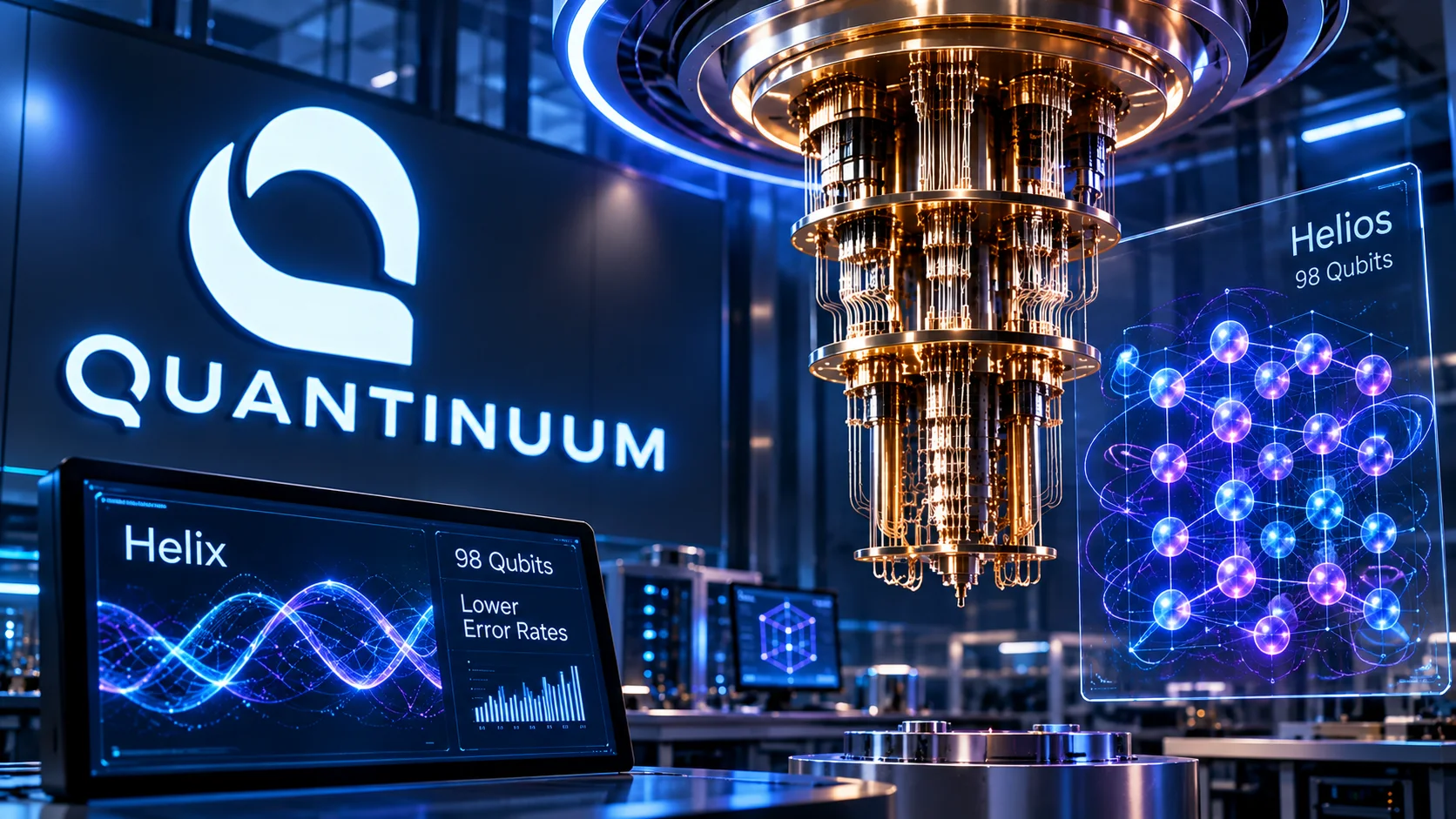
Quantinuum has demonstrated its Helix quantum error-correction architecture on its 98-qubit Helios processor, reporting logical operations that performed with lower error rates than the underlying physical hardware. The company says the results bring several core components of fault-tolerant quantum computing together on a commercial quantum system.
The experiments covered logical memory, logical computation and logical entanglement using different quantum error-correction codes. Quantinuum reported the results without relying on post-selection in the main demonstrations, meaning unsuccessful runs were not simply discarded to improve the reported performance.
Helix Targets Fault-Tolerant Quantum Computing
Quantum processors are highly sensitive to noise, making error correction essential if machines are eventually expected to run long and complex algorithms reliably. Physical qubits can lose or corrupt information during operations, so quantum error-correction systems distribute information across multiple physical qubits to create more reliable logical qubits.
Helix is designed to reduce the physical-qubit and processing overhead normally associated with this approach. Quantinuum uses the reconfigurable connectivity of its trapped-ion hardware to switch between different error-correction codes depending on the operation being performed.
Logical Memory Shows Lower Error Rate
In its logical-memory experiment, Quantinuum ran 20 rounds of syndrome extraction while addressing leakage, one of the significant error sources on Helios. The company reported a per-qubit, per-round error rate of 4.6 × 10⁻⁵ without post-selection.
The corresponding block logical error rate was 9.3 × 10⁻⁵ per round. With 0.5% post-selection, the figure fell further to 1.9 × 10⁻⁵. Quantinuum says the result demonstrates that encoded quantum information can be maintained with a lower error rate than the physical operations used to build the logical qubit.
Logical Computation Beats Physical Performance
Quantinuum also tested logical computation by benchmarking the Clifford group while performing up to 27 rounds of active adaptive syndrome extraction. The company reported a logical error rate of 2.8 × 10⁻⁴ per Clifford gate.
That represented a 4.28-fold improvement over Helios' physical two-qubit Clifford error rate. Quantinuum attributes part of the improvement to its adaptive syndrome extraction technique, which reduced the number of physical gates required for each logical operation by about 33% and shortened execution time by roughly 23%.
The results build on Helios' existing error-correction capabilities. The system has 98 fully connected physical qubits and can produce up to 50 logical qubits for error-detected applications. Quantinuum has previously demonstrated 48 fully error-corrected logical qubits on the processor using its Iceberg code.
Helix Forms Part of Quantinuum's Fault-Tolerance Roadmap
Quantinuum is positioning Helix as the architecture behind its planned Apollo system, which is intended to combine multiple error-correction encodings with efficient logical gates and eventually support universal fault-tolerant computation.
The latest demonstration does not mean a fully fault-tolerant quantum computer is already available. Large-scale systems still need substantially more reliable logical operations, greater numbers of logical qubits and efficient ways to correct errors throughout long computations. Quantinuum's results instead show that error-corrected memory and computation can already outperform corresponding physical operations on its current hardware.
For the quantum industry, the key measure is increasingly shifting from the number of physical qubits alone to how effectively those qubits can be converted into reliable logical resources. Quantinuum's Helix results provide another hardware demonstration of that approach, while the company continues working toward a scalable fault-tolerant system.