Rendezvous Robotics Funding: $20 Million for Self-Assembling Spacecraft
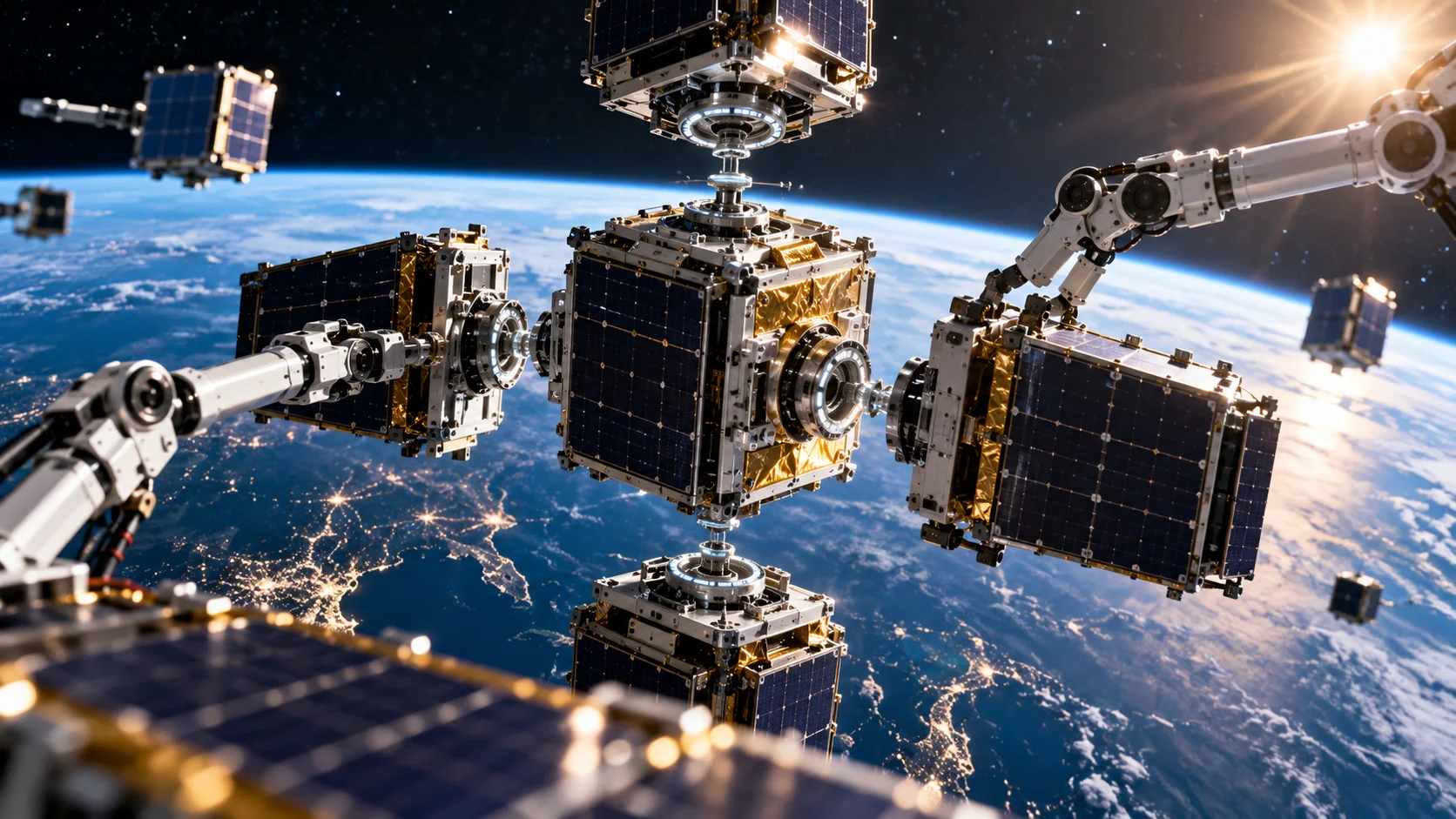
The Rendezvous Robotics funding round has raised $20 million to advance the startup’s plan to build spacecraft that can assemble and reconfigure themselves in orbit. Led by MaC Venture Capital and Toyota Ventures, the oversubscribed seed round will support development and testing ahead of a planned orbital demonstration in 2028.
The Colorado-based company is developing modular spacecraft components that can launch separately and join together after reaching orbit. Its approach aims to overcome a long-standing limitation in satellite design: spacecraft must generally fit within the available space inside a rocket’s payload fairing, restricting the size of antennas, solar arrays and other equipment that can be launched as a single unit.
How Rendezvous Robotics Plans to Assemble Spacecraft in Orbit
The startup’s technology uses hexagonal tiles measuring approximately one metre across. Each tile is equipped with sensors and onboard processing capabilities, while electromagnetic fields help the modules move towards and connect with one another in space.
The technology builds on nearly a decade of research under the TESSERAE programme, which began at the Massachusetts Institute of Technology and was developed by co-founder Ariel Ekblaw. The company initially explored applications such as large structures and space habitats but has shifted its near-term focus towards satellites.
The modules are designed to accommodate different spacecraft components, including computers, solar panels, propulsion systems and radiators. Rather than designing a satellite entirely around what can fit inside a rocket, the system could allow operators to launch separate components and combine them after deployment.
2028 Mission to Test Autonomous Reconfiguration
Rendezvous Robotics plans to launch seven spacecraft tiles into low Earth orbit for a demonstration mission scheduled for no earlier than April 2028. The company intends to test whether the modules can autonomously assemble into a functional satellite, separate and then reconnect in a different configuration.
Before that mission, the startup plans further tests. A 32-tile demonstration aboard the International Space Station is scheduled for no earlier than December 2026, while a planned parabolic-flight campaign will test electromagnetic actuation and tile movement under microgravity conditions.
The earlier experiments provide opportunities to test parts of the technology, but the 2028 mission will address a different challenge: autonomous assembly and reconfiguration in free space, outside the controlled environment of a space station.
Funding Targets More Adaptable Satellite Design
The Rendezvous Robotics funding round included participation from the University of Michigan Endowment, Astera Ventures, Industrious Ventures, Aurelia Foundry, ATX Venture Partners and Mana Ventures, among others.
The company argues that modular spacecraft could eventually allow satellite operators to replace damaged components, add new capabilities or change a satellite’s configuration without launching an entirely new vehicle. In the longer term, it has also proposed storing replacement modules in orbit for use when required.
These applications remain prospective. The company must demonstrate reliable autonomous assembly and prove that the system can operate under the conditions encountered in orbit before the technology can be considered a practical alternative to conventional satellite construction.
If the planned tests succeed, the approach could give satellite designers more flexibility over spacecraft size, maintenance and upgrades. For now, the 2028 demonstration is the key milestone in determining whether self-assembling spacecraft can move from experimental research towards operational use.