
Arianespace Launches 36 Amazon Leo Satellites on Ariane 6's 10th Flight
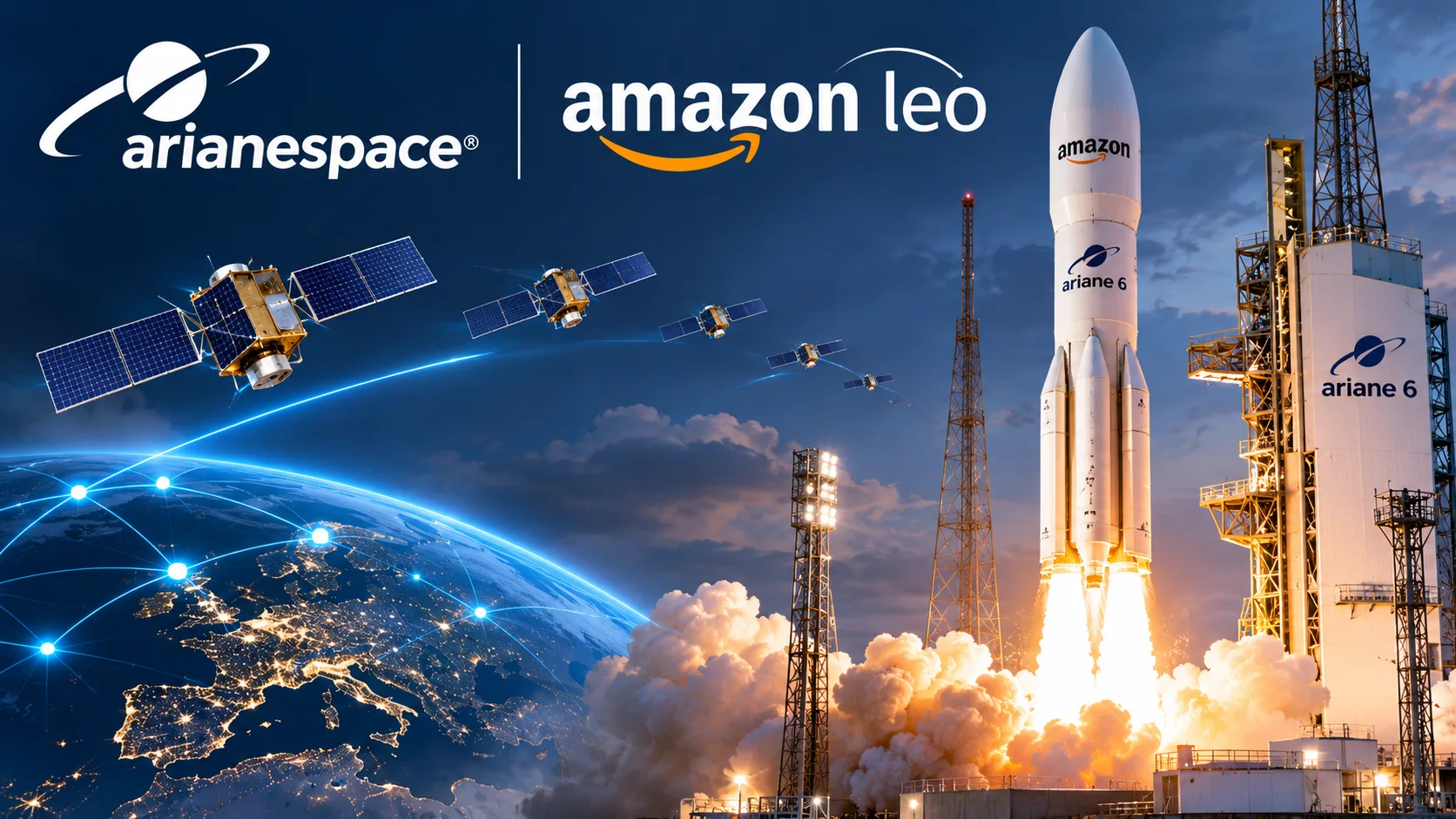
Arianespace has successfully launched 36 Amazon Leo satellites into low Earth orbit aboard an Ariane 6 rocket, adding another batch to Amazon's expanding broadband constellation. The launch took place on 24 November 2026 from Europe's Spaceport in Kourou, French Guiana.
The mission, designated VA271 by Arianespace and Leo Europe 4 (LE-04) by Amazon, marked the tenth flight of Ariane 6 and the fourth time the European launcher has carried satellites for Amazon Leo this year.
The latest deployment brings the total number of Amazon Leo satellites placed into orbit by Arianespace to 136 in less than 10 months. The satellites reached an altitude of approximately 460 kilometres, with the mission lasting two hours and four minutes from liftoff to the separation of the final spacecraft.
Ariane 6 Completes Its Tenth Flight
The rocket flew in its Ariane 64 configuration, which uses four solid rocket boosters. For this mission, Arianespace used enhanced-performance P160C boosters for the second time.
The upgraded boosters increase Ariane 6's performance in low Earth orbit by approximately 10% compared with the earlier P120C version. The launcher can now carry a payload of around 22 tonnes into low Earth orbit in its Ariane 64 configuration.
Arianespace said the successful mission demonstrated the launcher's ability to support large satellite constellations and a growing schedule of commercial and institutional launches.
VA271 was also the fifth Ariane 6 mission of 2026. The launcher has completed all ten of its flights successfully since its inaugural mission in July 2024.
Amazon Leo Expands Its Satellite Internet Network
Amazon Leo, previously known as Project Kuiper, is Amazon's low Earth orbit satellite network designed to provide broadband connectivity to homes, businesses and communities with limited access to conventional internet infrastructure.
The constellation is intended to compete in the growing satellite broadband market, where SpaceX's Starlink is already an established operator. Amazon's network will require a large number of satellites and supporting ground infrastructure to provide broad geographic coverage.
The latest launch adds 36 spacecraft to the system, but the network is still being deployed. The company has not yet completed the full constellation required for its planned global service.
Amazon is using several launch providers to accelerate deployment. Its launch arrangements include Arianespace, United Launch Alliance, Blue Origin and SpaceX.
Amazon and Arianespace Extend Their Partnership
The launch follows an expansion of the partnership between Amazon and Arianespace. In September 2026, Amazon ordered six additional Ariane 64 launches, bringing the total number of missions under contract to 24.
The agreement gives Amazon additional launch capacity as it works to deploy its satellite network. For Arianespace, the repeated missions provide a significant commercial role in the development of large-scale broadband constellations.
The successful VA271 flight adds another 36 satellites to Amazon Leo and brings Arianespace's contribution to 136 spacecraft. Further launches will be needed as Amazon continues building the infrastructure for its planned satellite internet service.