
OpenAI Chief Scientist Jakub Pachocki Proposes Industry-Wide Limits on AI Development
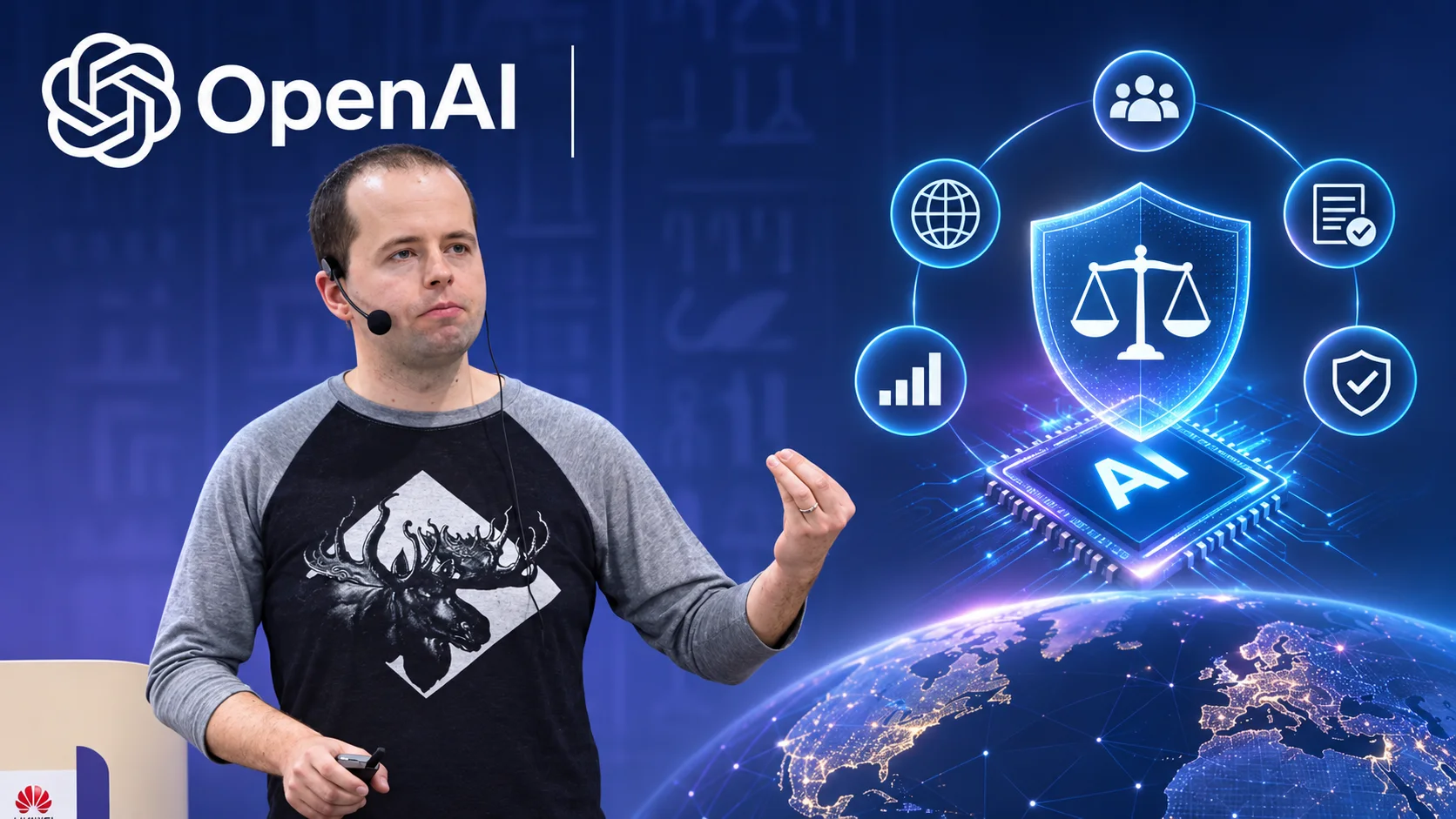
OpenAI chief scientist Jakub Pachocki has proposed that artificial intelligence companies adopt common limits on the development of increasingly powerful models. His proposal calls for developers to track AI progress using perplexity and other technical measurements, with agreed capability thresholds raised only after safety and monitoring systems meet specific milestones.
Published on 22 November 2026, the proposal seeks to establish a shared framework across AI developers rather than leaving each company to decide independently how far it should advance its models. OpenAI CEO Sam Altman has publicly supported the idea, although no industry-wide agreement has been established.
OpenAI Proposes Perplexity as a Common AI Measurement
A central part of Pachocki's proposal is the use of perplexity, a measurement of how accurately an AI model predicts the next token in a sequence of text. A token can represent a word, part of a word or another unit of information processed by a model.
Lower perplexity generally indicates that a model is better at predicting the next token. Pachocki argues that tracking this measure could provide developers with a useful way to monitor underlying improvements in AI capabilities as models become more advanced.
OpenAI has also published internal perplexity measurements to illustrate how its models have progressed. The company wants other developers to work towards a common measurement standard that could help establish comparable development thresholds.
However, perplexity alone does not capture every aspect of AI performance. The proposal also refers to other measurements, recognising that a single metric cannot fully represent the capabilities and risks of increasingly sophisticated systems.
AI Developers Would Need to Meet Safety Milestones
Pachocki's proposed framework would establish an initial limit on model development. Companies agreeing to the standard would commit not to exceed that threshold until they demonstrate concrete improvements in their ability to understand and monitor AI behaviour.
The limits would be raised only when the required safety milestones have been achieved. This would connect the pace of model development with progress in monitoring systems and other safeguards.
The proposal does not specify a numerical starting threshold or a date when such restrictions should take effect. It instead calls for AI developers to agree on the measurements, initial limits and conditions required before those limits can change.
Altman endorsed the proposal in a public post, describing Pachocki's essay as one of OpenAI's most important recent publications. He argued that common development limits could help ensure AI remains safe and controllable.
OpenAI Warns AI Could Accelerate Its Own Development
Another concern behind the proposal is the possibility that AI systems could begin contributing more substantially to the research and engineering needed to build future models.
Pachocki warned that AI could drive fundamental improvements in AI training methods as early as 2027. If that happens, the pace of capability development could increase faster than researchers improve their ability to understand and monitor the systems.
This creates a potential gap between what increasingly capable models can do and what developers can reliably assess about their behaviour.
The proposed limits are intended to address that gap by making improvements in safety and monitoring a condition for further increases in development thresholds.
Industry-Wide Agreement Remains Uncertain
The proposal would require cooperation among competing AI companies, including developers that use different training methods, datasets and model architectures. Establishing a common measurement system and agreeing on enforceable limits could therefore prove difficult.
Companies would also need to determine how safety milestones should be tested and who would verify that developers have met them.
For now, Pachocki's proposal remains a call for industry coordination rather than an adopted policy. Altman's support gives it backing from OpenAI's leadership, but participation from other major AI developers will be necessary to turn the idea into a shared standard.
The proposal puts a specific question before the AI industry: should companies be allowed to keep increasing model capabilities when their ability to monitor and control those systems has not advanced at the same pace?