ESA-JAXA BepiColombo Mission Reaches Mercury Orbit After Eight-Year Journey
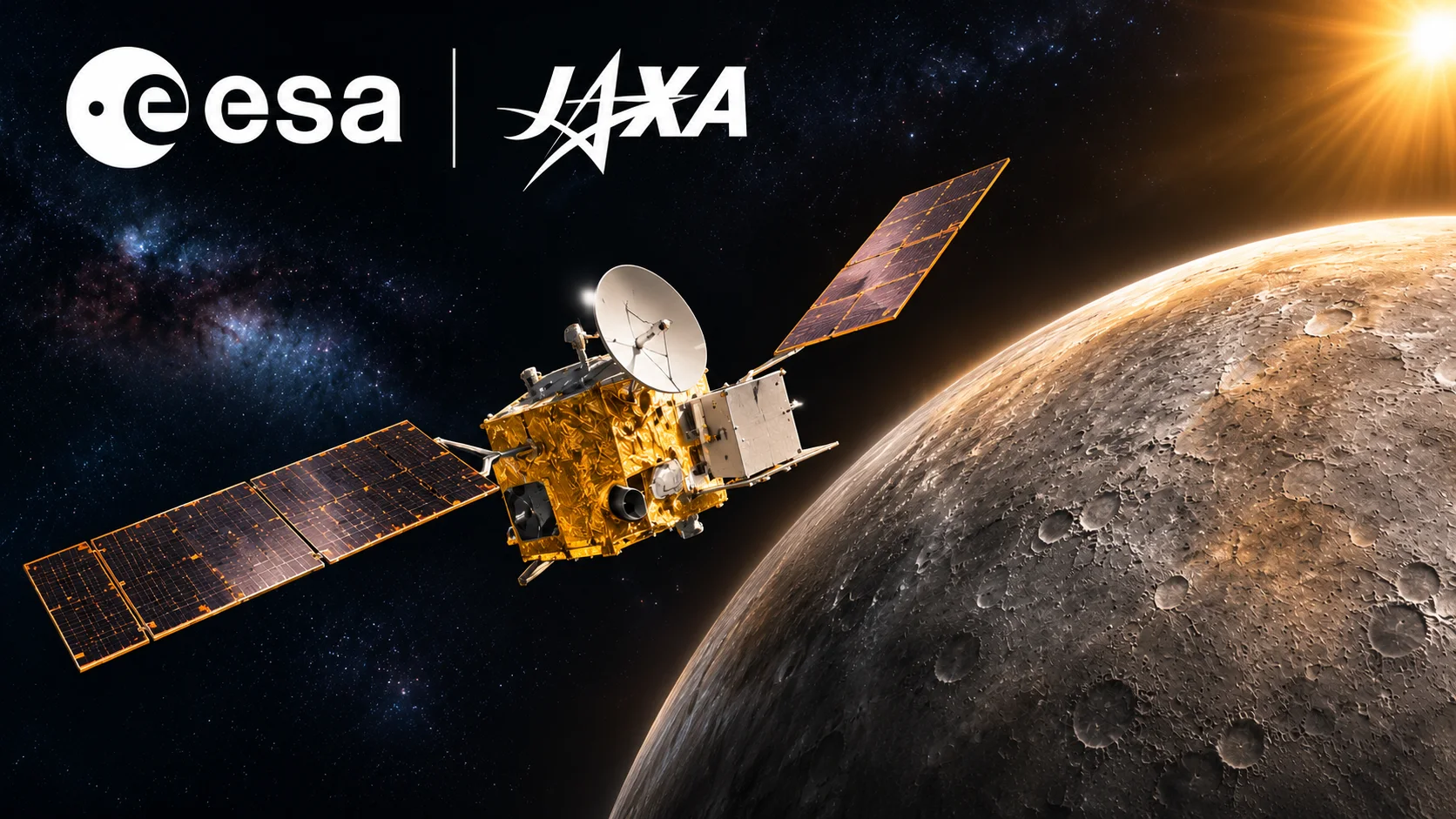
The joint European Space Agency (ESA) and Japan Aerospace Exploration Agency (JAXA) BepiColombo mission reached Mercury orbit on 21 November 2026, marking a major milestone after nearly eight years of travel through the inner Solar System. The spacecraft entered an initial orbit around the planet with its two science orbiters still attached.
The arrival brings the mission closer to its main objective: investigating Mercury's surface, internal structure and magnetic environment. However, the two orbiters have not yet begun their independent operations. They must first separate and complete a series of orbital adjustments and instrument checks before the science phase starts in April 2027.
BepiColombo Enters Mercury Orbit as a Combined Spacecraft
BepiColombo consists of ESA's Mercury Planetary Orbiter (MPO) and JAXA's Mercury Magnetospheric Orbiter, known as Mio. Both spacecraft travelled together during the final approach to Mercury, with MPO providing propulsion and control.
The orbit insertion placed the combined spacecraft into an initial elliptical polar orbit around Mercury, approximately 590 by 11,640 kilometres. The manoeuvre required the spacecraft's thrusters to slow it down sufficiently for orbital capture.
The mission launched on 20 October 2018 from Europe's Spaceport in French Guiana. Its journey included multiple gravity-assist flybys of Earth, Venus and Mercury to adjust its trajectory and reduce the energy required to reach the innermost planet.
BepiColombo's arrival was originally expected earlier, but a problem affecting the spacecraft's solar-electric propulsion system required changes to its flight path and delayed the planned orbital insertion.
Two Orbiters Will Separate in December
The 21 November arrival is only one stage of the mission's complex orbital sequence. ESA and JAXA plan to separate MPO and Mio on 9–10 December 2026.
Mio will then move towards its own highly elliptical polar orbit, where it will investigate Mercury's magnetic field and the interaction between the planet and the solar wind. MPO will continue a series of manoeuvres to reach its designated science orbit.
ESA's timeline schedules the release of Mio's protective sunshield for 16 December. MPO is expected to reach its final science orbit in March 2027, completing another important stage of the arrival sequence.
BepiColombo Science Operations Set for April 2027
The two orbiters will study different aspects of Mercury using complementary scientific instruments. ESA's MPO will focus on the planet's surface, geology, composition and internal structure. JAXA's Mio will examine its magnetic field, surrounding plasma environment and interaction with the solar wind.
Studying these areas together will help scientists investigate how Mercury formed and evolved. The planet has an unusually large metallic core and a magnetic field, despite its relatively small size. Its proximity to the Sun also creates a challenging environment for spacecraft and scientific instruments.
ESA has scheduled the beginning of BepiColombo's science operations for 6 April 2027. Until then, mission teams will concentrate on spacecraft separation, orbital adjustments and instrument commissioning.
The successful orbital insertion marks the end of a long interplanetary journey, but the mission's central scientific work is still ahead. Its two orbiters are now approaching the stage when they can begin examining Mercury from separate, complementary positions.