Bharat Semi Raises $24 Million Seed Funding to Develop AI-Powered Image Sensors
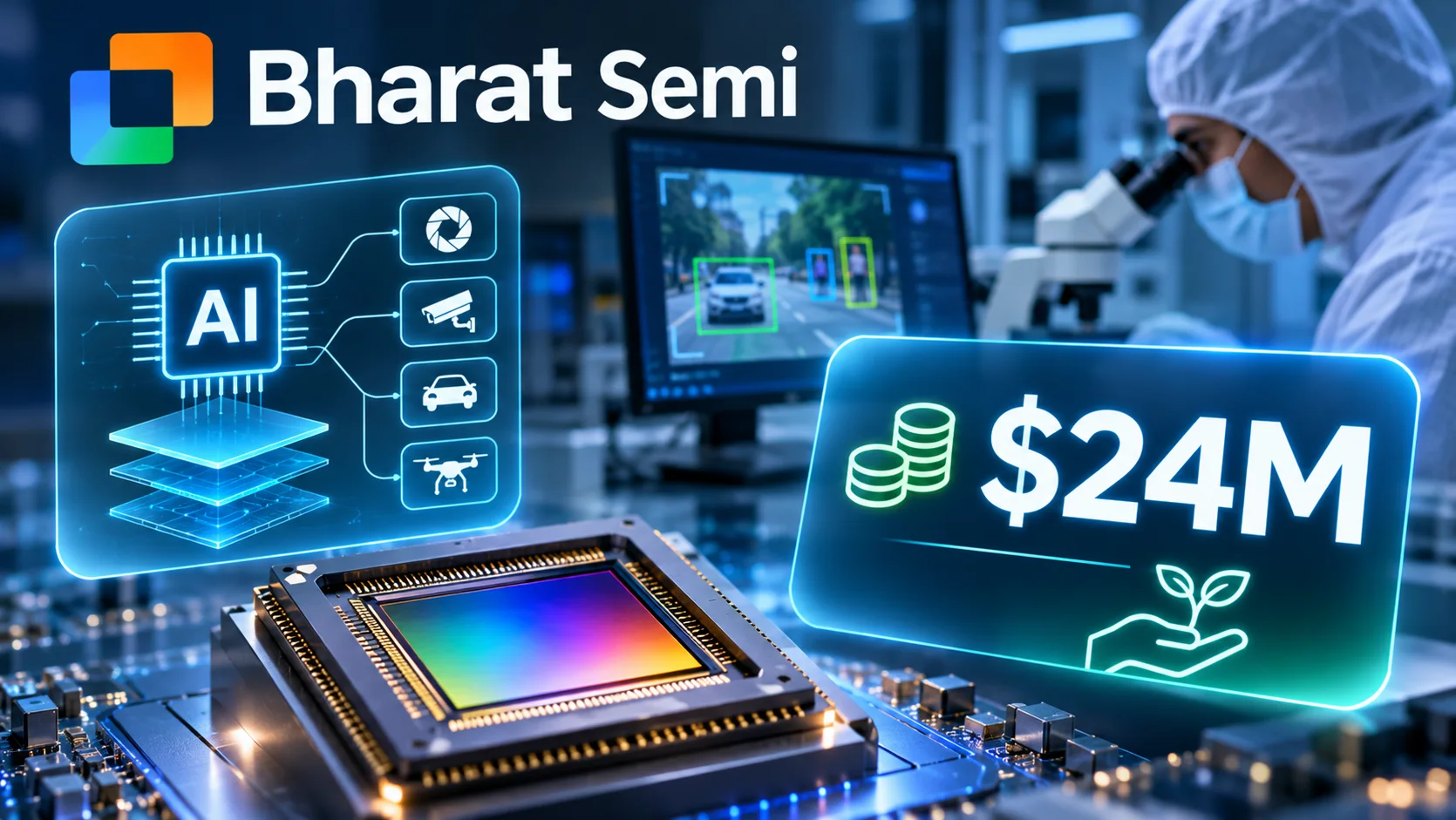
Indian semiconductor startup Bharat Semi has raised $24 million in seed funding to develop programmable image sensors that combine image capture, processing and artificial intelligence on a single chip. The New Delhi-based company plans to use the investment to accelerate product development, expand its engineering teams and prepare for commercial production in 2027.
The all-equity funding round was led by Info Edge Group, South Park Commons and Indus Bridge Ventures, with participation from Valour Capital, Micromax, Gaingels and individual investors. TechCrunch reported the investment on November 15, 2026.
The funding comes as companies explore specialised semiconductor hardware for physical AI applications, including machines that need to interpret visual information and respond to their surroundings.
Bharat Semi Funding Supports Programmable AI Image Sensors
Bharat Semi is developing image sensors that bring three functions together: capturing visual information, processing it and running AI capabilities directly on the chip.
Conventional camera systems often use separate components for image capture, image signal processing and computing. Bharat Semi's approach aims to reduce the need for these separate processors by handling more of the work within the sensor itself.
Co-founder Vrinda Kapoor told TechCrunch that this architecture could reduce system costs by at least 70% compared with conventional multi-component setups. This is a company estimate, and its commercial performance will need to be assessed once the sensors reach wider deployment.
The technology is designed for applications where devices need to interpret visual information locally. Potential uses include smart home appliances, industrial automation, surveillance systems, drones and aerospace equipment.
Startup Targets Commercial Production in 2027
Bharat Semi's products are still under development. According to Kapoor, its first-generation sensors have entered the prototyping stage, while a second generation with more advanced AI capabilities is expected to reach the prototype stage by mid-2027.
The company is targeting initial commercial production in 2027. It also says it has secured design wins with US defence technology company General Atomics and India's Kaynes Semicon.
These design wins indicate that the technology has attracted interest from potential customers, but they should not be confused with completed commercial deployments or confirmed production orders. Bharat Semi remains a pre-revenue startup.
The company plans to use the new capital to expand its engineering workforce, complete product development and prepare its sensors for the market. It has around 75 employees across India and the United States.
India's Semiconductor Startups Target Global Markets
The investment highlights an emerging part of India's semiconductor ambitions. While much of the country's chip strategy has focused on manufacturing facilities and supply-chain development, startups such as Bharat Semi are working on specialised chip designs for international markets.
Bharat Semi plans to remain fabless, meaning it will concentrate on semiconductor design and software while outsourcing chip manufacturing to external facilities. This allows the company to focus its resources on developing its sensor technology rather than building and operating a fabrication plant.
Its proposed semiconductor fabrication project, announced separately in 2024, remains under development and is not being financed by this seed round.
Why AI-Enabled Sensors Matter for Physical AI
As AI moves beyond software into robots, vehicles, drones and connected devices, sensors are becoming an important part of the technology stack. Machines need to interpret information from their surroundings before they can make decisions or perform tasks.
Bharat Semi is betting that integrating AI capabilities directly into image sensors can make these systems more efficient and reduce their dependence on separate computing components.
The company still needs to demonstrate that its technology can move from prototypes to reliable commercial products. Its progress towards 2027 production, along with the development of its customer relationships, will be important indicators of whether the approach can compete in the global semiconductor market.