China Targets Universal AI Education for Schoolchildren by 2030 in Nationwide Push
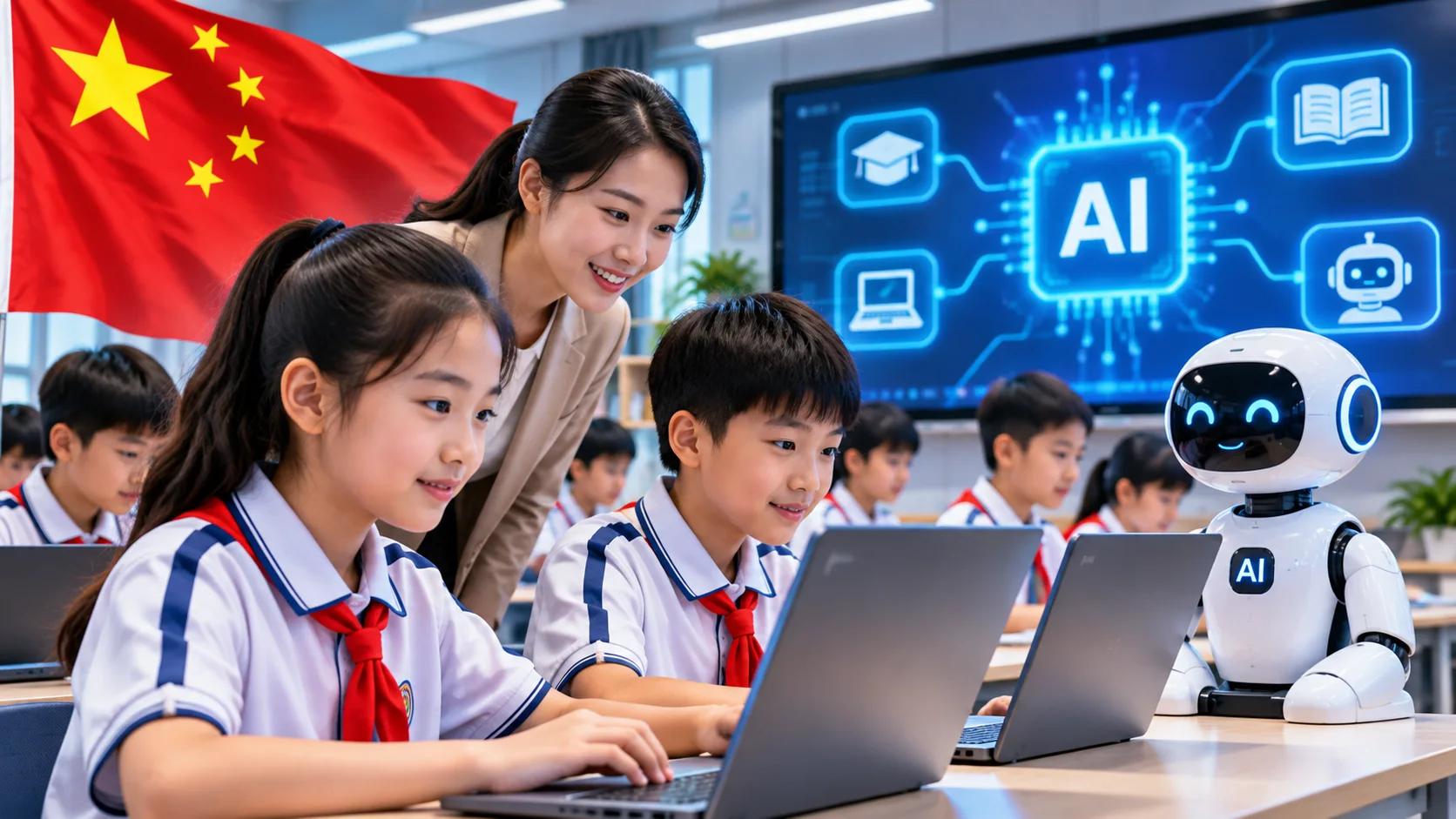
China is accelerating its efforts to introduce artificial intelligence across the school system, with a national goal of making AI literacy universal among schoolchildren by 2030. The initiative could affect nearly 200 million primary and secondary students, making it one of the world's largest efforts to integrate AI into education.
A Reuters investigation published on November 16, 2026, found that schools are already using AI for coding, robotics, personalised lessons and classroom monitoring. The government sees early exposure to the technology as a way to prepare students for an economy increasingly shaped by AI and strengthen China's technological capabilities.
However, the expansion is also raising concerns about how much students should rely on AI when learning and solving problems independently.
AI Education in China Expands Across Schools
China's education ministry has encouraged schools to introduce AI courses, train teachers and develop pilot programmes since 2024. Under the broader policy direction, younger pupils are introduced to basic AI concepts, while older students are expected to apply more advanced tools and develop critical-thinking skills.
The rollout is already visible in different parts of the country. Shanghai requires at least 30 hours of annual AI skills teaching per grade. Beijing plans to establish 100 AI pilot demonstration schools and integrate AI into student health monitoring.
Other regions are exploring more extensive applications. Guizhou is introducing facial recognition and behavioural analysis in classrooms, while Yunnan plans to have AI record and analyse lessons in 14,000 classrooms.
Reuters also reviewed more than 100 government procurement documents and found that authorities had committed at least $31 million to AI classroom equipment, teacher training and educational platforms over the previous year. The actual spending could be higher because many local budgets are not included in a central total.
Schools Use AI for Coding, Robotics and Personalised Learning
The adoption of AI varies considerably between schools. Some institutions are encouraging students to build applications, programme robots and experiment with AI-assisted projects. Others are using the technology to address shortages of qualified teachers and educational resources.
At a school in Beijing, students are learning through coding workshops, robotics projects and flight simulators. In rural Anhui province, another school uses AI-generated lessons and personalised tablet-based classes to support thousands of pupils.
These applications demonstrate how AI could extend access to learning resources, particularly where schools struggle to provide individual attention. AI systems can generate explanations, create interactive lessons and help students work through difficult subjects.
However, Reuters found that implementation remains uneven. Schools do not yet share a common approach to teaching AI or assessing whether students have developed meaningful AI literacy.
Concerns Grow Over AI Dependence and Independent Thinking
The rapid expansion has raised questions about the effect of frequent AI use on children's learning habits. Some educators worry that students may begin outsourcing problem-solving and analytical work to AI instead of developing those abilities themselves.
Research reviewed by Reuters offers mixed findings. One study involving nearly 27,000 Chinese teenagers associated AI adoption with an 18% increase in homework scores but a 20% decline in monthly examination scores over six months. Another nationwide survey involving more than 320,000 pupils identified educational benefits alongside concerns about dependence and weaker independent thinking.
These findings show associations rather than proof that AI use directly causes declining academic performance. Nevertheless, they have strengthened calls for schools to teach students how to use AI critically rather than depend on it for ready-made answers.
China's AI Education Ambition Faces a Major Test
China's target for universal AI literacy by 2030 reflects a wider effort to prepare its workforce for technological change. Introducing AI at school level could help students understand emerging technologies before entering higher education or employment.
But expanding access is only part of the challenge. Schools will also need trained teachers, consistent learning standards and safeguards around student data and classroom monitoring.
China's education experiment will therefore be judged not simply by how many schools adopt AI, but by whether students learn to use the technology while retaining their ability to think independently. The balance between technological familiarity and genuine learning could shape the long-term results of the programme.