Comtech and US Marines Set Record with 187-Mile Satellite-Free Communication Link
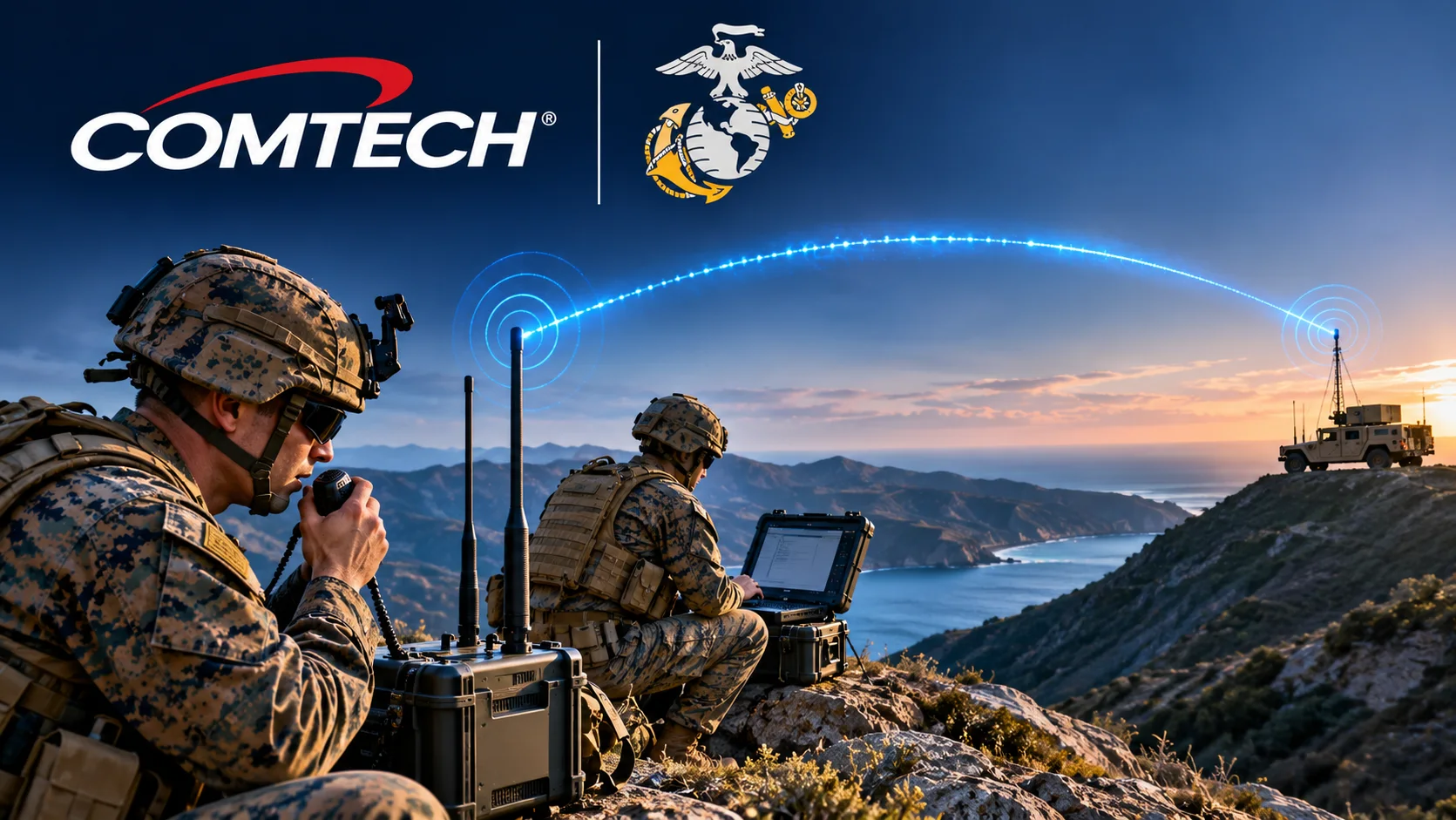
Comtech Telecommunications and the US Marine Corps have demonstrated a 187-mile communication link in Hawaii using low-power troposcatter technology. The connection operated without satellite communications, marking what Comtech describes as the longest low-power troposcatter link established by the Marine Corps.
The demonstration connected Joint Base Pearl Harbor-Hickam on Oahu with the Pohakuloa Training Area on Hawaii Island. Comtech announced the milestone on November 18, 2026, following the field exercise.
The system delivered average throughput of approximately 10 Mbps, with reported availability of 100% and round-trip latency of around six milliseconds. These figures were reported by Comtech for the demonstration.
How troposcatter communication works
Troposcatter communication uses the scattering of radio signals in the troposphere, the lowest layer of Earth's atmosphere, to transmit information beyond the normal line of sight.
Conventional line-of-sight radio systems generally require a relatively direct path between transmitting and receiving antennas. Troposcatter systems overcome that limitation by directing radio energy towards a region of the atmosphere where a small portion of the signal is scattered towards a distant receiver.
The technique can support long-distance terrestrial communications without depending on satellites. It has been used in military communications for decades, but advances in equipment design and portability are creating new possibilities for field deployment.
During the Hawaii exercise, Comtech used its COMET MPR system to maintain the connection across the 187-mile route.
Portable equipment designed for military deployment
The demonstration also highlighted the system's compact deployment requirements. Comtech said its MPR radio and accompanying 2.4-metre inflatable antenna can be transported in airline-checkable cases.
The equipment took approximately 30 minutes to deploy and operated with less than 350 watts of total prime power. This could make the system useful for military teams that need to establish communications in locations without permanent network infrastructure.
Its portability is particularly relevant to expeditionary operations, where personnel may need to move equipment quickly and establish connections across difficult terrain or separated locations.
Why satellite-independent communications matter
Satellite networks remain important to military operations, but they are not the only option for maintaining long-distance communications. In remote or contested environments, access to satellite services, fibre networks and other established infrastructure may be limited or disrupted.
A ground-based troposcatter system provides another route for beyond-line-of-sight connectivity. It does not replace satellite communications, but it can add resilience by giving military units an alternative when conventional connections are unavailable.
The Hawaii demonstration does not establish that the same performance will be achieved under every operational condition. Terrain, weather, equipment positioning and other factors can affect radio transmission. The reported results should therefore be understood as the performance recorded during this particular exercise.
Comtech's demonstration shows how an established communications technique can be adapted for modern military requirements. As armed forces seek portable and resilient ways to connect dispersed units, low-power troposcatter systems could form part of a broader mix of satellite and terrestrial communications technologies.