FMC3 Robotics Deploys First European Humanoid at Aachen Battery Plant
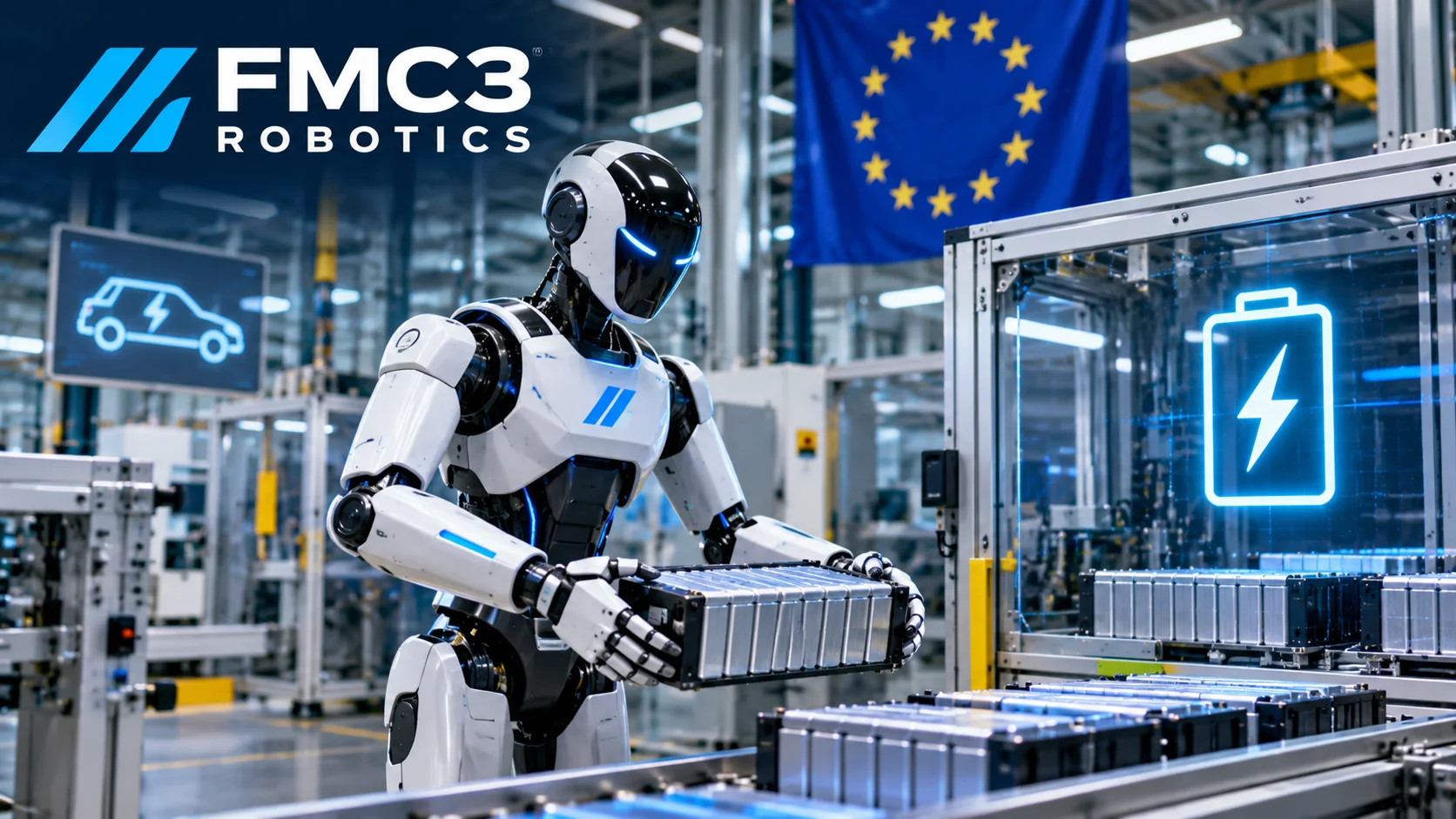
FMC3 Robotics has reported its first European humanoid deployment at a battery manufacturing facility in Aachen, Germany. The company’s announcement marks another attempt to move embodied artificial intelligence from demonstrations and proof-of-concept projects into industrial environments.
The deployment was reported on November 19 by Humanoid Press, which said the development was shown in a new company video. However, the available material does not identify the factory operator or provide details about the robot’s model, assigned tasks or operating schedule.
The announcement is therefore an early indication of industrial adoption rather than evidence of a fully established production system.
FMC3 humanoid deployment enters a battery manufacturing environment
Aachen is an established centre for battery production research and industrial development. Its manufacturing ecosystem makes the location relevant to companies exploring how robots could handle materials and support processes in battery production.
FMC3 Robotics develops technology for embodied AI systems. Unlike software-based AI tools, embodied AI allows machines to interpret information from their physical surroundings and perform actions in the real world.
The company has previously described its approach as providing the AI software layer, or robotic “brain”, for humanoid platforms developed with hardware partners. This model allows its technology to be applied across different robotic configurations.
The latest video places one of these systems at a battery manufacturing site in Aachen. However, it does not establish whether the robot is performing routine production work, undergoing supervised testing or participating in a limited pilot.
Battery production presents a demanding test for robots
Battery manufacturing involves processes that require careful material handling, controlled environments and precise positioning. Electrode sheets, for example, are sensitive components that must be moved and placed accurately during production.
FMC3 had previously outlined a proof-of-concept project involving the handling and positioning of battery electrode sheets at a battery cell production site. The company described the project as a test of how its embodied AI technology could coordinate robotic movements with existing equipment and manufacturing processes.
That earlier project provides context for FMC3’s interest in battery production. However, there is no confirmed information establishing that the Aachen deployment is the same project or uses the same equipment and workflows.
The distinction matters because a robot operating inside a factory does not necessarily mean it has been integrated into a production line or achieved consistent performance under normal operating conditions.
Key details about the deployment remain undisclosed
FMC3 has not publicly identified the customer behind the Aachen installation. The available report also does not specify how many robots have been deployed, which tasks they are expected to perform or how long the deployment will continue.
No independently verified figures have been released on operating hours, task completion rates, reliability or productivity improvements. Without those measurements, the commercial impact of the project cannot yet be assessed.
For manufacturers, the value of humanoid robotics will depend on more than the ability to perform individual movements. Systems must operate reliably, work safely alongside existing equipment and deliver measurable benefits compared with conventional automation.
The FMC3 humanoid deployment adds another real-world industrial setting to Europe's growing interest in embodied AI. Its significance will become clearer when the company or its manufacturing partner provides details about the robot's responsibilities and performance.
For now, the Aachen installation is a reported deployment milestone, but its contribution to everyday battery production remains to be established.