Four Indian Space Startups Send Payloads to Orbit on SpaceX Falcon 9
Falcon 9 Carries Four Indian Space Technologies
A SpaceX Falcon 9 has carried payloads from four Indian space startups into orbit as part of the Transporter-18 rideshare mission, launched from Vandenberg Space Force Base in California. The mission lifted off on October 1 local time, corresponding to early October 2 in India, with Indian technologies joining a large group of commercial and research payloads headed to low Earth orbit.
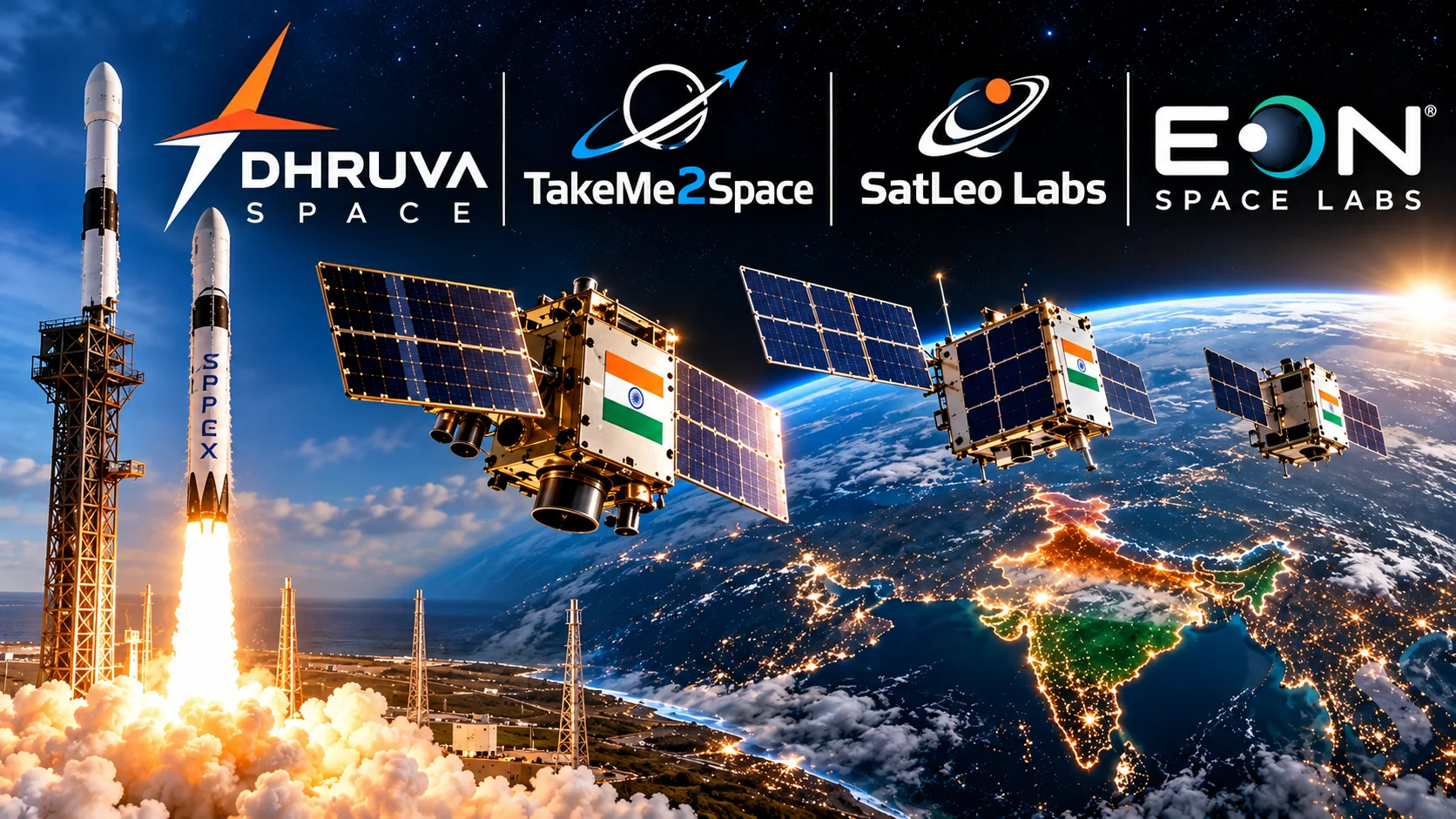
The Indian participants are Dhruva Space, TakeMe2Space, SatLeo Labs and EON Space Labs. Their technologies are aimed at different parts of the space economy, from hosted-payload infrastructure and thermal Earth observation to multispectral imaging and artificial intelligence-based processing of satellite data.
Dhruva Space’s LEAP-2 Hosts Commercial Payloads
Dhruva Space’s LEAP-2 is the company’s second commercial mission using its P-30 satellite platform. The spacecraft hosts SatLeo Labs’ TAPAS-1 thermal-imaging payload as well as a star tracker developed by France-based Sodern, part of ArianeGroup. Dhruva also handled the end-to-end integration of LEAP-2 with Falcon 9.
The mission expands Dhruva Space’s role beyond satellite manufacturing into hosted payload services and launch integration. LEAP-2 is also supported by the company’s international ground infrastructure, including its ground station in Luleå, Sweden.
SatLeo’s TAPAS-1 Looks at Earth’s Heat
Ahmedabad-based SatLeo Labs’ TAPAS-1 is described by the company as India’s first dedicated commercial thermal payload. Instead of relying on conventional optical imagery, the CubeSat-category payload uses thermal infrared sensing to measure temperature patterns across Earth’s surface.
The mission is designed to validate TAPAS-1’s thermal sensing, calibration and onboard data-processing capabilities. Potential applications include urban heat mapping, crop-stress monitoring, disaster observation and infrastructure monitoring. SatLeo plans to use the technology as a foundation for future thermal-imaging missions and a larger constellation.
TakeMe2Space Puts AI Computing in Orbit
Hyderabad-based TakeMe2Space has sent its 14-kg MOI-1A spacecraft as part of the mission. The satellite is designed to process Earth-observation data in orbit rather than sending all raw imagery back to ground stations for analysis.
MOI-1A carries computing hardware capable of 117 trillion operations per second, 2TB of storage and a nine-band multispectral imager. Customers can run AI models on the spacecraft to identify information within satellite imagery and transmit the resulting insights instead of the complete dataset. The approach is intended for applications including agriculture, mining, supply-chain intelligence and insurance.
The spacecraft follows TakeMe2Space’s earlier technology demonstrator, which tested onboard AI inference and data processing. The company says it has already signed 23 customers for its in-orbit computing services.
EON Space Labs Brings Multispectral Imaging
EON Space Labs’ MIRA imaging system is another technology carried on the mission. The compact optical telescope weighs about 502 grams and is designed for Earth observation, with applications spanning agriculture, mining, marine monitoring, supply chains and insurance.
MIRA is flying aboard TakeMe2Space’s MOI-1A and serves as a pathfinder for EON’s planned small-satellite constellation. Its presence alongside onboard AI computing also demonstrates how imaging and data processing can be combined within the same space-based system.
Indian Startups Move Toward Commercial Space Services
Transporter-18 brings these four Indian startups into a single rideshare mission while demonstrating four different approaches to commercial space technology. Dhruva Space is providing hosted-payload and mission-integration infrastructure, SatLeo is testing thermal intelligence, TakeMe2Space is developing orbital AI computing, and EON is advancing compact Earth-imaging systems.
The technologies are still at different stages of demonstration and commercial development, so the mission itself does not establish the long-term performance of each system. The next milestones will be the successful deployment, commissioning and collection of useful data from the respective payloads.