
India Demonstrates 5.56-km Free-Space Quantum Key Distribution Link
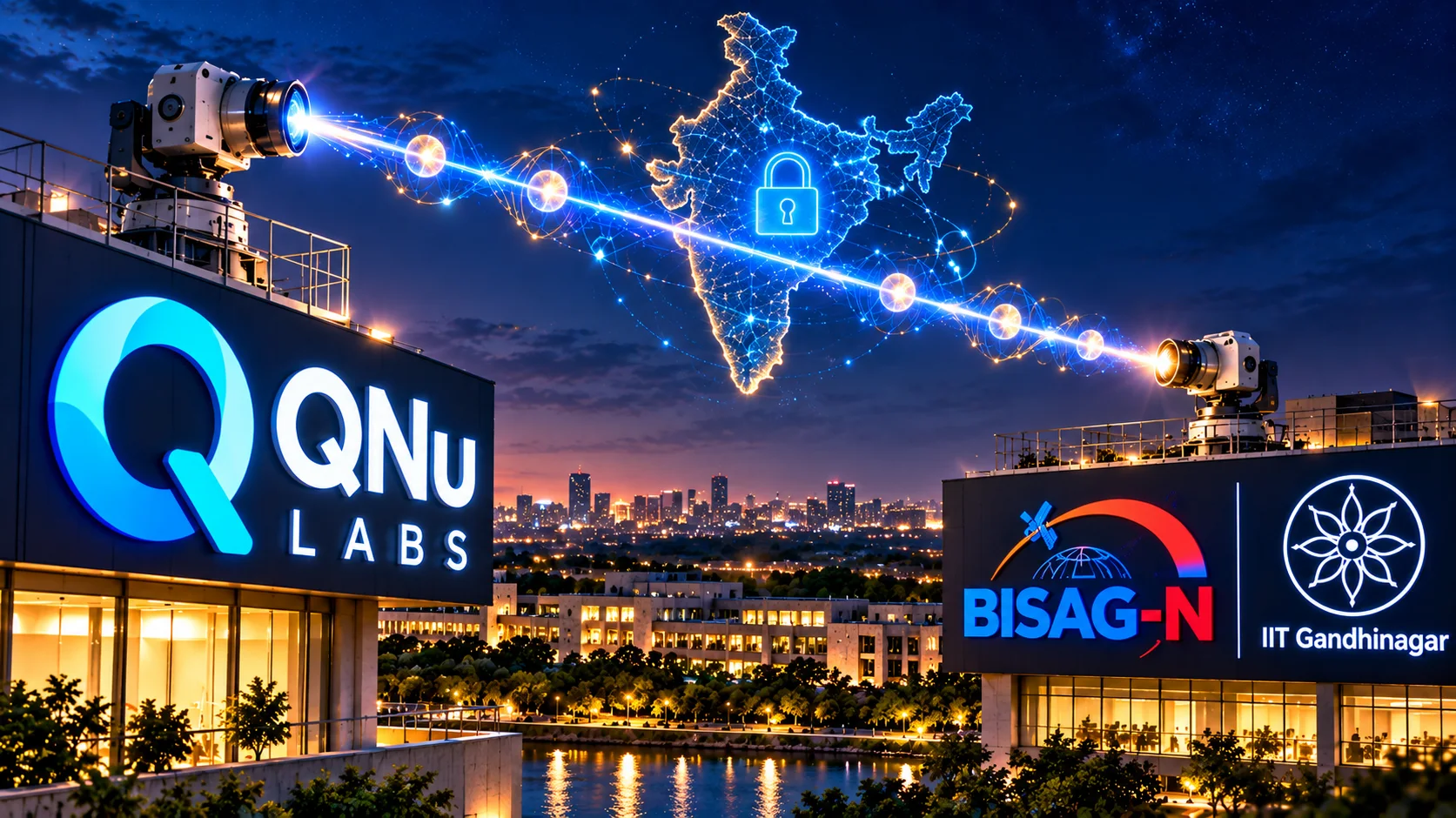
India Completes 5.56-km Free-Space QKD Trial
India has demonstrated its first free-space Quantum Key Distribution (QKD) link at the 5.56-km scale, establishing a secure quantum communication channel between BISAG-N and IIT Gandhinagar in Gujarat. The field trial was conducted on the night of September 27–28 by deep-tech company QNu Labs in collaboration with BISAG-N and IIT Gandhinagar.
The demonstration is significant because the quantum signal travelled through open air rather than a fibre-optic cable. Free-space QKD can be useful in locations where laying fibre is difficult and is also considered an important technology for future satellite-to-ground quantum communication.
QNu Labs Uses QKD and Optical Tracking
QNu Labs used its Armos QKD system together with a Pointing, Acquisition and Tracking (PAT) system to maintain the optical quantum channel between the two sites. The trial achieved a stable Quantum Bit Error Rate below 5% while generating secure keys at 230–260 bits per second.
The generated keys were then integrated with BISAG-N’s Vedic Kavach platform, which uses post-quantum cryptography and quantum random number generation. The combined system successfully encrypted, transmitted and decrypted test messages end to end.
Hybrid Security Architecture
The demonstration did not rely on QKD alone. It combined hardware-based quantum key distribution with a software security layer based on post-quantum cryptography.
This creates a two-layer approach: QNu Labs’ free-space QKD system generates cryptographic keys using the quantum channel, while Vedic Kavach provides the application-level protection. According to the participating organisations, the architecture can continue providing protection if the physical quantum channel becomes temporarily unavailable.
Step Toward Longer-Distance Quantum Networks
The 5.56-km demonstration is a terrestrial field trial rather than an operational quantum network. Its importance lies in showing that the technology can maintain a quantum communication link over several kilometres through the atmosphere while producing usable secure keys.
QNu Labs says the result could support the development of longer-distance quantum-secure networks and future satellite-based quantum communication. Such systems could eventually allow quantum keys to be exchanged between ground stations and satellites, where fibre networks cannot provide the required connectivity.
India's National Quantum Mission is also pursuing secure quantum communication technologies, including satellite-based links. The latest demonstration therefore adds a practical open-air component to the country's broader effort to develop quantum-secure communications.
QNu Labs, BISAG-N and IIT Gandhinagar Collaborate
The project brought together a private deep-tech company, a government technology institution and an academic research centre. QNu Labs supplied the QKD hardware and optical tracking technology, BISAG-N integrated the system with its Vedic Kavach platform, and IIT Gandhinagar provided the field environment for the demonstration.
The participating organisations see the trial as a foundation for further work on quantum-resilient communications. However, longer distances, variable atmospheric conditions and integration with operational networks will need to be addressed before free-space QKD can be deployed at scale.