Intel D270 GPU Benchmarks Claim Up to 5.9× Throughput Over Nvidia RTX PRO 6000
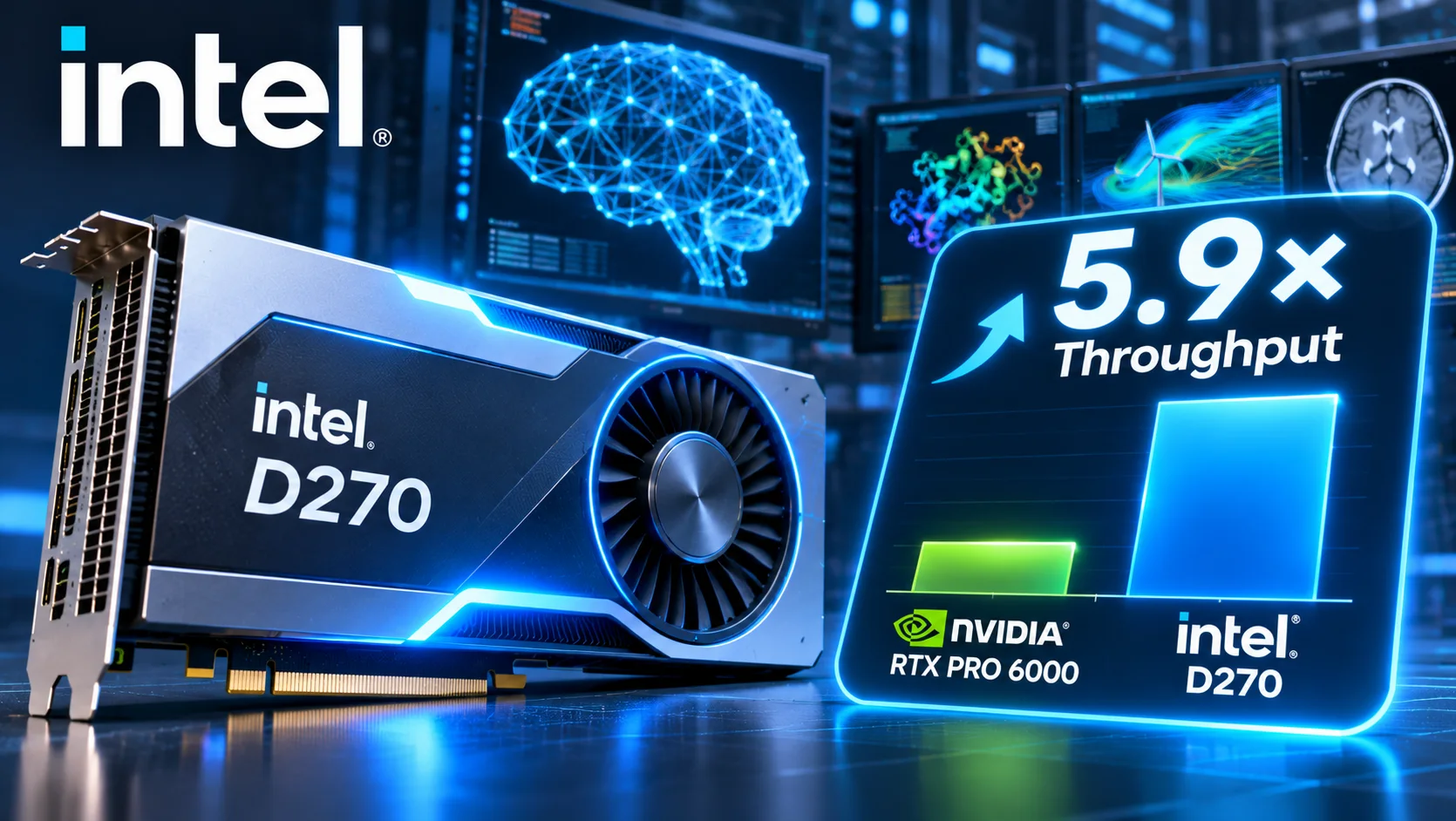
Intel has published its first detailed performance benchmarks for the D270 GPU, previously known by the codename Crescent Island. The company claims the accelerator delivers up to 5.9 times the application throughput of Nvidia's RTX PRO 6000 Blackwell Server Edition in selected financial computing workloads.
Published ahead of the SC26 supercomputing conference in Chicago, the Intel D270 GPU benchmarks focus on double-precision FP64 calculations used in financial modelling and other high-performance computing applications. Intel says the D270 operates with a 350-watt power limit, compared with 600 watts for the Nvidia GPU.
However, these are Intel's own results from pre-production hardware. They have not yet been independently validated.
Intel D270 GPU Benchmarks Show Different Gains Across Workloads
Intel reported its largest advantage in European Monte Carlo testing, where the D270 achieved 5.9 times the throughput of the Nvidia accelerator. The company also reported a 5.6-times advantage in European Black-Scholes testing and a 4.6-times lead in Binomial option pricing.
A fourth result, for American Monte Carlo, showed a smaller 1.92-times advantage. The difference illustrates why the headline figure should not be treated as a universal performance comparison. Results vary according to the application and the calculations involved.
The benchmarks were conducted on November 6 using pre-production D270 silicon. Intel's test appendix specifies one D270 against one RTX PRO 6000 Blackwell Server Edition. Although the Nvidia test system contained eight cards, Intel says only one was used for the comparison. The systems also used different host configurations and software stacks, details that matter when interpreting vendor-reported results.
Xe3P Architecture Brings Native FP64 Computing
The D270 is built on Intel's Xe3P architecture and features 32 Xe cores and 256 XMX engines. Its native FP64 support is particularly relevant to scientific and financial workloads that require high numerical precision.
The Intel-branded card includes 160GB of LPDDR5X memory, with bandwidth of 1.5TB per second. Partner-designed configurations can scale memory capacity up to 480GB. The accelerator supports computing formats from FP4 to FP64, allowing it to target both lower-precision AI inference and demanding double-precision calculations.
Intel is positioning the D270 beyond conventional AI inference. At SC26, the company is also demonstrating seismic modelling, a workload used in oil and gas exploration that involves repeated calculations across large three-dimensional datasets.
Lower Power Limit Does Not Settle the Performance Comparison
Intel's 350W power limit is lower than the Nvidia card's 600W limit, giving the D270 an apparent power-rating advantage in the comparison. However, these figures alone do not establish overall energy efficiency. That would require consistent measurements of actual power consumption alongside comparable completed workloads.
The company has also reported smaller advantages in separate AI tests: up to 29% lower latency on Drex 2.0 and 1.12 times the output-token throughput on Qwen 3 30B-A3B. These results suggest Intel is targeting both high-performance computing and AI inference, although they are separate tests with their own configurations.
Intel has not announced the D270's commercial pricing or general availability date. Independent benchmarks, final product specifications and customer testing will be important in determining whether the reported gains translate into practical advantages for data-centre operators and research institutions.
For now, the D270 gives Intel a stronger performance case in selected FP64 workloads, but Nvidia's wider position in the accelerator market will not be challenged by one set of vendor-run benchmarks alone.