
Lyte Raises $165M to Scale AI-Powered Robotic Perception
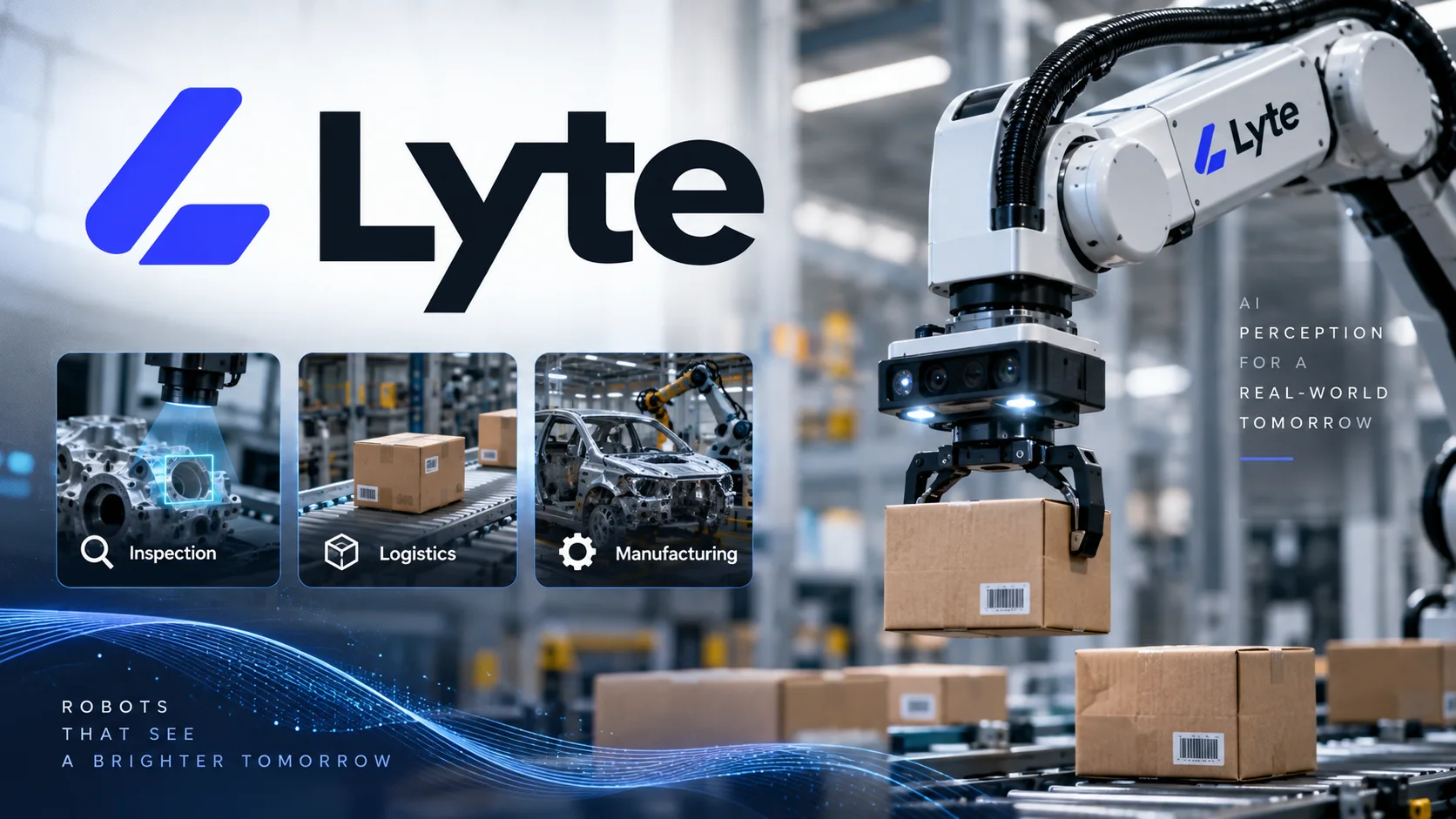
Physical AI company Lyte has raised $165 million in Series C funding led by Maverick Silicon, valuing the company at $1.6 billion. The financing will help Lyte scale production of its custom sensing silicon and LyteVision perception platform as it expands deployments across robotics and industrial environments.
Lyte is building the hardware and software that allow robots to understand their surroundings in real time. Its platform combines cameras, motion sensing, depth and other perception technologies with custom silicon, giving robots a unified stream of spatial information instead of relying on separate sensor systems.
Building a Perception System for Robots
LyteVision combines 4D sensing, RGB imaging and motion awareness in a single perception platform. The company says its custom silicon is designed to process this information with low latency, helping robots understand movement, position and changes in their surroundings.
The technology is aimed at physical AI systems including robotic arms, autonomous mobile robots, quadrupeds and humanoids. Lyte argues that reliable perception is essential for robots operating around people, machinery and unpredictable physical environments.
From Development to Production
The latest funding comes as Lyte moves beyond technology development and scales manufacturing. The company says it is already shipping its perception technology to customers and plans to use the new capital to increase production of its sensing silicon and sensor platform.
Lyte is also expanding its AI and perception capabilities while working with more robotics companies and industrial customers. Its technology has applications across manufacturing, inspection, logistics and other environments where robots need accurate spatial information to operate reliably.
Former Apple Engineers Behind the Platform
Lyte was founded by Alexander Shpunt, Arman Hajati and Yuval Gerson, engineers with backgrounds in 3D sensing and perception technology. Shpunt previously co-founded PrimeSense, whose technology became part of Microsoft's Kinect and later Apple's depth-sensing systems.
The company emerged from stealth in January 2026 with $107 million in aggregate funding. The new Series C brings its total capital raised to roughly $272 million, according to company and industry reports.
Physical AI Drives Demand for Better Sensing
The funding comes as robotics companies increasingly combine AI models with machines that operate in the physical world. While much of the attention has focused on increasingly capable AI models, robots still need dependable sensors and real-time perception to translate those capabilities into physical actions.
Lyte is positioning its technology as infrastructure for that transition. Its challenge now is to scale production while proving that its integrated perception system can deliver reliable performance across different robots, environments and commercial applications.