Meituan Releases LongCat-2.5, a 1.6-Trillion-Parameter AI Agent Model Built Without Nvidia GPUs
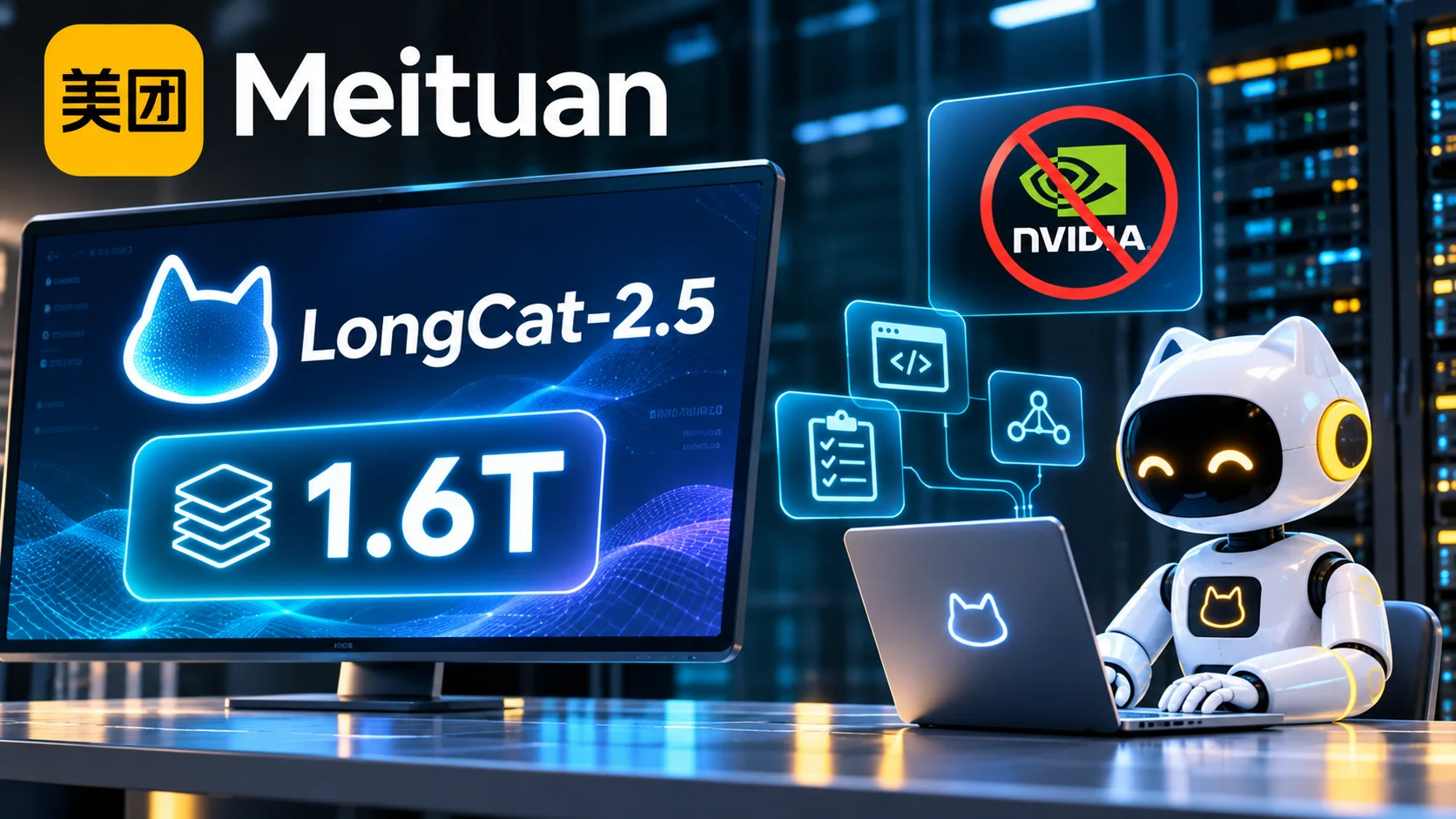
Chinese technology company Meituan has released the model weights for LongCat-2.5, a 1.6-trillion-parameter artificial intelligence model designed to handle autonomous agents and complex, multi-step tasks. The release is notable for its reported reliance on Chinese computing hardware rather than Nvidia GPUs throughout training.
The model was developed by Meituan's LongCat team and made publicly available under the MIT licence. Its architecture uses a mixture-of-experts (MoE) design, activating approximately 48 billion parameters for each token instead of using all 1.6 trillion parameters at once. This approach allows a model with a very large total parameter count to allocate computing resources to selected specialist components.
LongCat-2.5 Targets Complex AI Agent Tasks
Meituan has designed LongCat-2.5 for tasks that require AI agents to work through several stages rather than respond to a single instruction. Software development is a major focus, including understanding codebases, making changes across projects and completing longer engineering workflows.
The model also supports text, image and video inputs, with text as its output format. Its image-processing approach converts visual information into discrete tokens that can be handled alongside text. Meituan says this native multimodal design is intended to support visual coding, creative design and 3D-related tasks.
Through its API, the model supports a context window of up to one million tokens and can generate responses of up to 128,000 tokens. These capabilities are intended to help agents retain information across longer tasks and process substantial amounts of material within a single interaction.
Chinese Hardware Powers the Model's Infrastructure
The hardware behind LongCat-2.5 is central to the announcement. Meituan says the model was trained entirely on Chinese hardware, demonstrating an alternative to the Nvidia-based infrastructure widely used for large-scale AI development.
The company has also published a self-hosting configuration based on 194 Huawei Ascend Atlas A2 accelerators. The proposed setup divides processing between image handling, prompt ingestion and response generation. It uses four-bit quantisation, which reduces the numerical precision used to represent model weights and activations.
According to Meituan's reported tests, this configuration improves prompt-processing throughput by 43.3% and response-generation throughput by 42.77% compared with an eight-bit version. The company says accuracy remains comparable, although these performance figures are based on its own evaluations.
Open Weights Give Developers Access to the Model
The LongCat-2.5 weights are available under the MIT licence, which permits commercial use, modification and redistribution. Developers can therefore examine the model and explore self-hosting rather than relying exclusively on a company-operated service.
Meituan's published benchmark results show competitive performance on selected coding and agent evaluations. The company reports a score of 88.4 on Terminal Bench v2.1, close to the 89.1 listed for Claude Opus 5 in its comparison. However, benchmark results should be interpreted carefully because performance can vary across evaluation methods and task types.
Why the Release Matters for China's AI Industry
LongCat-2.5 adds to China's efforts to build large AI systems around domestic processors and infrastructure. Developing capable models without Nvidia GPUs could give Chinese technology companies greater flexibility as access to advanced foreign chips remains a strategic concern.
The release also gives developers another open-weight option for building AI agents, particularly for coding and other extended workflows. However, its practical value will depend on independent testing, deployment costs and performance across real-world applications.
For Meituan, the announcement demonstrates progress in combining large-scale model development with domestic hardware. It also highlights how competition in AI is increasingly shaped not only by model capabilities, but by the computing infrastructure needed to train and operate them.