Microsoft and Nvidia Push Surface Laptop Ultra for Local AI Agents
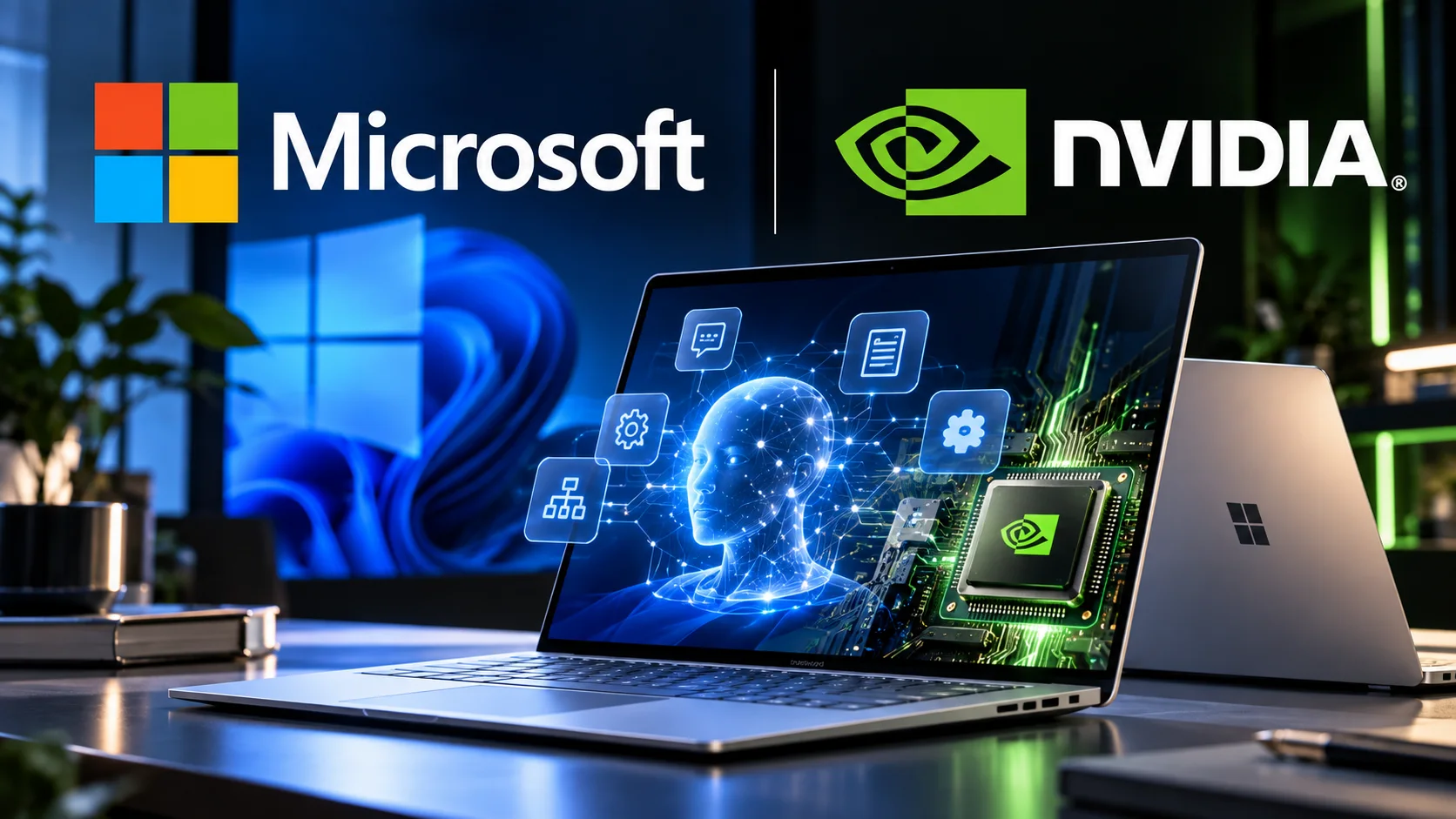
Microsoft and Nvidia are putting local AI at the centre of their latest Windows hardware push, with the Surface Laptop Ultra designed to run advanced AI agents directly on the device.
The October 7 event in San Francisco brings Microsoft CEO Satya Nadella and Nvidia CEO Jensen Huang together as the companies expand their collaboration around Windows PCs powered by Nvidia's RTX Spark platform. The strategy is aimed at moving workloads such as coding and complex business tasks from cloud infrastructure to high-performance personal computers.
The Surface Laptop Ultra was initially unveiled earlier this year as Microsoft's first full-fledged Windows laptop powered by an Nvidia processor. Its RTX Spark system combines a 20-core Grace CPU with a Blackwell GPU and up to 128GB of unified memory.
RTX Spark Brings More AI Computing On Device
Nvidia's RTX Spark is designed specifically for personal AI workloads, offering up to 1 petaflop of AI performance and enough unified memory to run models with as many as 120 billion parameters locally.
That capability is intended to reduce the need to send every AI request to a remote data center. For users and businesses, local processing can also keep sensitive information on the device for workloads where privacy and data control are important.
Microsoft and Nvidia are also building software around the hardware. Windows security primitives and Nvidia OpenShell are designed to give users greater control over what AI agents can access and do on a computer.
AI Agents Become the New PC Workload
The companies are betting that AI agents will become a major category of personal-computing workloads. Unlike conventional chatbots, these systems can perform multi-step tasks, interact with applications and work across files and services.
Nvidia says RTX Spark systems can support local agents through frameworks such as Hermes Agent and OpenClaw. Microsoft is also working on Windows-native agent experiences that can operate across applications and workflows.
The shift could also change the economics of AI computing. Microsoft currently runs many AI workloads through Azure data centers, while local processing moves some of that computing demand onto hardware purchased by consumers and businesses.
Cost Could Limit Local AI Adoption
The biggest challenge may be the cost of the hardware. Demand for memory has pushed up prices across the PC market, while Nvidia recently raised the price of its DGX Spark AI desktop by about 75% to $6,950.
That creates a tension for the local-AI strategy: the technology is becoming capable enough to run sophisticated agents on personal computers, but the hardware required to do it may remain expensive for mainstream users.
Microsoft and Nvidia are therefore entering a market where local AI must compete not only on performance, but also on price, security, battery life and the practical benefits of keeping workloads on the device.