Microsoft Runs 235-Billion-Parameter AI Model Across Three PCs
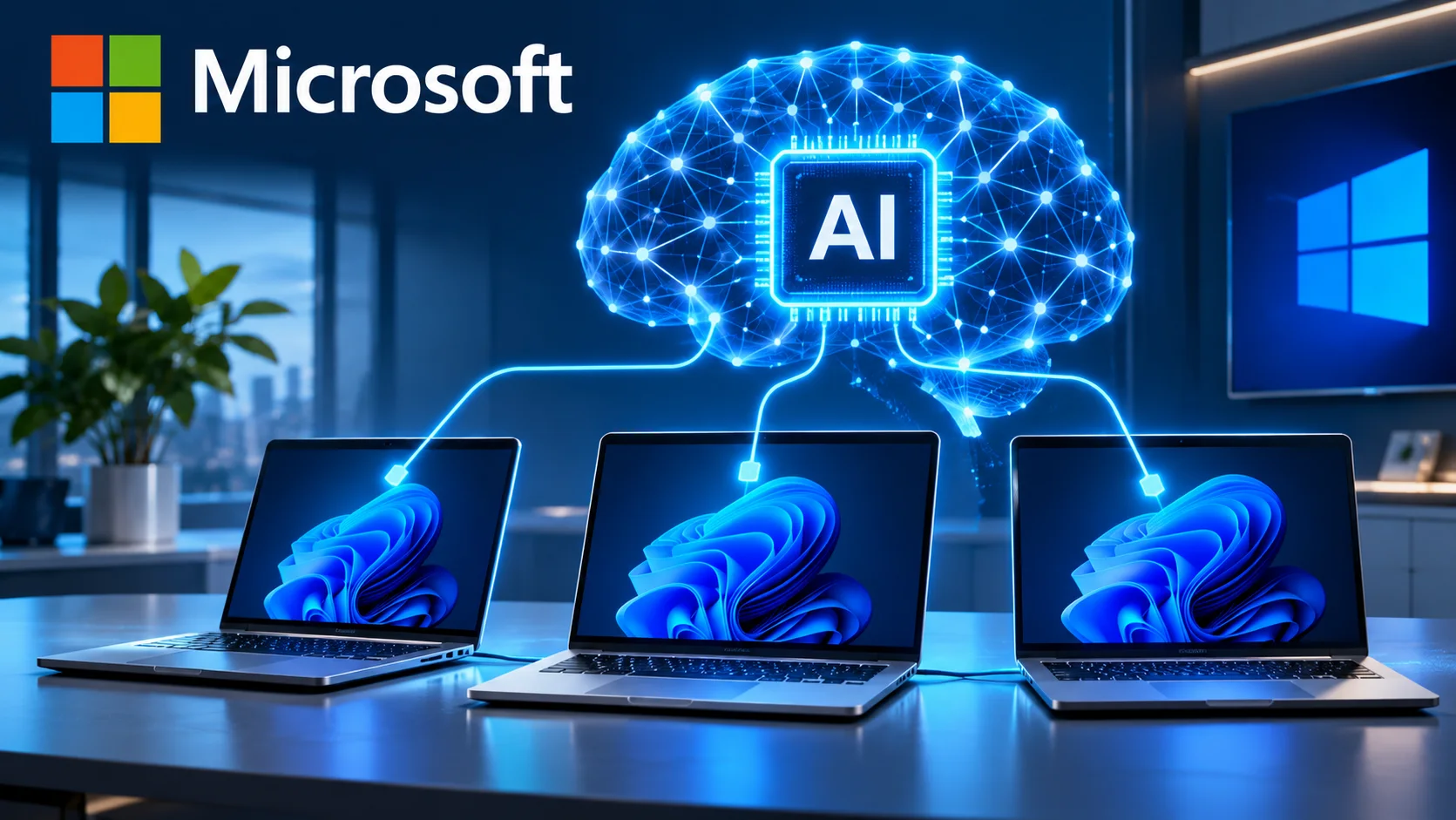
Microsoft has demonstrated how three Windows mini PCs can work together to run an artificial intelligence model containing 235 billion parameters. The demonstration uses RDMA over USB4, a new technology designed to connect compatible computers and combine their memory and GPU computing resources for local AI workloads.
Microsoft published the technical details on November 19, 2026. Its demonstration involved the Qwen3-235B-A22B model, which ran across three AMD Ryzen AI Max-powered mini PCs at approximately 18.5 tokens per second using four-bit quantisation.
The development offers a way to run larger AI models locally without relying entirely on cloud computing or investing in specialised data centre networking equipment.
How RDMA over USB4 Connects Multiple PCs
RDMA stands for Remote Direct Memory Access. It allows computers to transfer data directly between memory regions, reducing the work handled by conventional networking software and lowering communication delays.
Microsoft's implementation brings this capability to USB4 connections between Windows PCs. It uses the NetworkDirect interface, which Windows already supports for remote direct memory access through specialised network adapters.
With RDMA over USB4, compatible computers can distribute parts of a single AI model across their combined memory and GPU resources. This is particularly useful for models that exceed the memory capacity of an individual machine.
Microsoft reported that its tests achieved round-trip latency of approximately 28–50 microseconds for small messages. That was roughly four times lower than Ethernet over UDP using the same USB4 connection, according to the company's measurements.
Three Mini PCs Run a 235-Billion-Parameter Model
The demonstration used three mini PCs equipped with AMD Ryzen AI Max processors, Radeon 8060S graphics and 128GB of unified memory each. Connected through USB4 at 40Gbps in a full-mesh configuration, the systems ran Qwen3-235B-A22B at around 18.5 tokens per second.
Qwen3-235B-A22B is a 235-billion-parameter mixture-of-experts model. Four-bit quantisation reduces its memory requirements, making distributed execution across the three computers possible.
AMD separately reported 21.98 tokens per second in decoding speed and 117.98 tokens per second in prompt processing on its own three-PC configuration. These figures come from different test measurements and should not be treated as identical results.
Intel also demonstrated distributed inference using GPT-OSS-120B across three and four Core Ultra Series 3-based PCs. Its reported decoding speeds reached 49.4 tokens per second with three computers and 54.2 tokens per second with four at a 1,000-token context.
Windows Developer Preview Is Still Pending
Microsoft has released the open-source NetworkDirect provider for USB4, along with sample code and testing tools. However, the Windows build containing the required RDMA support was not yet available when the announcement was published.
The company plans to bring the capability to Windows Insiders through the Experimental Channel under Future Platforms. Developers will also need compatible USB4 hardware, direct connections between every pair of computers and an AI framework capable of distributing model execution.
Microsoft recommends a full-mesh arrangement rather than daisy-chaining the machines, as the latter can significantly reduce performance. The preview also requires test signing, which means disabling Secure Boot during testing. Microsoft advises using dedicated test computers rather than everyday devices.
What It Could Mean for Local AI Computing
The technology could make larger local AI models more accessible to developers and researchers who already have multiple compatible PCs. Instead of depending on one machine's memory capacity, they could distribute workloads across a small cluster.
However, the approach still depends on hardware compatibility, available memory, GPU performance and software support. Connecting computers alone does not automatically allow every AI application to share their resources.
Microsoft is exploring support for more hardware platforms and future Windows releases. For now, RDMA over USB4 remains a developer preview, but the demonstration shows how ordinary PC connectivity could become part of the infrastructure for increasingly demanding local AI workloads.