Nvidia Rubin HPC GPU Brings More Than 50,000 CUDA Cores to Scientific Computing
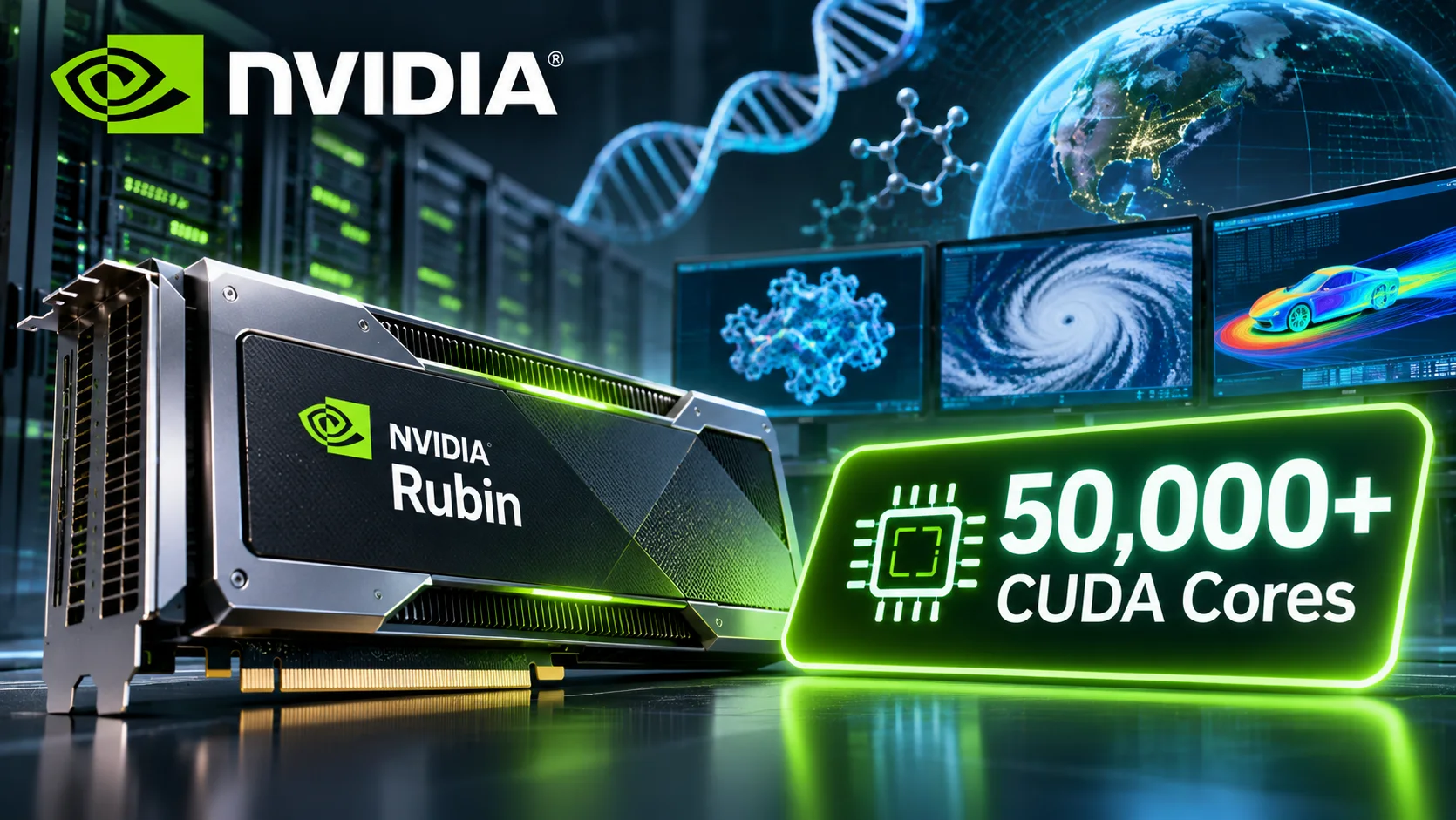
Nvidia has introduced Rubin HPC, a new graphics processing unit designed to accelerate scientific computing, engineering simulations and large-scale analytics. Announced at the SC26 supercomputing conference in Chicago, the GPU is part of the company's Vera Rubin platform and is expected to become available in 2028.
The Nvidia Rubin HPC GPU features more than 50,000 CUDA cores on a single chip, a figure the company describes as a record for its GPUs. It also introduces sparse-data acceleration and seventh-generation Nvidia NVLink connectivity, with the design focused on moving data efficiently alongside raw computing power.
The announcement reflects Nvidia's effort to extend its next-generation computing architecture into research environments where simulations, complex datasets and AI-driven workflows increasingly work together.
Nvidia Rubin HPC Targets Scientific Simulations and Analytics
Scientific workloads often involve processing large datasets in which relevant information is spread across different locations. Climate modelling, engineering simulations, genomic analysis and financial risk calculations all rely on repeated operations involving large volumes of data.
Nvidia says Rubin HPC is designed to address this challenge through a balanced approach to computation and data movement. Its sparse-data acceleration capability is intended to keep the GPU's large number of CUDA cores supplied with information, reducing the time they spend waiting for data.
The GPU is also designed to accelerate operations such as sparse matrix calculations, stencil computations, sorting and reductions. These are recurring tasks in scientific and analytical workloads, where improvements in data handling can be as important as additional processing capacity.
Seventh-Generation NVLink Supports GPU Connectivity
Rubin HPC also uses seventh-generation Nvidia NVLink technology to accelerate communication between GPUs. High-performance computing systems often distribute workloads across multiple processors, making fast data exchange essential for scaling complex simulations.
Nvidia is linking this hardware to the growing use of AI agents in scientific research. Such systems can help researchers explore candidate materials, molecules and engineering designs, then run simulations to test possible outcomes. Faster simulations could shorten the cycle between forming a hypothesis, evaluating it and refining the next experiment.
At SC26, Nvidia vice president Ian Buck also described Rubin HPC as supporting computing precisions from FP64 to FP4. He said it has around three times as many CUDA cores as the Hopper architecture. These details add context to the company's wider scientific-computing pitch, although application-level performance will need to be assessed through benchmarks.
Rubin HPC Availability Expected in 2028
Nvidia has placed Rubin HPC within its Vera Rubin platform, but the announcement is an early product preview rather than a full technical specification release. The company has not yet provided a complete set of performance benchmarks or detailed figures for memory capacity, power consumption and pricing in its dedicated Rubin HPC announcement.
Those details will matter to research institutions and supercomputing operators evaluating the GPU for specific workloads. A high CUDA core count alone does not establish how quickly a processor will handle every scientific application. Performance also depends on memory bandwidth, precision capabilities, software optimisation and the nature of the task.
Nvidia expects Rubin HPC to become available in 2028. Until then, further technical disclosures and independent testing will be needed to establish its practical advantages over existing high-performance computing hardware.
The announcement signals a broader direction for accelerated computing: GPUs are being developed not only to train and run AI models, but also to power the simulations and data-intensive research that AI agents may increasingly coordinate.