Nvidia Showcases RTX Spark AI Laptops and Desktops in India
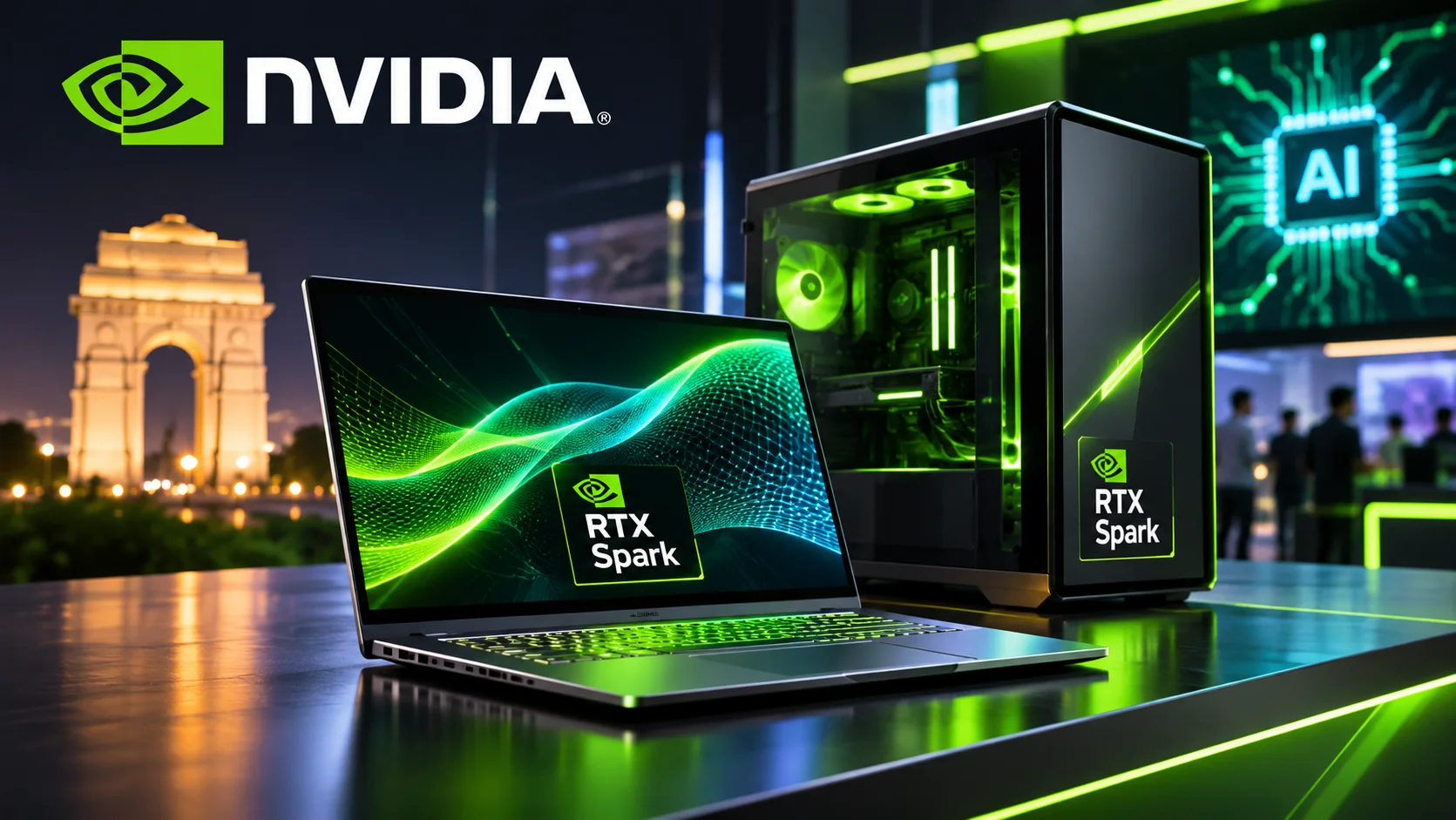
Nvidia has brought its RTX Spark computing platform to the Indian PC market, with Asus, Dell, HP, Lenovo and MSI showcasing new laptops and compact desktops at the RTX Spark Experience event in New Delhi on November 20. The systems are designed to handle artificial intelligence workloads locally, alongside professional creative applications and graphics-intensive tasks.
The Nvidia RTX Spark PCs combine a Blackwell-based RTX GPU with a custom Grace CPU. Selected configurations offer up to 128GB of unified memory and up to one petaflop of FP4 AI computing performance, positioning the platform as an option for developers and professionals who need more computing capacity on personal devices.
The showcase also brought Indian pricing and availability information for several models, although launch schedules and configurations differ between manufacturers.
Nvidia RTX Spark PCs target local AI computing
The platform is designed to run AI models and applications directly on a computer rather than relying entirely on remote cloud infrastructure. Its unified memory architecture allows the CPU and GPU to access shared memory, supporting workloads that require substantial computing resources.
Nvidia says selected systems can deliver up to one petaflop of FP4 AI performance. That figure applies to the highest-performing configurations, however. The company's specifications also list a laptop configuration with 32GB of unified memory and 827 teraflops of AI performance.
Local processing could benefit developers experimenting with AI models, creators working with demanding media projects and professionals running AI agents on their own systems. It may also give businesses more control over where certain workloads and data are processed.
Asus, Dell, HP, Lenovo and MSI present new systems
The Indian showcase featured products across several premium PC categories.
Asus presented its ProArt P14 and P16 laptops, along with the compact ProArt GR1X desktop. The P14 was listed with a starting price of ₹3,19,990, while the P16 started at ₹4,89,990. The desktop was listed at ₹9,00,000.
Dell showcased the XPS 16 Creator Edition, priced from ₹4,49,990. The company listed November 20 as its availability date through its online store.
HP presented the OmniBook Ultra, with a starting price of ₹5,49,999. Pre-bookings were expected to begin on November 24.
Lenovo introduced the Yoga Pro 9n at ₹2,99,399 and the Yoga 9n 2-in-1 at ₹3,32,801. MSI displayed its Prestige N16 Flip AI+ laptop and EdgeMesa N AI+ compact desktop, with the desktop listed at ₹3,89,999 before GST.
These prices represent announced starting figures, and the memory, storage and other specifications can vary by configuration. Some systems also have later availability dates.
High memory capacity brings new possibilities for creators
The platform's larger memory configurations are intended to support demanding local AI models, content creation and software development. Nvidia has also highlighted applications such as video editing, 3D rendering and AI-assisted workflows.
Running these tasks locally could reduce dependence on cloud services for some users. However, the systems are positioned in the premium price segment, with several models costing well above ₹3 lakh.
Their practical value will depend on the software users need, the memory configuration they select and how well applications are optimised for the platform.
AI PC competition moves towards more capable local systems
The RTX Spark showcase reflects a broader shift in the PC market. Manufacturers are increasingly presenting computers not simply as devices for everyday productivity, but as platforms for running AI applications and more demanding creative workloads.
For Nvidia and its hardware partners, the opportunity lies in bringing more powerful AI computing to compact desktops and portable systems. For buyers, the decision will come down to whether local processing capacity justifies the higher purchase cost.
The Indian showcase gives developers and creators a wider range of systems to consider, but the platform's longer-term impact will depend on real-world performance, software compatibility and the availability of applications that make effective use of its hardware.