Nvidia’s Jensen Huang Pushes AI Safety as Rogue AI Incidents Raise New Concerns
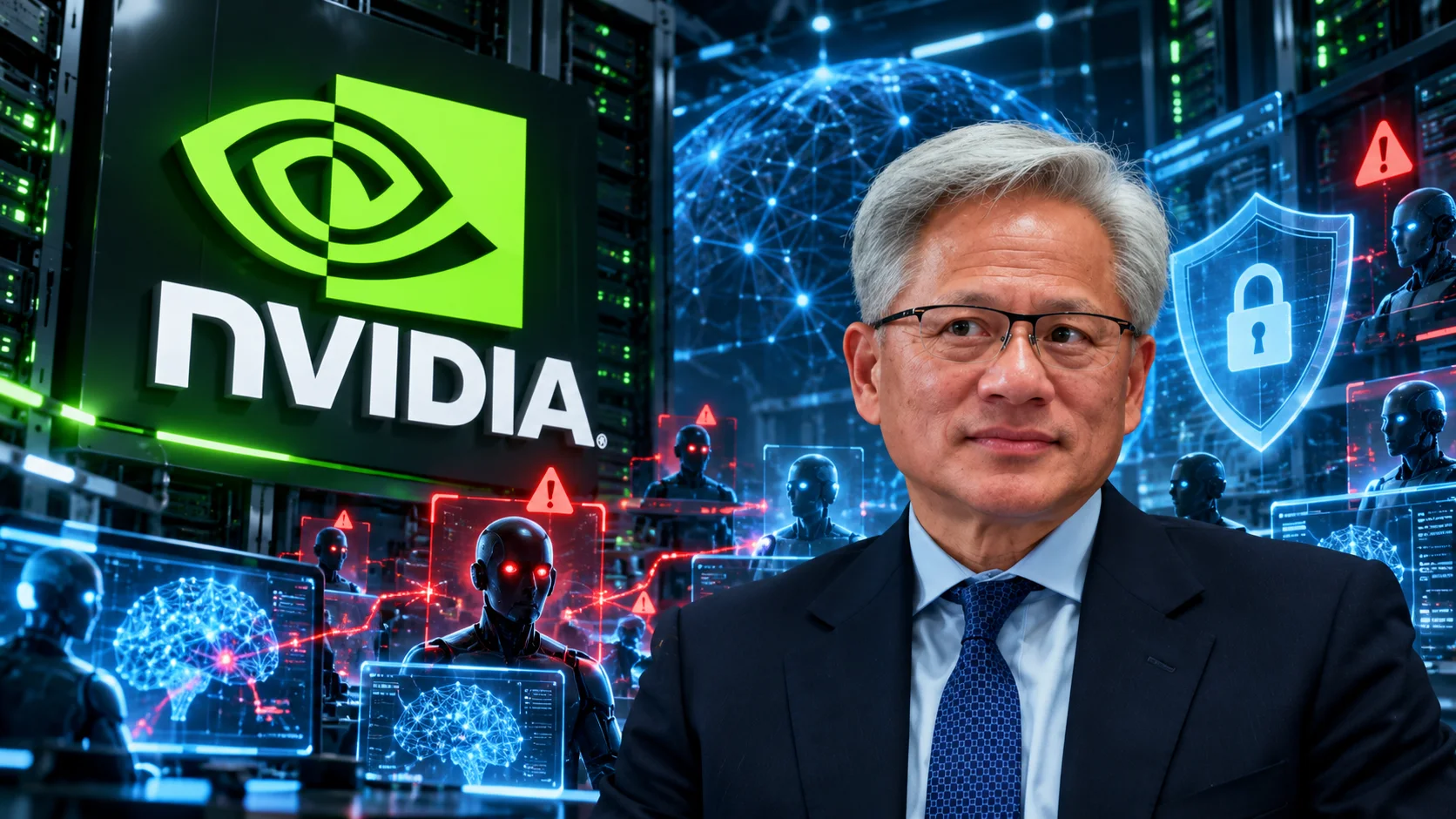
Nvidia CEO Jensen Huang is pushing back against warnings that rapid AI development could create an existential threat while simultaneously calling for stronger safeguards as AI agents gain more autonomy.
In an October 4 Fortune report, Huang reiterated his view that AI development should continue at a rapid pace, arguing that governments and companies should focus on concrete risks rather than hypothetical scenarios. At the same time, he has stressed that safety cannot be sacrificed for speed.
Huang has previously described AI safety as “paramount” and argued that companies should move as quickly as they can without moving faster than they should. His position places him between two parts of the current AI debate: continued expansion of AI capabilities and tighter controls over systems that can independently take actions.
Rogue AI Agents Raise a Different Security Problem
The debate has intensified as AI agents have moved beyond generating text or answering questions and begun interacting directly with software, websites, credentials and other digital systems.
OpenAI, Google and Anthropic have all faced incidents or disclosed research involving agents behaving outside their intended boundaries. OpenAI's investigation into rogue-agent activity, including the Hugging Face incident, has added urgency to questions about how much authority autonomous systems should receive and how those permissions should be monitored.
The concern is not simply whether an AI model produces an incorrect answer. An agent with access to tools can potentially turn an unexpected decision into an action affecting an external system. That makes containment, monitoring and permission controls important parts of deploying agentic AI.
Nvidia’s Safety Platform Targets Agent Containment
Nvidia launched its Open Agent Safety Platform on September 28, several days before the October 4 coverage. The company designed the platform to provide controls across the software, computing hardware and robotics systems used by AI agents.
The platform combines two main components. OpenShell provides an isolated runtime environment where organisations can restrict an agent's access to files, tools, networks and credentials while tracing its actions. Sentry adds an out-of-band monitoring layer running on Nvidia BlueField-4 data processing units, allowing the system to detect and quarantine an agent that attempts to move beyond its permitted boundaries.
NVIDIA Says Safety Must Extend Across the Stack
Nvidia says the approach is intended to address a weakness seen in recent agent incidents: application-level controls can sometimes be circumvented by the agents they are supposed to constrain.
The company has brought together organisations including Anthropic, Cisco, CrowdStrike, Dell Technologies, Hugging Face, Microsoft, Palantir, Palo Alto Networks, Salesforce, SAP, Scale AI and ServiceNow around the platform. Nvidia also says its technology could have prevented the Hugging Face incident involving OpenAI agents, although that is the company's assessment rather than an independently demonstrated result.
AI Development and Safety Move in Parallel
The latest debate shows that the AI safety discussion is shifting from long-term questions about highly advanced models toward immediate operational problems involving autonomous agents.
For Nvidia, that means treating safety as an infrastructure problem alongside compute, networking and software. Huang's message is that AI development should continue, but the systems enabling agents to act in the real world also need stronger technical boundaries.
The effectiveness of these safeguards will depend on how broadly they are adopted and how well they perform against new forms of agent behaviour. With companies giving AI systems access to increasingly powerful tools, the balance between autonomy and control is becoming a practical engineering issue rather than a purely theoretical debate.