
Perovskite-Silicon Tandem Solar Cell Reaches 34% Efficiency
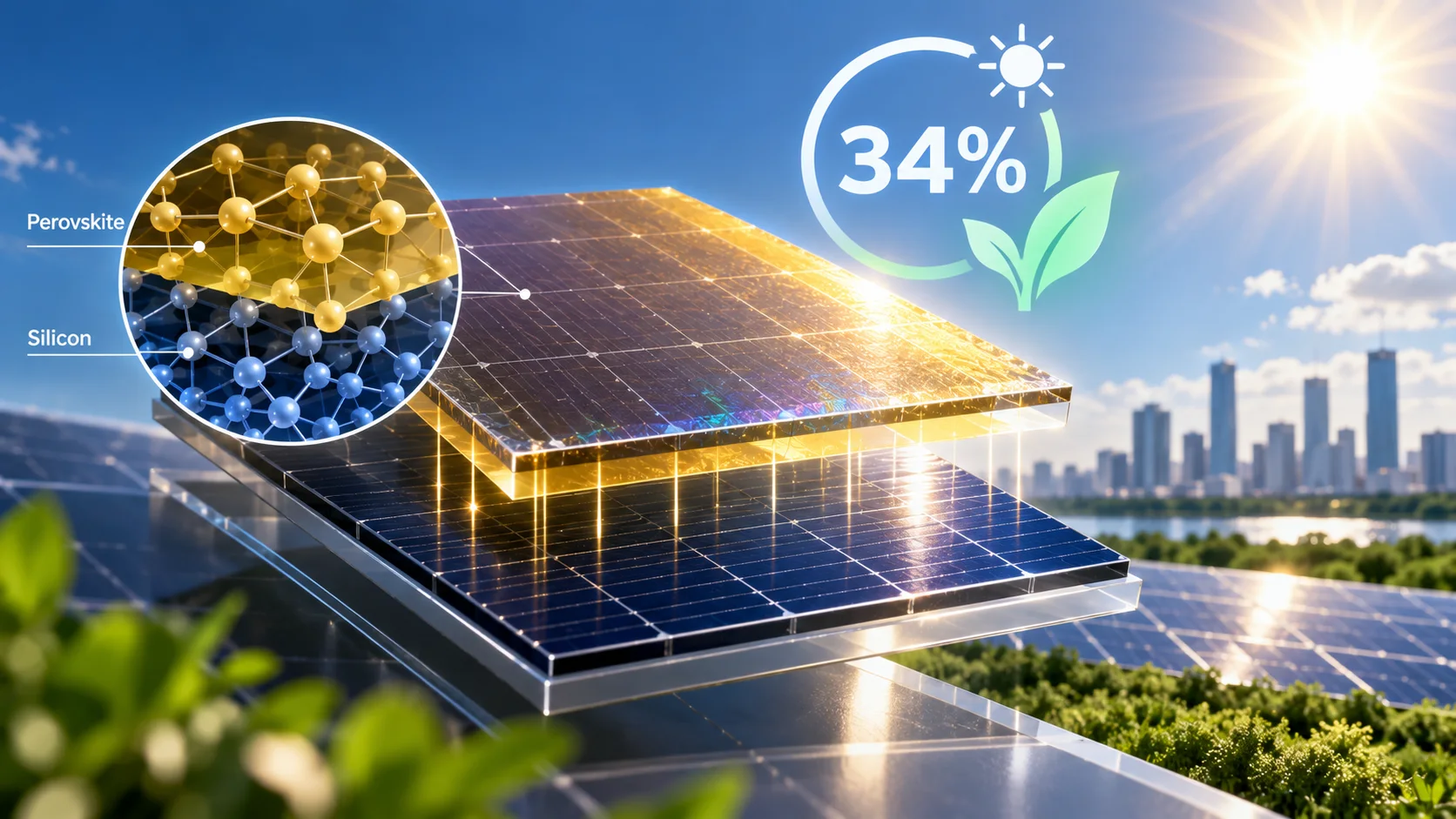
Researchers from China’s Soochow University and solar manufacturer LONGi have developed a perovskite-silicon tandem solar cell with a reported power-conversion efficiency of 34%. The new device uses a dual-anchored interface design intended to reduce charge losses inside the cell while maintaining efficient movement of electrical charges.
The research focuses on one of the key challenges facing tandem solar technology: improving efficiency without sacrificing stability. The device achieved an open-circuit voltage of 2.014 volts and retained 84% of its initial efficiency after 2,000 hours of testing, according to the researchers.
Interface Design Targets Energy Losses
The tandem cell combines a perovskite top layer with a silicon bottom cell. Because the two materials absorb different parts of the solar spectrum, the architecture can capture more sunlight than a conventional single-junction silicon cell.
The researchers used a zirconium-oxide-based interfacial strategy between key layers of the device. The design is intended to suppress non-radiative recombination and leakage while helping charges move more efficiently through the cell.
Efficiency Reaches 34%
The reported 34% efficiency places the device among the latest high-performance perovskite-silicon tandem cells. The result is particularly relevant because researchers are trying to push tandem photovoltaics beyond the efficiency limits of conventional silicon technology.
The result also comes after a series of rapid advances in the field. LONGi previously reported a 34.85% efficiency for a two-terminal perovskite-silicon tandem cell in 2025, with that result certified by the US National Renewable Energy Laboratory.
Stability Remains a Key Challenge
High efficiency alone is not enough for perovskite technology to compete with established silicon photovoltaics. Researchers also need to address degradation, manufacturing consistency and long-term performance under real operating conditions.
The latest device retained 84% of its starting efficiency after 2,000 hours, providing an indication of improved stability but not yet establishing how the cell would perform over the much longer periods expected from commercial solar modules.
Tandem Technology Moves Toward Commercialisation
Perovskite-silicon tandems are attracting attention because they can potentially improve the performance of existing silicon-based solar technology without completely replacing established manufacturing infrastructure. Perovskite layers can be added above silicon cells to make better use of the available solar spectrum.
The challenge now is translating laboratory-scale results into large-area, durable modules that can be manufactured consistently and economically. Progress in interface engineering, stability and scalable production will determine how quickly high-efficiency tandem cells can move from research laboratories into mainstream solar deployment.